Saint Elijah Cathedral
Located in the heart of the al-Jdayde quarter—the historic Christian district of Aleppo, Syria—the Saint Elijah Cathedral stands as a testament to faith and endurance. Named after the Biblical prophet Elijah, this Eastern Catholic church serves as a primary place of worship for the Maronite Catholic Archeparchy of Aleppo.
The cathedral is not merely a religious site but a landmark of architectural evolution and cultural heritage, having survived centuries of change and the devastation of modern conflict.
Key Facts
- Affiliation: Maronite Church (Eastern Catholic).
- Location: Al-Jdayde quarter, Aleppo, Syria.
- Consecration Year: 1873.
- Notable Feature: The first building in Aleppo to use concrete during its 1914 renovation.
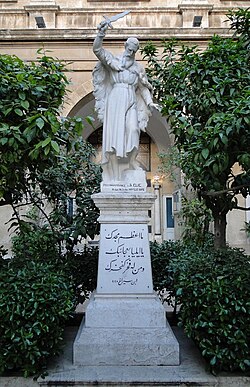
- Commemoration: Home to the statue of Archbishop Germanos Farhat.
- Recent History: Reopened in July 2020 following extensive restoration after war damage.
Historical Evolution
The site of the current cathedral has been a center of Maronite worship since the 15th century. In 1625, the Italian explorer Pietro Della Valle documented a small church on this site, noting that it was one of four churches sharing a single yard and gate in the newly established Jdeydeh quarter. These neighboring institutions included the Forty Martyrs Armenian Church, the Holy Mother of God Armenian Church (now the Zarehian Treasury), and the Greek Orthodox Church of the Dormition of Our Lady.
The current cathedral structure was completed in 1873, replacing the earlier 15th-century building. Its design is characterized by two magnificent belfries on the façade and a marble entrance featuring yellow columns, situated beneath a high dome on the eastern side.
Architectural Innovations and Additions
In 1914, under the leadership of Archbishop Michael Akhras, the cathedral underwent a significant renovation of its dome. This project was historically noteworthy as it marked the first time concrete was used in the construction history of Aleppo, a feat achieved with the assistance of Belgian experts.
During this same period, a chiming clock was installed on the tower, which continues to play the Ave Maria every fifteen minutes.
The Legacy of Germanos Farhat
The area surrounding the cathedral is known as Farhat Square, named after Archbishop and poet Germanos Farhat (1670–1732). In 1932, a statue of Farhat was erected in front of the main gate to mark the 200th anniversary of his death. The monument honors his pivotal role in founding the Maronite library of Aleppo, which houses a collection of rare and valuable ancient manuscripts.
War and Restoration
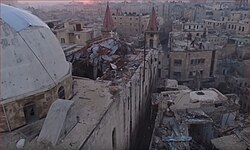
The Syrian civil war brought severe destruction to the cathedral. In 2013, numerous explosions caused the roof to collapse, leaving the structure heavily damaged. However, following a multi-year program of renovation and restoration, the cathedral officially reopened in July 2020, serving as a symbol of rebirth for the local community.
Cathedral Summary
| Attribute | Details |
|---|---|
| Religion | Maronite Catholic |
| Location | Al-Jdayde, Aleppo, Syria |
| Year Built | 1873 (Current structure) |
| Coordinates | 36°12′26″N 37°09′21″E |
| Status | Active |
Frequently Asked Questions
Who is the cathedral named after?
The cathedral is named after the Biblical prophet Elijah.
What makes the 1914 renovation historically significant?
The 1914 renovation of the dome was the first time concrete was utilized in the construction history of Aleppo, with technical help provided by experts from Belgium.
Who was Germanos Farhat?
Germanos Farhat (1670–1732) was an Archbishop and poet who founded the Maronite library of Aleppo, which preserves valuable old manuscripts.
When did the cathedral reopen after the Syrian civil war?
After suffering a roof collapse in 2013 and undergoing a multi-year restoration process, the cathedral officially reopened in July 2020.
Which other churches were historically adjacent to the cathedral?
The cathedral shared a yard with the Forty Martyrs Armenian Church, the Holy Mother of God Armenian Church, and the Greek Orthodox Church of the Dormition of Our Lady.