Al-Madina Souq: The World's Largest Historic Covered Market
Located in the heart of the walled ancient city of Aleppo, Syria, Al-Madina Souq (Arabic: سوق المدينة) stands as a testament to centuries of global commerce. As the largest covered historic market in the world, it stretches approximately 13 kilometers through a network of long, narrow alleys. This architectural marvel served as a vital nexus where trade routes from China, Mesopotamia, Europe, Egypt, and the Fertile Crescent converged.
Most of the market's structures date back to the 14th century. Historically, the souq functioned as a hub for both imported luxury goods—such as Indian spices and dyes and Iranian raw silk—and local staples, including soap, wool, and agricultural products.
Key Facts
- Scale: Approximately 13 kilometers in length, making it the world's largest covered historic market.
- Heritage: Part of the Ancient City of Aleppo, a UNESCO World Heritage Site since 1986.
- Origin: Most sections were completed in the 14th century.
- Architecture: Features a combination of souqs (markets), khans (caravanserais), and caeserias (craft workshops).
- Trade: Historically traded raw silk, spices, dyes, leather, and jewelry.
The Architecture of Commerce: Souqs, Khans, and Caeserias
The layout of Al-Madina Souq is defined by three distinct types of commercial spaces. The souqs are the primary market alleys, often named after the specific craft or profession practiced there, such as the copper or wool markets.
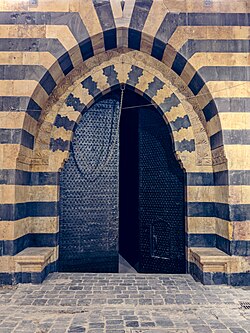
To support the traveling merchants, the city integrated khans (also known as caravanserais). These were large inns that provided lodging for traders and secure storage for their goods. Khans are typically recognized by their beautiful façades and fortified wooden doors.
Smaller than khans, caeserias served as specialized workshops for local craftsmen, blending production and retail in one space.
Notable Markets and Trading Hubs
The souq is divided into numerous specialized sections, each with its own historical significance and commercial focus.
Textiles and Luxury Goods
The market has long been famous for its fabrics. Souq Khan al-Harir (the silk khan), built in the second half of the 16th century, specialized in textiles and once hosted the Iranian consulate. Other textile hubs include Souq Khan al-Jumrok (the customs' khan), the largest khan in ancient Aleppo with 55 stores, and Souq Khan al-Wazir, which focused on cotton products.
Specialized Craft and Trade Alleys
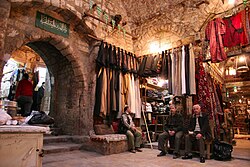
From jewelry to leather, every trade had its place. Souq as-Siyyagh is the premier jewelry center in Syria, featuring 99 stores across two parallel alleys. Souq al-Atiq specialized in raw leather, while Souq al-Haddadin served as the traditional blacksmiths' market.
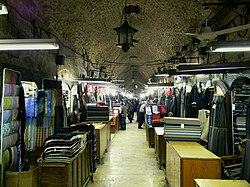
Other notable areas include Souq al-Dira', a highly organized tailoring center with 59 workshops, and Souq al-Hiraj, which transitioned from a firewood and charcoal market to a center for rugs and carpets.
Regional Specialties and Consulates
Aleppo's international status is reflected in its khans. Khan al-Burghul (built 1472) hosted the British general consulate until the early 20th century, and Khan al-Nahhaseen (the coopery souq) hosted the Belgian consulate in the 16th century.
Local industry is best represented by Souq al-Saboun, a primary center for the production of the world-renowned Aleppo soap.
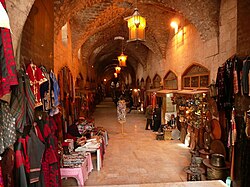
For those entering from the south, Souq al-Farrayin (the fur market) serves as the main gateway, while Souq az-Zirb provides the eastern entrance. The latter was historically a site for striking coins during the Mamluk period.
Summary of Major Souqs and Khans
| Name | Primary Specialization | Key Detail |
|---|---|---|
| Khan al-Jumrok | Textiles | Largest khan in ancient Aleppo |
| Souq as-Siyyagh | Jewelry | 99 stores in two parallel alleys |
| Souq al-Saboun | Soap | Main center for Aleppo soap production |
| Souq al-Dira' | Tailoring | 59 organized workshops |
| Khan al-Harir | Silk/Textiles | Former Iranian consulate |
| Souq al-Haddadin | Blacksmithing | Traditional metalwork market |
Recent History and Preservation
As a UNESCO World Heritage Site, Al-Madina Souq is of immense global value. However, the area suffered significant damage starting on September 25, 2012, due to fighting between the Syrian Armed Forces and the Syrian opposition. Many medieval buildings and sections of the souq were ruined, burnt, or destroyed during this conflict.
Frequently Asked Questions
How large is Al-Madina Souq?
It is the largest covered historic market in the world, with a total length of approximately 13 kilometers.
What is the difference between a khan and a caeseria?
A khan (caravanserai) was a larger facility used to accommodate traders and store their goods, while a caeseria was a smaller marketplace that functioned as a workshop for craftsmen.
What products was the souq famous for?
The souq was a major center for luxury imports like raw silk from Iran and spices from India, as well as local products like Aleppo soap, wool, and leather.
When was Al-Madina Souq built?
While various sections were added over time, most of the souqs date back to the 14th century.
Is Al-Madina Souq a protected site?
Yes, it is part of the Ancient City of Aleppo, which has been designated as a UNESCO World Heritage Site since 1986.