Formic Acid: Properties, Production, and Industrial Applications
Formic acid, also known by its systematic IUPAC name methanoic acid, is the simplest carboxylic acid. Characterized by its pungent, penetrating odor similar to vinegar, this colorless fuming liquid occurs naturally in various biological sources and serves as a critical component in numerous industrial processes. From the defensive sprays of ants to cutting-edge hydrogen storage research, formic acid plays a versatile role in both nature and science.
The substance is widely recognized as "ant acid" because it is found in most ants and certain stingless bees of the genus Oxytrigona. Wood ants (genus Formica) use it as a chemical weapon to defend their nests or subdue prey, while the puss moth caterpillar (Cerura vinula) employs it as a deterrent against predators.

Key Facts

- Chemical Formula: CH2O2 (Molar mass: 46.025 g/mol).
- Natural Occurrence: Found in ants, stinging nettles, and various fruits (e.g., pineapple, apple, kiwi) and vegetables (e.g., onion, eggplant).
- Acidity: Approximately 10 times stronger than acetic acid, with a pKa of 3.745.
- Industrial Use: Heavily utilized in leather tanning, textile dyeing, and rubber coagulation.
- Safety: Classified as corrosive and an irritant; requires careful handling.
Chemical and Physical Properties
Formic acid is a planar molecule that is completely miscible in water. At room temperature, it exists as a colorless liquid with a density of 1.220 g/mL. Its boiling point is 100.8 °C, and it has a melting point of 8.4 °C.
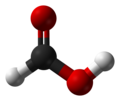
In terms of chemical behavior, formic acid is a strong organic acid. Its conjugate base is known as formate. One of its unique characteristics is its ability to act as a source of hydride ions in synthetic organic chemistry, most notably in the Eschweiler–Clarke reaction, where it facilitates the methylation of amines.

Summary of Technical Specifications
| Property | Value |
|---|---|
| IUPAC Name | Methanoic acid |
| CAS Number | 64-18-6 |
| Appearance | Colorless fuming liquid |
| pKa | 3.745 |
| Flash Point | 69 °C |
| Water Solubility | Miscible |
| E Number | E236 |
Production and Synthesis
Historically, formic acid was first isolated in 1671 by John Ray through the distillation of ants. Modern industrial production is far more scalable, with a global capacity of approximately 720 thousand tonnes per year as of 2009, primarily concentrated in Germany and China.
The primary commercial route involves the synthesis from methyl formate and formamide. Other methods include the hydrogenation of carbon dioxide, the oxidation of biomass, and electrochemical production using a lead cathode to reduce CO2 (in the form of bicarbonate) at a pH of 8.6.
Industrial and Scientific Applications
Formic acid is an essential reagent across several sectors:
- Leather and Textiles: It is used extensively in tanning (accounting for 23% of global consumption in 2009) and in the dyeing and finishing of textiles (9%).
- Rubber Production: It serves as a coagulant in the manufacturing of rubber (6% of global consumption).
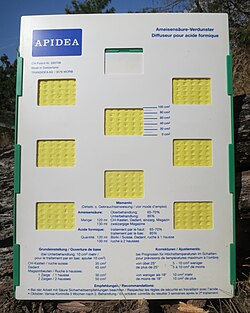
- Agriculture: It is used in beehives via specialized evaporators to manage hive health.
- Electronics: Formic acid vapor is employed in fluxless soldering to reduce metal oxides.
- Analytical Chemistry: It is used as a solvent in reversed-phase high-performance liquid chromatography (HPLC) for protein analysis.
Energy and Hydrogen Storage
One of the most promising modern applications of formic acid is in hydrogen storage. Because it contains 53 g/L of hydrogen at room temperature—three and a half times more than compressed hydrogen gas at 350 bar—it is considered a safe and efficient liquid carrier. The carbon dioxide produced during its decomposition can be rehydrogenated back into formic acid.
Safety and Hazards
Formic acid is a hazardous substance that can cause severe burns and respiratory irritation. It is classified as corrosive, an irritant, and a sensitizer. The NFPA 704 diamond indicates a high level of health hazard and moderate flammability.

Safety risks vary by concentration: solutions between 2–10% are skin irritants (H315), while concentrations exceeding 90% are severely corrosive (H314). Exposure limits are strictly monitored, with a Permissible Exposure Limit (PEL) of 5 ppm (TWA).
Frequently Asked Questions
What is the difference between formic acid and an antacid?
They are entirely different substances. Formic acid is a corrosive organic acid found in ants, whereas an antacid is a base used to neutralize stomach acidity.
Why is formic acid used in leather tanning?
Due to its acidic nature, it is highly effective in the tanning process, helping to stabilize the collagen fibers in animal hides.
How does formic acid store hydrogen?
Formic acid acts as a chemical carrier; it can be decomposed to release hydrogen gas and carbon dioxide, and the process can be reversed to store the hydrogen again.
Is formic acid found in human food?
Yes, in very small amounts. It occurs naturally in fruits like apples and pineapples, and in vegetables such as onions and eggplants.
What is the Eschweiler–Clarke reaction?
It is a chemical reaction used in organic synthesis where formic acid serves as a source of hydride ions to methylate primary or secondary amines.