Forelimb Evolution and Anatomy in Tetrapods
In the study of vertebrate anatomy, a forelimb (or front limb) refers to one of the paired articulated appendages attached to the cranial, or anterior, end of a terrestrial tetrapod's torso. Depending on the animal's posture, these structures are referred to by different names: quadrupeds typically have forelegs, while bipedal animals with upright postures, such as humans, possess upper limbs. It is important to distinguish the entire forelimb from the forearm, which is specifically the distal portion of the human upper limb located between the elbow and the wrist.
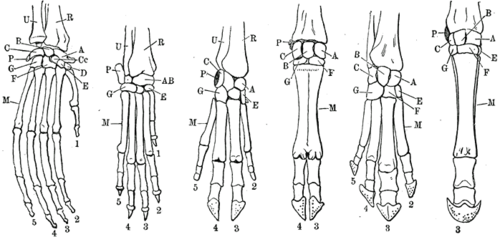
One of the most striking aspects of vertebrate biology is that all forelimbs are homologous. This means they evolved from the same ancestral structures, regardless of their current appearance or function. Whether it is the flipper of a dolphin, the wing of a bird, the leg of a horse, or a human arm, they all share a common evolutionary origin.
Key Facts
- Homology: All tetrapod forelimbs share a common evolutionary origin from lobe-finned fish.
- Convergent Evolution: Similar functions (like flight or swimming) often evolve independently using different biological paths.
- Polydactyly: Early tetrapods often had more than five digits, contrary to the long-held belief that five was the ancestral standard.
- Bone Robustness: Heavier species and those hunting large prey generally evolve more robust humeri, radii, and ulnas.
- Specialization: Forelimbs adapt specifically to habitats, such as the single toe of the horse for efficiency or the flippers of cetaceans for hydrodynamics.
The Evolution of Forelimb Shape
The shape of forelimb long bones—specifically the humerus, radius, and ulna—is heavily influenced by body mass, lifestyle, and predatory behavior. Generally, heavier species require more robust bones to support their weight.
Lifestyle and Habitat Influences
In musteloid carnivorans, habitat plays a critical role. Arboreal species (those living in trees) tend to have long, slender bones to enhance flexibility and movement. Conversely, aquatic or semi-fossorial (digging) species possess short, robust bones to withstand the physical strain of swimming and digging.
Predatory Strategies
The way a predator hunts also shapes its anatomy. Felids (cats), which rely on ambushing and grappling with prey, have shorter, more durable limbs. Canids (dogs), which pursue prey over long distances, have longer, more gracile limbs optimized for running. Furthermore, predators that hunt prey weighing half their body mass or more evolve sturdier bones to prevent fractures during the hunt, while those hunting smaller prey evolve slender bones for better energetic efficiency.
Digits and Polydactyly
While many believe that five digits (pentadactyly) were the ancestral trait for tetrapods, evidence suggests that the earliest "fishapod" ancestors exhibited polydactyly, or having more than five digits. For example, Acanthostega had eight digits, Ichthyostega had seven, and Tulerpeton had six.
These limbs evolved from the fins of lobe-finned fishes. During this transition, the limb's development axis rotated to create secondary axes, resulting in the stout skeletal supports that formed paddle-like feet.
Digit Specialization
Over time, digits specialized for specific types of movement. The horse is a prime example of monodactyly, having evolved a single toe for high-speed locomotion. Similarly, sauropods (long-necked dinosaurs) developed a tubular manus (front foot) and eventually lost their digits entirely, standing instead on their metacarpals to support their massive weight.
Advanced Limb Functionality
Opposable Thumbs
The ability to grasp objects is a specialized trait. While humans have unique forearm and hand musculature, various forms of opposability exist across species. Primates are categorized by their thumb capabilities:
- Nonopposable: Tarsiers and marmosets.
- Pseudo-opposable: All strepsirrhines and Cebidae.
- Opposable: Old World monkeys and great apes.
- Opposable with long thumbs: Gibbons.
Interestingly, pandas have evolved a pseudo-opposable thumb, but it is an extension of the sesamoid bone rather than a true digit.
Pronation and Supination
Pronation (rotating the palm downward) and supination (rotating the palm upward) are achieved in therian mammals by a rounded radius head that swivels across the ulna. While this is common in mammals, it also evolved independently in chameleons and varanids. In contrast, dinosaurs were only capable of semi-pronation.
Convergent Evolution: Wings and Flippers
While all forelimbs are homologous, the evolution of wings and flippers is an example of convergent evolution—where different species evolve similar traits independently to solve the same problem.
The Evolution of Flight
Birds, bats, and pterosaurs all evolved wings, but their structures differ wildly. Bat wings consist of a skin membrane stretched over five fingers. Bird wings rely on feathers supported by reduced fingers, with the second finger supporting the alula and the fourth supporting primary feathers.
The Evolution of Flippers
Marine mammals, including cetaceans (whales/dolphins), pinnipeds (seals), and sirenians (manatees), independently evolved streamlined flippers. This convergence is evident at the genetic level, with hundreds of parallel amino acid substitutions occurring across these groups to adapt to aquatic environments.
| Adaptation | Example Species | Primary Function | Evolutionary Type |
|---|---|---|---|
| Monodactyly | Horse | Efficient running | Specialization |
| Flippers | Dolphin / Seal | Hydrodynamic swimming | Convergent |
| Wings | Bat / Bird | Aerial locomotion | Convergent |
| Opposable Thumb | Humans / Great Apes | Grasping and manipulation | Specialization |
Frequently Asked Questions
What is the difference between homology and analogy in forelimbs?
Homology refers to structures that evolved from a common ancestor, such as the basic bone structure shared by all tetrapod forelimbs. Analogy (or convergent evolution) occurs when different species evolve similar functions independently, such as the wings of a bird and a bat.
Did all early tetrapods have five fingers?
No. While five digits became the standard for many, early tetrapods like Acanthostega and Ichthyostega had eight and seven digits, respectively.
How do the forelimbs of cats and dogs differ?
Felids (cats) have shorter, more robust limbs suited for sprinting and grappling with prey. Canids (dogs) have longer, more gracile limbs optimized for pursuing prey over long distances.
Is a panda's thumb a real finger?
No, the panda's pseudo-opposable thumb is an extension of the sesamoid bone, not a true digit.
What allows mammals to rotate their wrists?
The ability to pronate and supinate is made possible by the rounded head of the radius, which allows the bone to swivel across the ulna.