Food Prices: Drivers, Global Impacts, and Market Trends
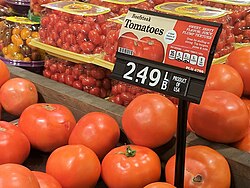
Food prices represent the average cost of food across different countries, regions, and the global market. These prices are not static; they are influenced by a complex web of production, marketing, and distribution processes. For producers, these prices determine profitability, while for consumers, they dictate accessibility and nutrition. When food prices fluctuate sharply, the effects ripple through society, often impacting the most vulnerable populations first.
The phenomenon of rising food prices, often termed agflation, can lead to severe consequences, including heightened food insecurity and social unrest. Because food is a fundamental necessity, price spikes can lead to disparities in diet quality and health, particularly among women and children in developing nations.
Key Facts
- Global Drivers: Prices are influenced by geopolitical events, climate change, energy costs, exchange rates, and government policies.
- Vulnerability: A 10% increase in food prices is linked to a 3.5% rise in moderate to severe food insecurity.
- Child Health: Food price inflation is associated with increased rates of wasting in children under five.
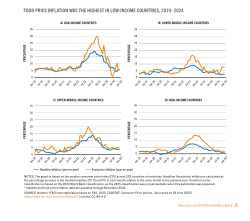
- Economic Disparity: Low-income countries experience significantly steeper inflation peaks than OECD nations.
- Nutritional Shift: Ultra-processed foods often remain cheaper per kilocalorie than nutrient-dense fruits and vegetables.
Factors Influencing Food Price Volatility
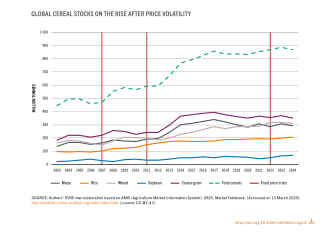
Several compounding factors determine how food prices shift over time. While some trends can be mitigated by food politics, many are driven by systemic global issues.
Energy Costs and Natural Resources
Energy costs are a primary driver of food prices. Higher costs for diesel and electricity increase the expense of farming, transporting, and processing food. Additionally, the availability of natural resources and the cost of synthetic nitrogen fertilizers play a critical role in supporting the global population.
![World population supported with and without synthetic nitrogen fertilizers[17]](/images/43/a9/43a9b09ae3a4c7241bffe853d81ef27c09b8c13b4b6eab1bea5c4565e9ee5687.webp)
Weather Events and Climate Change
Climate change increases the frequency of extreme weather events, such as droughts, storms, and heavy rain. Rising global temperatures directly affect crop yields, leading to supply shortages that drive prices upward.
Geopolitics and Market Speculation
Geopolitical conflicts and trade policy shifts can disrupt grain exports and imports. Furthermore, food speculation—where investors bet on the future price of commodities—can exacerbate price volatility.
Global Differences and Economic Impact
The impact of food price inflation is not distributed evenly. While wealthier regions may see modest increases, developing countries often face crises.
The Divide Between High and Low-Income Nations
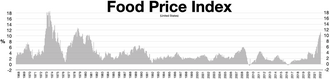
Between December 2020 and January 2023, median global food price inflation rose from 2.3% to 13.6%. However, low-income countries saw inflation peak at 30% in May 2023. In some nations, such as Sudan, Venezuela, and Zimbabwe, hyperinflation has pushed year-on-year peaks well above 350%.
Impact on Nutrition and Health
Rising prices for starchy staples and oils—the core of diets for the poorest households—undermine nutrition. In countries like Mexico, Nigeria, and Pakistan, these staples have seen the steepest increases between 2019 and 2024. This often forces a shift toward ultra-processed foods, which are cheaper per kilocalorie but offer lower nutritional value.
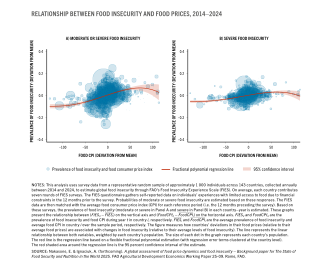
The health consequences are most evident in children. A 10% increase in food prices is associated with a 2.7% to 4.3% rise in overall wasting and a 4.8% to 6.1% increase in severe wasting among children under five.
Monitoring and Measurement
To protect global food security, organizations use various tools to track and predict price movements.
The FAO Food Price Index
The Food and Agriculture Organization (FAO) of the United Nations monitors several key indices, including those for cereals, vegetable oil, dairy, meat, and sugar. They have also implemented the Food Price Monitoring and Analysis (FPMA), an early warning tool designed to detect abnormal price growth in consumer markets within the developing world.
![Food, meat, dairy, cereals, vegetable oil, and sugar price indices, deflated using the World Bank Manufactures Unit Value Index (MUV).[35] The peaks in 2008 and 2011 indicate global food crises.](/images/64/4f/644ff47031629fc32e5e19a1624955840151971d409adba59edc5e0704fe02aa.webp)
Historical Price Trends
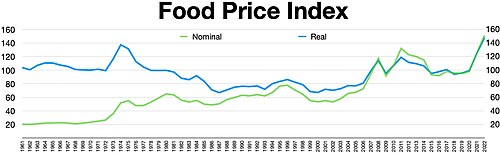
The world experienced significant food price crises in 2007–08 and 2010–12. During these periods, prices reached all-time peaks, often coinciding with spikes in oil prices. More recently, the COVID-19 pandemic caused supply chain disruptions in 2021, and the 2022 Russian invasion of Ukraine further threatened grain exports, pushing the FAO Food Price Index to record highs in February 2022.
In Nigeria, for example, food inflation reached 40.01% by March 2024, driven by currency depreciation and rising input costs for staples like garri, millet, and yam tubers.
Summary of Food Price Dynamics
| Category | Primary Drivers | Key Consequences |
|---|---|---|
| Economic | Energy costs, exchange rates, speculation | Reduced purchasing power, hyperinflation |
| Environmental | Climate change, droughts, pests | Lower crop yields, supply shortages |
| Political | Trade policies, conflict, subsidies | Export disruptions, social unrest |
| Health | Price of nutrient-dense foods | Child wasting, malnutrition, poor diet quality |
Frequently Asked Questions
What is agflation?
Agflation is a portmanteau of "agriculture" and "inflation," referring to a general increase in the price of agricultural products.
How does climate change affect food prices?
Climate change leads to more frequent extreme weather events like droughts and storms, which damage crops and reduce overall food production, thereby increasing prices due to lower supply.
Why are ultra-processed foods more common during price spikes?
Ultra-processed foods generally have lower prices per kilocalorie compared to nutrient-dense alternatives like fruits and vegetables, making them more accessible to low-income households during inflation.
What is the FAO Food Price Index?
It is a measurement tool used by the Food and Agriculture Organization of the United Nations to track the monthly change in international prices of a basket of food commodities, including cereals, vegetable oils, dairy, meat, and sugar.
How does food price inflation impact children?
Higher food prices are linked to increased rates of wasting and severe wasting in children under five, as families may struggle to afford the necessary nutrients for healthy development.