Figured Bass Notation
Figured bass is a musical shorthand used primarily in the Baroque era to indicate harmonic accompaniment. It consists of a bass line written on a musical staff, supplemented by numbers and accidentals placed beneath the notes. These figures tell the performer which intervals to play above the bass, effectively defining the chords and their inversions without requiring every single note to be written out.
This system allows the chord-playing instrumentalist—such as a keyboardist or lutenist—to realize the harmony based on the provided figures, often adding their own improvised ornaments or arpeggios depending on the music's texture and tempo.
Key Facts
- Purpose: Indicates intervals above the bass note to determine the chord and its inversion.
- Tasto Solo: A directive meaning "single key," instructing the player to play only the bass line without any chords.
- Implicit Figures: Numbers like 3 and 5 are often omitted if the chord is a standard root-position triad.
- Accidentals: A standalone accidental typically modifies the third above the bass note.
- Flexibility: Performers may choose the octave or elaborate the chords into arpeggios.
Understanding the Numbers
The numbers in figured bass represent the number of scale steps above the bass note that should be played. For instance, if the bass note is C and the figures are 4 and 6, the performer plays an F (a fourth above) and an A (a sixth above), creating a second inversion F major chord.
Triads and Seventh Chords
Different combinations of numbers signal different chord inversions. While some composers were inconsistent—often omitting numbers when the harmony was obvious—standard conventions emerged for triads and seventh chords.
| Chord Type | Inversion | Intervals Above Bass | Common Symbol |
|---|---|---|---|
| Triad | Root Position | 3, 5 | None (or 5 3) |
| Triad | 1st Inversion | 6, 3 | 6 |
| Triad | 2nd Inversion | 6, 4 | 6 4 |
| Seventh Chord | Root Position | 7, 5, 3 | 7 |
| Seventh Chord | 1st Inversion | 6, 5, 3 | 6 5 |
| Seventh Chord | 2nd Inversion | 6, 4, 3 | 4 3 |
| Seventh Chord | 3rd Inversion | 6, 4, 2 | 2 |
In many cases, figures are abbreviated. For example, a "2" on its own typically implies a 6 4 2 chord (a third inversion seventh chord), as the sixth is considered an automatic inference for the player.
Special Notation and Holding Notes
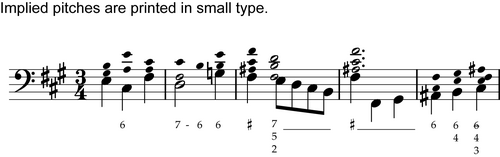
Figured bass also accounts for changes in harmony while notes are held. If the bass note remains the same but the chord changes, the new figures are written at the exact point in the measure where the harmony shifts.
Conversely, if the bass note moves but the upper chord notes are to be held, a line is drawn next to the figures to indicate the duration of the hold.
Accidentals and Modifications
Accidentals in figured bass modify the pitch of the intervals. If an accidental appears without a number, it generally applies to the note a third above the bass (the chord's third). If a number is present, the accidental modifies that specific interval.
Raising and Lowering Pitches
- Raising (Augmenting): A cross next to a number, or a backslash through the number, indicates the pitch should be raised by a semitone.
- Lowering (Diminishing): A forward slash through a number indicates the pitch should be lowered by a semitone.
In 17th-century music, sharps and flats were sometimes used interchangeably with natural signs to cancel out the existing key signature.
Frequently Asked Questions
What does tasto solo mean in a bass line?
Tasto solo instructs the performer to play only the bass note, omitting any improvised chords, until the next figure appears.
Why are some numbers missing from the figured bass?
Numbers are often omitted when the chord is obvious from the harmonic progression or melody. For example, root-position triads often have no figures at all.
How do I know which note a standalone accidental affects?
A standalone accidental without a number typically applies to the third above the lowest bass note.
What is the difference between a backslash and a forward slash through a number?
A backslash indicates that the pitch of that interval should be raised (augmented) by a semitone, while a forward slash indicates it should be lowered (diminished) by a semitone.
Can the performer change how the chords are played?
Yes. While the intervals must be correct, the performer can choose the octave and may play the notes as arpeggios or add improvised ornaments based on the music's tempo and texture.