Fernando Henrique Cardoso: The Scholar-President of Brazil
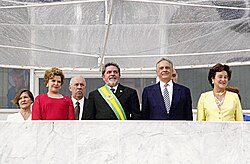
Fernando Henrique Cardoso, widely known by his initials FHC, occupies a unique place in Brazilian history as both a world-renowned sociologist and a transformative political leader. Serving as the 34th president of Brazil from 1995 to 2003, Cardoso bridged the gap between academic theory and state governance, becoming the first Brazilian president to be re-elected for a second term.
Before ascending to the presidency, Cardoso established himself as a leading intellectual. He is particularly noted for his contributions to dependency theory—a sociological framework that examines how the global economic system creates a relationship of dependence between wealthy "core" nations and poorer "periphery" nations. This academic foundation deeply influenced his approach to Brazil's development and international relations.
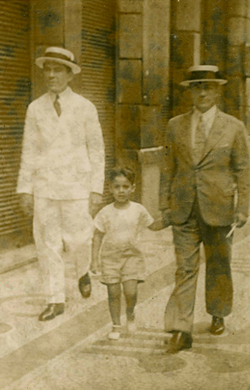
Key Facts
- Presidency: Served as the 34th President of Brazil (1995–2003).
- Historic Milestone: First Brazilian president to win re-election.
- Academic Background: PhD in Sociology from the University of São Paulo.
- Economic Legacy: Oversaw the continuation of inflation-lowering reforms and privatization of state companies.
- Global Recognition: Recipient of the Prince of Asturias Award (2000) and the Kluge Prize (2012).
Academic Career and Intellectual Contributions
Cardoso's journey began at the University of São Paulo, where he earned his bachelor's, master's, and doctorate in Social Sciences. His doctoral thesis, supervised by Florestan Fernandes, provided a Marxist critique of slavery in Southern Brazil, challenging the prevailing views of the time and becoming a classic text in the field.
Due to the restrictions of the Brazilian military dictatorship, Cardoso spent significant time in Chile and France. During this period, he published influential works on state bureaucracy and industrial elites. His leadership extended to the global academic community when he served as the 10th president of the International Sociological Association from 1982 to 1986.
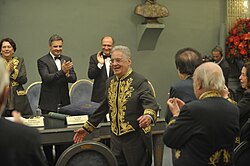
The Path to the Presidency
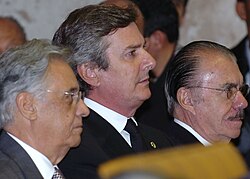
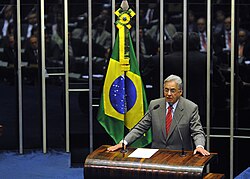
Cardoso's transition into formal politics began in the 1980s. Elected to the Senate in 1986 under the PMDB, he eventually helped found the Brazilian Social Democracy Party (PSDB) after feeling the PMDB had shifted too far to the right. He played a pivotal role in the 1987–1988 National Constituent Assembly, leading the committee that drafted the internal rules for Brazil's current Constitution.
In the early 1990s, Cardoso held critical cabinet positions under President Itamar Franco, serving first as Minister of Foreign Affairs and later as Minister of Finance. It was in the latter role that he helped implement the economic stability measures that would define his early presidency.
In the 1994 election, Cardoso won a historic victory in the first round with 54% of the vote—the largest margin of victory in a free Brazilian election. He repeated this feat in 1998, winning 53% of the vote to secure a second term.
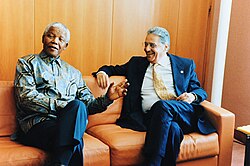
Presidency and Economic Governance (1995–2003)
Cardoso's presidency was characterized by a commitment to market liberalization and administrative reform. His administration focused on keeping inflation low and privatizing several state-owned companies to increase Brazil's visibility and competitiveness in the international market.
However, his second term faced significant headwinds. International financial crises and a sharp devaluation of the Real (Brazil's currency) led to a rise in public debt, which grew from 30% to 55.5% of GDP. While the government maintained low inflation, these economic pressures and an energy crisis caused a decline in his popularity toward the end of his tenure.
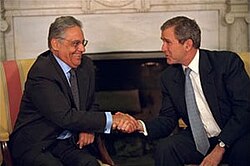
Post-Presidency and Global Influence
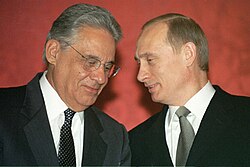
After leaving office on January 1, 2003, Cardoso returned to the world of academia and international diplomacy. He served as a professor-at-large at Brown University's Watson Institute for International Studies and founded the Fernando Henrique Cardoso Foundation in 2004.
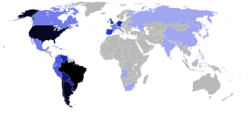
He has remained active in global governance as a member of The Elders and the Club of Madrid, and has served on advisory boards for the United Nations Foundation and the Clinton Global Initiative.
Summary of Political and Academic Milestones
| Period | Role/Achievement | Key Focus |
|---|---|---|
| 1982–1986 | President, International Sociological Association | Global Sociology |
| 1986–1992 | Senator for São Paulo | Constitutional Drafting |
| 1993–1994 | Minister of Finance | Economic Stabilization |
| 1995–2003 | 34th President of Brazil | Privatization & Inflation Control |
| 2004–Present | Founder, FHC Foundation | Public Policy & Research |
Frequently Asked Questions
What is dependency theory?
Dependency theory is a sociological and economic framework developed in part by Cardoso. It suggests that resources flow from a "periphery" of poor and underdeveloped states to a "core" of wealthy states, enriching the latter at the expense of the former.
Why was Cardoso's 1994 election victory significant?
Cardoso won the 1994 election in the first round with 54% of the vote, which remains the largest margin of victory ever recorded in a free Brazilian election.
What were the main economic goals of his presidency?
His primary goals included maintaining low inflation rates, privatizing state-owned enterprises, and liberalizing the market to integrate Brazil more deeply into the global economy.
Was Fernando Henrique Cardoso the first president to be re-elected in Brazil?
Yes, he was the first Brazilian president to be re-elected for a subsequent term after the constitution was amended to allow executive officeholders to succeed themselves.
What academic honors has he received?
Beyond his PhD and the title of Cathedratic Professor, he has received the Prince of Asturias Award for International Cooperation, the Kluge Prize from the US Library of Congress, and was elected to the Brazilian Academy of Letters in 2013.