Romário: The Legendary Striker and Brazilian Political Figure
Few athletes have transitioned from the global sporting stage to the halls of government as prominently as Romário. Born Romário de Souza Faria on January 29, 1966, in Rio de Janeiro, he is celebrated as one of the most lethal strikers in the history of association football. Known for his clinical finishing and exceptional movement inside the penalty area, Romário's career spanned several decades and multiple continents, culminating in a World Cup victory and a subsequent career in Brazilian politics.
Key Facts
- Full Name: Romário de Souza Faria.
- World Cup Success: Winner of the 1994 FIFA World Cup.
- Goal Scoring: Recorded 542 goals in 698 senior club appearances.
- International Record: Scored 55 goals in 70 appearances for Brazil.
- Political Office: Served as a Senator for Rio de Janeiro and Second Vice President of the Federal Senate.
- Major Awards: FIFA World Player of the Year (1994) and Golden Ball winner of the 1994 World Cup.
A Prolific Club Career
Romário's professional journey began at Vasco da Gama, where he first showcased his scoring prowess. His talent soon took him to Europe, starting with PSV Eindhoven in the Netherlands, where he became a dominant force in the Eredivisie.
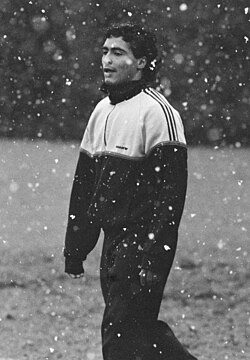
Following his success in the Netherlands, he moved to FC Barcelona in 1993. His impact was immediate, winning La Liga in the 1993–94 season and earning the Pichichi Trophy as the league's top scorer. His career later saw him return to Brazil to play for Flamengo and Vasco da Gama, as well as stints with Valencia in Spain, Al Sadd in Qatar, Miami FC in the United States, and Adelaide United in Australia.
One of the most remarkable milestones of his career was his pursuit of the thousandth goal, a feat he officially reached in 2007, cementing his status as a legendary goal-scorer.
International Glory with Brazil
On the international stage, Romário was a cornerstone of the Brazilian national team. While he experienced the disappointment of the 1990 World Cup, he reached the pinnacle of the sport in 1994.
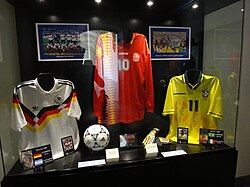
During the 1994 FIFA World Cup in the United States, Romário's brilliance led Brazil to victory. He was awarded the Golden Ball as the tournament's best player and the Bronze Boot. His partnership with Bebeto, often referred to as the "Ro-Ro attack," became one of the most feared offensive pairings in football history.
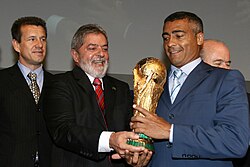
Beyond the World Cup, Romário helped Brazil secure victories in the Copa América (1989, 1997) and the FIFA Confederations Cup (1997). He also earned a silver medal at the 1988 Seoul Olympics, where he finished as the tournament's top scorer.
Transition to Politics
After retiring from professional football, Romário entered the political arena, representing the state of Rio de Janeiro. He served as a member of the Chamber of Deputies from 2011 to 2015 before being elected to the Federal Senate on February 1, 2015.
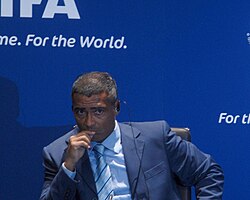
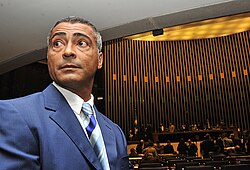
His political ascent continued as he served as the Second Vice President of the Federal Senate from February 1, 2021, to February 1, 2023. Throughout his political career, he has been affiliated with several parties, including the PP, PSB, PODE, and most recently, the PL.
Career Summary
| Category | Details / Achievements |
|---|---|
| Primary Position | Striker |
| Major Club Honors | La Liga (Barcelona), Eredivisie (PSV), Campeonato Brasileiro (Vasco da Gama) |
| International Titles | FIFA World Cup (1994), Copa América (1989, 1997), Confederations Cup (1997) |
| Individual Peak | FIFA World Player of the Year (1994) |
| Political Role | Senator for Rio de Janeiro (2015–Present) |
Frequently Asked Questions
Which World Cup did Romário win?
Romário won the 1994 FIFA World Cup with Brazil, where he was also named the tournament's best player (Golden Ball).
How many goals did Romário score in his club career?
According to senior career statistics, Romário scored 542 goals in 698 appearances across various clubs.
What was the "Ro-Ro attack"?
The "Ro-Ro attack" refers to the highly effective striking partnership between Romário and Bebeto during their time with the Brazilian national team.
What political positions has Romário held?
Romário has served as a member of the Chamber of Deputies (2011–2015), a Senator for Rio de Janeiro (since 2015), and the Second Vice President of the Federal Senate (2021–2023).
Which European clubs did Romário play for?
Romário played for PSV Eindhoven in the Netherlands, FC Barcelona in Spain, and Valencia in Spain.