Fernando de la Rúa: The Presidency and Political Legacy of Argentina's 51st President
Fernando de la Rúa (1937–2019) was a pivotal figure in Argentine politics, serving as the 51st President of Argentina from 1999 to 2001. A lifelong member of the Radical Civic Union (UCR), his career spanned several decades, during which he held key legislative and executive roles. While his presidency is often remembered for its tumultuous end during a severe economic collapse, his earlier career was marked by significant urban development and a steadfast commitment to his party's principles.
Key Facts
- Presidency: Served as President of Argentina from December 10, 1999, to December 21, 2001.
- Political Affiliation: Member of the Radical Civic Union (UCR) and the Alliance coalition.
- Urban Impact: As the first elected Chief of Government of Buenos Aires, he expanded the city's subway system and bicycle infrastructure.
- Economic Crisis: His term ended in resignation following a banking panic and the implementation of the Corralito (restrictions on bank withdrawals).
- Education: Graduated with a law degree from the National University of Córdoba at age 21.
Early Life and Political Ascent
Born in Córdoba, Argentina, Fernando de la Rúa entered public service early, serving as an advisor to Minister Juan Palmero under President Arturo Illia in 1963. After completing his legal studies, he transitioned into elective politics, winning a seat as a national senator for Buenos Aires in 1973.
Throughout the 1980s and 1990s, de la Rúa became a prominent voice within the UCR. He served multiple non-consecutive terms as a senator and a term as a national deputy. He is notably remembered for his opposition to the Pact of Olivos—an agreement between President Carlos Menem and UCR leader Raúl Alfonsín that allowed for constitutional amendments enabling Menem's re-election in 1995.
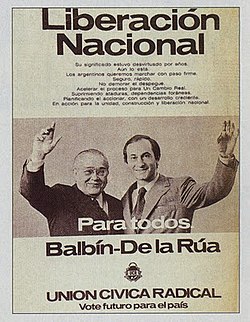
Chief of Government of Buenos Aires
Following the constitutional amendments of 1994, the position of Chief of Government of Buenos Aires became an elected office. De la Rúa became the first person to hold this role via popular vote, serving from 1996 to 1999. His tenure was characterized by a focus on modernization and infrastructure.
His primary achievements in the capital included the expansion of the Buenos Aires Underground (Subte), specifically adding stations to Line D and initiating work on Line B and Line H. He also established the city's first bicycle path and created Roberto Goyeneche Avenue.
The Path to the Presidency
In the late 1990s, the UCR joined forces with the Frepaso to form the Alliance, a political coalition designed to challenge the dominant Peronist party. De la Rúa won the coalition's primary elections and ran for president with Carlos Álvarez as his vice-presidential running mate.
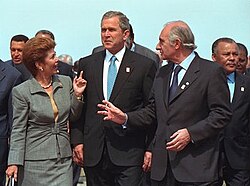
On October 24, 1999, de la Rúa won the general election with 48.4% of the vote, defeating Eduardo Duhalde. He took office on December 10, 1999, with a high favorability rating of 75% and a cabinet featuring several internationally trained economists.
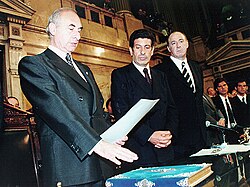
The Presidential Term and Economic Collapse
De la Rúa's presidency was plagued by instability from the start. His vice president, Carlos Álvarez, resigned in 2000 after alleging bribery within the Senate. This internal fracture weakened the administration just as a deep-seated economic crisis, which had begun during the previous administration, intensified.
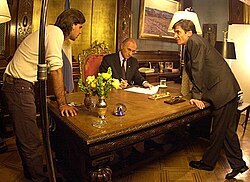
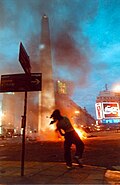
By late 2001, Argentina faced a severe banking panic. In an attempt to stabilize the financial system, the government implemented the Corralito, a measure that strictly limited the amount of cash citizens could withdraw from their bank accounts. This sparked widespread public outrage and social unrest.
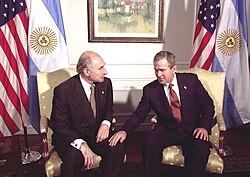
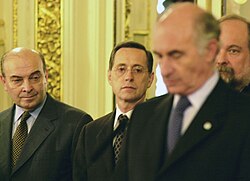
Despite efforts to manage the crisis with figures like Domingo Cavallo, the situation deteriorated into violent riots in December 2001. De la Rúa declared a state of emergency, but the pressure became insurmountable.
Resignation and Later Years
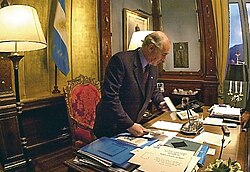
On December 20, 2001, Fernando de la Rúa resigned from the presidency. His departure was marked by images of him leaving the Casa Rosada to collect his personal belongings amidst nationwide protests centered around the Obelisco in Buenos Aires.
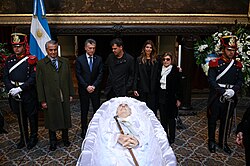
Following his resignation, de la Rúa retired from active politics. He spent much of his remaining years dealing with legal proceedings, including an indictment related to a labor flexibility law scandal, though he was cleared of all charges in 2013. He passed away on July 9, 2019, at the age of 81.
Summary of Political Career
| Office | Period | Constituency/Organization |
|---|---|---|
| National Senator | 1973–1976, 1983–1987, 1993–1996 | City of Buenos Aires |
| National Deputy | 1991–1993 | City of Buenos Aires |
| Chief of Government of Buenos Aires | 1996–1999 | City of Buenos Aires |
| President of the National Committee of the UCR | 1997–1999 | Radical Civic Union |
| President of Argentina | 1999–2001 | National |
Frequently Asked Questions
Why did Fernando de la Rúa resign from the presidency?
He resigned on December 20, 2001, following a catastrophic economic crisis, a banking panic, and violent nationwide riots triggered by the implementation of the Corralito.
What was the "Corralito"?
The Corralito was a government-imposed restriction on bank withdrawals designed to prevent a total collapse of the banking system during the 2001 economic crisis.
What was the Alliance coalition?
The Alliance was a political coalition formed between the Radical Civic Union (UCR) and the Frepaso to challenge the Peronist party in the late 1990s.
What were de la Rúa's main achievements as Mayor of Buenos Aires?
He is credited with expanding the Buenos Aires Underground (Subte) system, adding new stations to Line D and starting Line B and H, as well as creating the city's first bicycle path.
Did Fernando de la Rúa face legal issues after his presidency?
Yes, he faced legal proceedings for several years, including an indictment regarding bribes related to a labor flexibility law, but he was unanimously cleared of those charges in 2013.