Argentinazo: The 2001 Argentine Crisis and Political Collapse
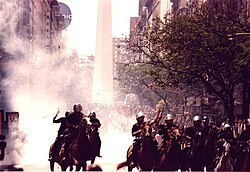
The Argentinazo, also known as the December 2001 crisis or Cacerolazo, was a period of intense civil unrest and rioting that shook Argentina to its core. Peaking on December 19 and 20, 2001, the violence centered in Buenos Aires, Rosario, and other major cities. This explosion of public anger was the culmination of the Argentine Great Depression—a severe economic, political, and social crisis spanning from 1998 to 2002.
Driven by the rallying cry "¡Que se vayan todos!" ("All of them must go!"), the protests targeted the entire political establishment. The unrest led to the resignation of President Fernando de la Rúa and triggered a chaotic period of institutional instability where five different officials held the presidency in rapid succession.
Key Facts
- Dates: Peak violence occurred on December 19–20, 2001.
- Primary Cause: The Corralito, a policy restricting bank cash withdrawals.
- Casualties: 39 civilians killed, including nine minors.
- Political Outcome: Resignation of President Fernando de la Rúa and subsequent short-term presidencies.
- Economic Context: Part of the Argentine Great Depression (1998–2002).
The Economic Roots of the Crisis
The seeds of the collapse were sown years earlier with the Convertibility plan of 1991, which pegged the Argentine peso 1:1 to the United States dollar. While this initially curbed inflation, it created a dangerous dependency on a steady supply of US dollars.
Initially, the government funded this through the privatization of state industries and pension funds. However, once privatization ended, the export-based economy could not generate enough dollars to sustain the peg, forcing the state to rely heavily on sovereign debt. By the time Fernando de la Rúa took office in December 1999, Argentina was already in a recession.
The Failure of the Alliance
De la Rúa campaigned on the promise to maintain the "one peso, one dollar" status quo. However, his administration faced a precarious political landscape. His coalition, the Alliance for Work, Justice and Education, lacked a majority in Congress and lost key provincial elections to the Peronists.
Internal friction grew as the coalition split over economic policy, and a major scandal involving bribes paid by the intelligence service (SIDE) to senators further eroded trust. This led to the resignation of Vice President Carlos Álvarez in October 2000.
The Path to Collapse: 2001
The year 2001 saw a rapid deterioration of government authority. Following the resignation of Economy Minister José Luis Machinea and a failed "shock program" by Ricardo López Murphy, Domingo Cavallo—the original architect of the Convertibility plan—was appointed as Economy Minister.
Social unrest intensified as the piqueteros (unemployed workers) began blockading highways to demand welfare subsidies. By November 29, the system reached a breaking point as investors began withdrawing deposits en masse, causing massive capital flight.
The Corralito
In a desperate attempt to stop the banking system from collapsing after the IMF refused to refinance Argentina's debt, Minister Cavallo introduced the Corralito on December 2, 2001. This policy limited cash withdrawals to $250 per week. While the limit was higher than the savings of many poor citizens, it outraged the middle class and shattered remaining public confidence in the government.
The December Riots and Presidential Flight
Tensions boiled over in mid-December. Looting of supermarkets began in Rosario and Greater Buenos Aires, while the General Confederation of Labour and the Argentine Workers' Central Union launched a massive general strike on December 13.
On the night of December 19, President de la Rúa declared a state of siege. This triggered spontaneous cacerolazos (pot-banging protests) across the country. The following day, December 20, violence peaked at the Plaza de Mayo in Buenos Aires.
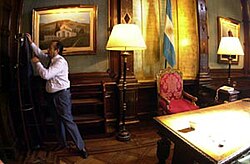
Facing total collapse, de la Rúa resigned. Because the violence around the Casa Rosada (Presidential Palace) was too intense for a car exit, the President was famously evacuated by an Air Force helicopter.
The Plaza de Mayo Massacre
The crackdown on protesters resulted in the "Plaza de Mayo Massacre," where five people were killed and 227 injured. In total, 36 to 39 people died nationwide during the riots, many in Peronist-governed provinces. While some officials, including the Secretary of Security, were charged, many cases remained unresolved for years.
Political Aftermath and Succession
The resignation of de la Rúa led to a period of extreme instability. Adolfo Rodríguez Saá was elected by Congress on December 22 but resigned just a week later after failing to secure support from fellow Peronist governors.
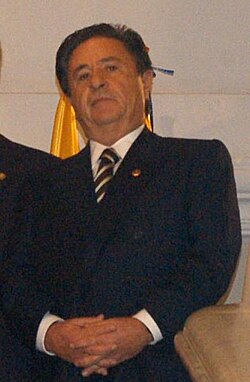
Finally, on January 1, 2002, the Legislative Assembly designated Senator Eduardo Duhalde as president. In a twist of irony, Duhalde—who had lost the 1999 election to de la Rúa—was tasked with completing the term of the man who had defeated him.
| Category | Details |
|---|---|
| Key Policy | Corralito (Withdrawal limits) |
| Economic Trigger | Collapse of the Convertibility plan (Peso-Dollar peg) |
| Casualties | 39 deaths (including 9 minors) |
| Presidential Sequence | De la Rúa → Rodríguez Saá → Duhalde |
| Main Protest Motto | "¡Que se vayan todos!" |
Frequently Asked Questions
What was the "Corralito"?
The Corralito was a government policy implemented in December 2001 that restricted the amount of cash citizens could withdraw from their bank accounts to $250 per week to prevent a total banking collapse caused by capital flight.
Why did President Fernando de la Rúa leave by helicopter?
President de la Rúa resigned on December 20, 2001. Because violent protests at the Plaza de Mayo made it impossible for his security detail to drive him from the Casa Rosada to his residence, he was evacuated via an Air Force helicopter.
What was the Convertibility plan?
Passed in 1991, the Convertibility plan pegged the Argentine peso to the US dollar at a 1:1 ratio. While it initially stopped inflation, it eventually led to a crisis because the government could not maintain enough dollar reserves to support the peg.
Who were the piqueteros?
The piqueteros were protest movements primarily composed of unemployed workers who used road blockades to demand government subsidies and social welfare measures during the economic depression.
How many people died during the Argentinazo?
Reports indicate that 39 civilians were killed by police and security forces during the unrest, including nine minors. The most concentrated violence occurred during the Plaza de Mayo Massacre.