Domingo Cavallo: The Architect of Argentina's Convertibility Plan
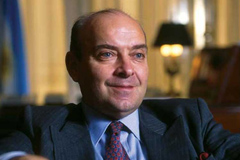
Domingo Cavallo is one of the most influential and controversial figures in Argentine economic history. An economist and politician with an academic pedigree from Harvard and the National University of Córdoba, Cavallo served as the Minister of Economy under two different presidents. He is best known for his aggressive pro-market reforms and the implementation of a rigid currency system that first halted hyperinflation and later became a focal point of a national economic collapse.
Throughout his career, Cavallo has navigated the highest levels of government, serving as a National Deputy, Minister of Foreign Affairs, and President of the Central Bank. His legacy is a study in extremes: from achieving record-breaking productivity growth in the early 1990s to overseeing the restrictive financial measures of the 2001 crisis.
Key Facts
- Convertibility Plan: Fixed the Argentine peso to the U.S. dollar at a 1:1 ratio in 1991.
- Inflation Control: Reduced inflation from over 1,300% in 1990 to nearly zero by the mid-1990s.
- Productivity Surge: Productivity per hour worked increased by 117% between 1991 and 1996.
- The Corralito: Implemented cash withdrawal restrictions in 2001 to prevent a total bank run.
- Academic Background: Holds PhDs in Economics from both the National University of Córdoba and Harvard University.
Early Career and the Central Bank
Born in San Francisco, Córdoba, Cavallo established his academic foundation early, earning degrees in accounting and economics. His first major foray into high-level financial management occurred in July 1982 when he was appointed President of the Central Bank of Argentina during a severe economic crisis.
During this tenure, Cavallo rescinded Circular 1050, a controversial measure that had tied loan installments to the U.S. dollar, which had caused many homeowners and small businesses to lose their properties following a sharp devaluation of the peso. While this provided immediate relief, his time at the Central Bank remained a subject of debate due to policies that allowed private companies to shift debt to the state.
The Menem Era: Stability and Privatization
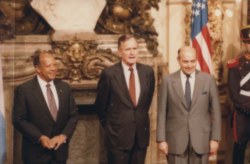
After serving as Minister of Foreign Affairs from 1989 to 1991—where he helped realign Argentina with the Washington Consensus (a set of free-market economic prescriptions)—Cavallo was appointed Minister of Economy in February 1991 under President Carlos Menem.
Facing hyperinflation that had reached 5,000% in 1989, Cavallo launched the Convertibility Plan on April 1, 1991. This created a currency board that legally fixed the exchange rate at 1 peso per 1 U.S. dollar. To support this, he implemented sweeping pro-market reforms, including:
- Trade Liberalization: Removing export taxes, reducing import duties, and eliminating non-tariff barriers.
- Privatization: Selling over 200 state enterprises, including the national airline, railroads, oil monopoly (YPF), and various public utilities.
- Fiscal Reform: Reducing public spending and simplifying the tax system to lower the fiscal deficit.
The immediate results were dramatic. GDP grew by about a third between 1991 and 1994, and income poverty fell by approximately half. However, these gains came with social costs; the privatization process and productivity shifts contributed to unemployment rising from 7% in 1991-92 to over 12% by 1994, and eventually 18% following the 1995 Mexican Crisis.
![Productivity per hour worked between 1991 and 1996 increased by 117%. More than any other country on any 5-year period since the start of the series in 1950.[2]](/images/ea/8d/ea8df960d0f1248bcb09b4b3690d9c35fd7ec2a605400d75c1b0293bc9470145.png)
Political Transitions and the 2001 Collapse
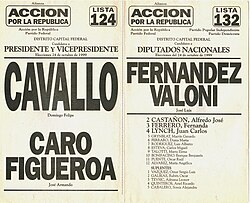
By 1996, strained relations with President Menem led to Cavallo's resignation. He transitioned into independent politics, founding the Action for the Republic party and serving as a National Deputy. He ran for president in 1999, finishing third with 11% of the vote.
In March 2001, President Fernando de la Rúa recalled Cavallo to the Ministry of Economy to combat a deep recession. Cavallo attempted to renegotiate external debt with the IMF, but escalating country risk triggered a massive bank run. In November 2001, he introduced the corralito, a restriction on cash withdrawals designed to stop capital flight.
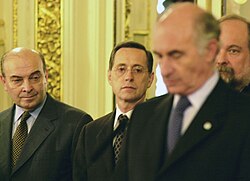
The corralito sparked widespread public outrage, leading to the cacerolazo (pot-banging protests) and the December 2001 riots. This turmoil forced the resignations of both Cavallo and President de la Rúa. Shortly after, the government ended the peso-dollar convertibility, leading to a sharp devaluation and a spike in inflation.
Later Years and Legal Challenges
Following the crisis, Cavallo's later years were marked by a mix of academic prestige and legal battles. He served as a visiting professor at Harvard and Yale and remained a member of the Group of Thirty. However, he faced legal scrutiny, including a 2005 exoneration regarding illegal weapons sales and a 2015 conviction for embezzlement related to the payment of "over-salaries" (sobresueldos) during his time in office.
| Role | Period | President/Administration | Key Action/Outcome |
|---|---|---|---|
| President of Central Bank | 1982 | Reynaldo Bignone | Rescinded Circular 1050 |
| Minister of Foreign Affairs | 1989–1991 | Carlos Menem | Realignment with Washington Consensus |
| Minister of Economy (1st) | 1991–1996 | Carlos Menem | Convertibility Plan & Privatizations |
| National Deputy | 1997–2001 | Legislative Branch | Represented Buenos Aires/Córdoba |
| Minister of Economy (2nd) | 2001 | Fernando de la Rúa | Implemented the corralito |
Frequently Asked Questions
What was the Convertibility Plan?
The Convertibility Plan was an economic policy implemented by Domingo Cavallo in 1991 that fixed the Argentine peso to the U.S. dollar at a 1:1 ratio. It functioned as a pseudo-currency board, effectively ending hyperinflation by tying the local currency to a stable foreign reserve.
What was the "corralito"?
The corralito was a financial restriction introduced by Cavallo in November 2001. It limited the amount of cash citizens could withdraw from their bank accounts to prevent a total collapse of the banking system during a massive bank run.
How did Cavallo affect Argentina's productivity?
During his first term as Minister of Economy (1991–1996), productivity per hour worked increased by 117%, a rate of growth higher than any other country in any five-year period since 1950.
Why is Cavallo's legacy controversial?
While he is credited with stopping hyperinflation and modernizing the economy through privatization, critics argue his policies led to deindustrialization, increased unemployment, and the eventual economic collapse and debt default of 2001.
What were the results of his 1999 presidential bid?
Cavallo ran for president in 1999 but finished in third place, receiving 11% of the total vote, losing to Fernando de la Rúa and Eduardo Duhalde.