Alfonso Prat-Gay: The Economist Who Reshaped Argentina's Financial Landscape
Alfonso Prat-Gay is a prominent Argentine economist and politician known for his influential roles in both the public and private financial sectors. With a career spanning high-level banking, legislative service, and cabinet-level governance, Prat-Gay has been a central figure in Argentina's efforts to navigate economic volatility and reintegrate into global capital markets.
Educated at the Pontifical Catholic University of Argentina and the University of Pennsylvania, where he was a PhD candidate, Prat-Gay blends academic rigor with practical market experience. He is widely regarded as an orthodox liberal—an economic philosophy favoring free markets and limited government intervention—though his political alliances have occasionally drawn diverse interpretations from his peers.
Key Facts
- Highest Office: Minister of Treasury and Public Finances (2015–2017).
- Central Bank Leadership: Served as President of the Central Bank of Argentina from 2002 to 2004.
- Major Achievement: Ended Argentina's sovereign default and restored access to international capital markets.
- Award: Named Euromoney's Central Bank Governor of the Year in 2004.
- Key Policy: Lifted four-year-old capital controls on the Argentine peso within days of taking office in 2015.
Early Career and Financial Expertise
Prat-Gay began his professional journey in the private sector, joining JP Morgan in New York City in 1994. He later worked in the bank's London and Buenos Aires branches until 2001. His entrepreneurial ventures include co-founding APL Economía, an economic consulting firm, and Tilton Capital, an asset management company established in 2005.
Beyond asset management, he served as president of the Andares Foundation for the Development of Microfinances. However, his tenure at Tilton Capital faced scrutiny regarding the management of wealth for high-profile clients, including the late María Amalia Lacroze de Fortabat, with allegations concerning capital flight and tax evasion.
Leadership at the Central Bank and National Congress
At the age of 37, Prat-Gay was appointed President of the Central Bank of Argentina in December 2002. His tenure was marked by significant success; he managed to reduce inflation from 40% to 5% while sustaining an economic growth rate of 8%. This performance earned him international acclaim, including the Euromoney Central Bank Governor of the Year award.
Despite his success, he declined a six-year term renewal from President Néstor Kirchner due to fundamental disagreements over the independence of the Central Bank and anti-inflationary strategies. He subsequently transitioned into politics, serving as a National Deputy for the City of Buenos Aires from 2009 to 2013 under the Civic Coalition. During this time, he focused on deregulation of the financial system and combating money laundering.
Minister of Treasury and Public Finances
Following the election of Mauricio Macri in 2015, Prat-Gay was appointed Minister of Treasury and Public Finances. His arrival signaled a dramatic shift in economic policy. Within seven days, he removed the capital controls (restrictions on the purchase and sale of foreign currency) that had been in place for four years, resulting in a 30% devaluation of the peso.
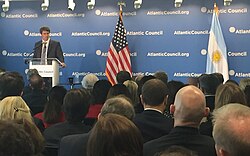
His administration implemented several aggressive reforms to stimulate the economy, including:
- Eliminating export taxes on meat, fishing, corn, wheat, mining, and industry.
- Gradually reducing tariffs on soy by 5% annually.
- Removing the Advance Affidavits of Importation (import control program).
- Phasing out energy and transport subsidies for electricity, gas, water, buses, and trains.
Prat-Gay was instrumental in ending the sovereign default declared in 2001, which allowed Argentina to return to international capital markets. He also worked to restore the credibility of national statistics, leading the IMF to declare in 2016 that Argentine data once again met international standards.
In January 2016, he represented Argentina at the World Economic Forum in Davos, meeting with global leaders such as Joe Biden, David Cameron, and Eric Schmidt to attract foreign investment. Despite these strides, he faced challenges with high inflation—which reached 40% in 2016—and internal policy conflicts with Central Bank President Federico Sturzenegger. Prat-Gay resigned at the request of President Macri on December 26, 2016.
Summary of Professional Tenure
| Role | Period | Key Contribution/Outcome |
|---|---|---|
| President, Central Bank of Argentina | 2002–2004 | Reduced inflation from 40% to 5%; 8% economic growth. |
| National Deputy (Buenos Aires) | 2009–2013 | Advocated for financial deregulation and banking security. |
| Minister of Treasury and Public Finances | 2015–2017 | Ended sovereign default; lifted currency controls. |
Frequently Asked Questions
What was Alfonso Prat-Gay's most significant achievement as Minister?
His most significant achievement was successfully ending the sovereign default declared in 2001, which restored Argentina's relationship with international creditors and allowed the country to return to global capital markets.
Why did Prat-Gay leave the Central Bank in 2004?
He rejected an offer from President Néstor Kirchner to renew his term due to disagreements regarding the independence of the Central Bank, the approach to anti-inflationary policies, and negotiations involving defaulted bonds.
What happened when Prat-Gay lifted capital controls in 2015?
The removal of these controls, which occurred just days after he took office, led to an immediate 30% devaluation of the Argentine peso.
Which international award did Alfonso Prat-Gay receive?
He was named the Central Bank Governor of the Year by Euromoney in 2004 for his success in lowering inflation while maintaining strong economic growth.
What was the impact of removing energy and transport subsidies?
The removal of subsidies for electricity, gas, water, and public transport led to a significant increase in prices for consumers, though Prat-Gay attempted to implement these changes gradually rather than through "shock therapy."