Corralito: The 2001 Argentine Banking Crisis
In late 2001, Argentina faced one of the most severe economic collapses in its history. At the center of this turmoil was a controversial set of financial restrictions known as the Corralito. Coined by journalist Antonio Laje, the term is the diminutive of the Spanish word corral (meaning a pen or enclosure), evoking the image of a child's playpen. This name reflected the feeling of the Argentine public, whose assets were suddenly "penned in" by the state.
The measure was implemented by Minister of Economy Domingo Cavallo to halt a massive bank run—a phenomenon where a large number of customers withdraw their deposits simultaneously due to fears of bank insolvency—which threatened to destroy the nation's entire banking system.
Key Facts
- Weekly Limit: Cash withdrawals were initially capped at 250 Argentine pesos (ARS) per week.
- Exchange Rate: At the start of the measure, the exchange rate was fixed at 1 ARS to 1 US dollar.
- Trigger: A three-year recession and heavy national debt led to widespread capital flight.
- Political Fallout: The crisis led to the resignation of President Fernando de la Rúa on December 20, 2001.
- Evolution: The Corralito eventually transitioned into the more severe Corralón.
The Road to Economic Collapse
By 2001, Argentina was trapped in a deep economic depression. The country was burdened by heavy debt and a stagnant economy. A primary driver of the instability was the Convertibility plan, a law that fixed the exchange rate at one US dollar per Argentine peso. While intended to stabilize the currency, this fixed rate made Argentine exports uncompetitive and stripped the government of its ability to manage an independent monetary policy.
Fearing a total economic crash or a sudden devaluation of the peso, many citizens and corporations began converting their pesos into dollars and moving them to foreign accounts. This process, known as capital flight, drained the banks of their liquidity.
The Implementation of Restrictions
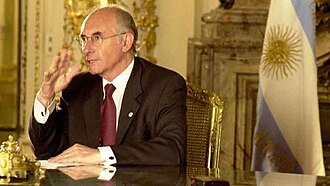
On December 1, 2001, the government froze all bank accounts for an initial period of 90 days. The restrictions were strict: only a small amount of cash (initially 250 ARS, later 300 ARS) could be withdrawn weekly, and only from peso-denominated accounts. Withdrawals from US dollar accounts were prohibited unless the owner agreed to convert the funds into pesos.
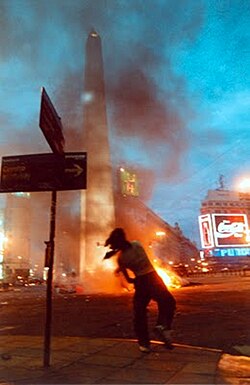
While electronic transfers, credit cards, and debit cards remained functional, the measure caused chaos. At the time, the average Argentine relied heavily on cash; many did not own bank accounts, and many businesses lacked the technology to process debit cards. The lack of physical currency exacerbated the recession and sparked public outrage.
The Role of Financial Institutions
Evidence suggests that banks played a significant role in the crisis. By mid-2001, bank owners and high-ranking officials likely recognized the impending crash. Some allegedly tipped off their largest depositors—primarily major corporations—allowing them to move their funds abroad before the freeze. Meanwhile, these same institutions continued to encourage middle-class customers to keep their deposits in the banks.
The aftermath saw mixed results for the banks. Some, such as Scotiabank Quilmes, exited the country immediately. Others remained, suffering severe reputational damage and physical attacks on their branches. Some international banks reportedly benefited by negotiating compensation bonds from the government for "missing" money that had often simply been moved between internal branches.
Transition to the Corralón
Following the resignation of Fernando de la Rúa, Eduardo Duhalde assumed the presidency. Under his administration, the crisis evolved into the Corralón. In this phase, US dollar-denominated deposits were forcibly converted into pesos at a rate of 1.4 pesos per dollar (and 1.0 for debt), while the actual market exchange rate spiked to 4 ARS/USD.
The term shifted to "Corralón" because the weekly 250 ARS withdrawal limit became irrelevant; people could no longer withdraw their dollars because they no longer possessed them. This led to increased protests and the closure of banks for several months.
| Feature | Corralito | Corralón |
|---|---|---|
| Primary Action | Withdrawal limits on cash | Forced conversion of USD to ARS |
| Withdrawal Limit | 250–300 ARS per week | Effectively zero for USD deposits |
| Exchange Rate | Fixed (1 ARS = 1 USD) | Devalued (Market reached 4 ARS = 1 USD) |
| Key Goal | Stop bank runs/capital flight | Debt and deposit restructuring |
Frequently Asked Questions
What was the main purpose of the Corralito?
The primary goal was to stop a massive bank run and prevent the total collapse of the Argentine banking system by limiting the amount of cash customers could withdraw.
How did the Corralito affect daily life in Argentina?
Because the economy relied heavily on cash and many businesses could not accept debit cards, the withdrawal limits caused severe liquidity problems for both individuals and businesses, deepening the recession.
What is the difference between the Corralito and the Corralón?
The Corralito limited the withdrawal of funds, while the Corralón involved the forced conversion of US dollar deposits into Argentine pesos at an unfavorable rate.
Why did the Argentine government fix the exchange rate to the US dollar?
The Convertibility plan was designed to stabilize the economy, but it eventually made exports uncompetitive and prevented the state from using independent monetary policy to fight the recession.
Who coined the term "Corralito"?
The term was coined by the journalist Antonio Laje.