Ferenc Puskás: The Legendary Goalscorer of Hungary and Real Madrid
Ferenc Puskás remains one of the most prolific and influential figures in the history of association football. Known for his extraordinary scoring ability and technical mastery, Puskás transitioned from a national icon in Hungary to a global superstar in Spain. His career, spanning several decades as both a player and a manager, left an indelible mark on the sport, earning him a place among the greatest players of the 20th century.
Key Facts
- Total Career Goals: 670 goals in 659 club appearances.
- International Record: 84 goals in 85 appearances for Hungary.
- Major Honors: Three European Cups with Real Madrid and an Olympic Gold Medal with Hungary.
- Individual Accolades: 1954 FIFA World Cup Golden Ball and multiple Pichichi Trophies.
- Managerial Success: Won league titles with Panathinaikos, Sol de América, and South Melbourne.
Early Career and the Hungarian Golden Team
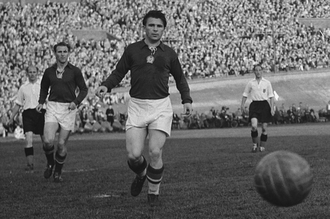
Born Ferenc Purczeld on April 1, 1927, in Budapest, Puskás began his journey with Kispest Honvéd. He quickly established himself as a dominant force in the forward and attacking midfielder positions. Between 1943 and 1956, he played for Budapest Honvéd, where he scored a staggering 428 goals in 397 appearances.
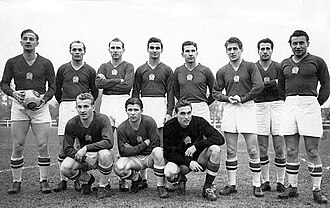
Puskás was the centerpiece of the legendary Hungarian national team, often referred to as the Golden Team. This era saw Hungary dominate international football, highlighted by a gold medal at the 1952 Helsinki Olympics and a runner-up finish at the 1954 FIFA World Cup in Switzerland.
During the 1952 Olympics, Puskás was instrumental, scoring goals in the quarter-finals, semi-finals, and the final against Yugoslavia. At the 1954 World Cup, he continued his dominance, scoring twice against South Korea and once each against West Germany in both the group stage and the final.
The Real Madrid Era
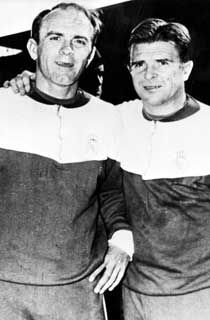
In 1958, Puskás joined Real Madrid, forming one of the most lethal attacking partnerships in football history alongside Alfredo Di Stéfano. His impact in Spain was immediate and profound. He helped the club secure five consecutive La Liga titles between 1961 and 1965 and won three European Cups (1959, 1960, and 1966).
Puskás's clinical finishing earned him the Pichichi Trophy (the award for the top scorer in La Liga) four times. In total, he netted 242 goals in 262 appearances for the Spanish giants, cementing his legacy as a global icon of the game.
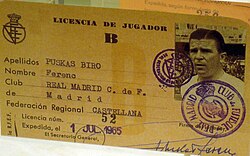
His integration into Spanish society was reflected even in his documentation; his player license listed his mother's maiden name, Biró, as a second surname to align with Spanish naming customs.
Managerial Career and Global Influence
After retiring as a player in 1966, Puskás embarked on an extensive managerial career that took him across the globe. He managed teams in Spain, the United States, Greece, Chile, Saudi Arabia, Paraguay, and Australia.
Some of his most notable managerial achievements include leading Panathinaikos to the Alpha Ethniki title in 1972 and the European Cup final in 1971. He also found success in South America with Sol de América and in Australia with South Melbourne, where he won the National Soccer League in 1991.
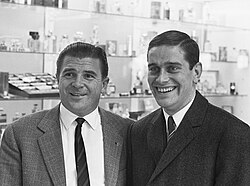
Legacy and Honors
Ferenc Puskás passed away on November 17, 2006, in Budapest at the age of 79. His contributions to football are commemorated worldwide, from the statue in Budapest depicting him teaching children how to keep the ball in the air, to a memorial in Melbourne, Australia.
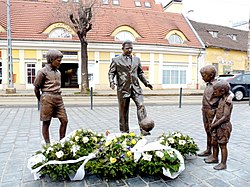
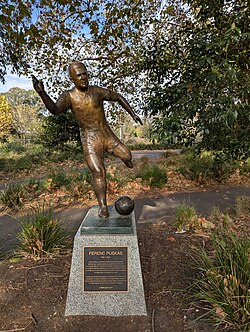
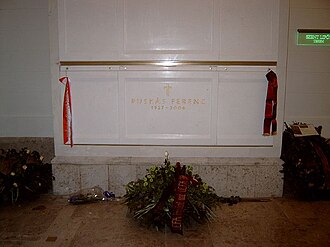
He is recognized by the IFFHS as the top scorer of the 20th century and is a member of the FIFA 100. He is buried at St. Stephen's Basilica in Budapest.
| Category | Details / Statistics |
|---|---|
| Club Goals | 670 (Honvéd & Real Madrid) |
| International Goals | 84 (Hungary) |
| European Cups | 3 (1959, 1960, 1966) |
| Olympic Gold | 1952 Helsinki |
| La Liga Titles | 5 |
Frequently Asked Questions
How many goals did Ferenc Puskás score in his club career?
Ferenc Puskás scored a total of 670 goals in 659 club appearances, with 428 goals for Budapest Honvéd and 242 goals for Real Madrid.
Which national teams did Puskás represent?
Puskás primarily represented Hungary, for whom he scored 84 goals in 85 matches. He also had brief appearances for Spain (4 caps) and a Castile representative team (1 cap).
What are Puskás's most significant achievements with Real Madrid?
With Real Madrid, he won three European Cups, five La Liga titles, and the Copa del Generalísimo in 1962, while winning the Pichichi Trophy four times.
Did Ferenc Puskás have a successful managerial career?
Yes, he won league titles with Panathinaikos (Greece), Sol de América (Paraguay), and South Melbourne (Australia), and led Panathinaikos to a European Cup final in 1971.
Where is Ferenc Puskás buried?
Ferenc Puskás is buried at St. Stephen's Basilica in his hometown of Budapest, Hungary.