Fats Domino: The New Orleans Pioneer of Rock and Roll
Antoine Caliste "Fats" Domino Jr. was more than just a musician; he was a foundational architect of the sound that defined a generation. Born into a French Creole family in New Orleans, Domino blended the rhythms of his hometown with a rolling piano style that helped bridge the gap between rhythm and blues (R&B) and the emerging genre of rock and roll. Over a career spanning several decades, he sold more than 65 million records, leaving an indelible mark on global music history.
Key Facts
- Record Sales: Sold over 65 million records worldwide.
- Historic Firsts: His single "The Fat Man" is cited by historians as one of the first rock and roll records to sell over 1 million copies.
- Chart Success: Achieved 37 Top 40 singles and 11 Top 10 US pop hits between 1955 and 1960.
- Accolades: Inducted into the Rock and Roll Hall of Fame (1986) and received the Grammy Lifetime Achievement Award (1987).
- Musical Style: A blend of New Orleans R&B, boogie-woogie, and blues.
Early Life and the Birth of a Sound
Born on February 26, 1928, Antoine Domino Jr. grew up in New Orleans, Louisiana. As the youngest of eight children in a Catholic, French Creole household, his first language was Louisiana Creole. This cultural melting pot provided the perfect backdrop for his musical development, allowing him to absorb the diverse sounds of the city.
Domino's professional ascent began in 1949 when he signed with Imperial Records. Unlike many artists of the era, he agreed to be paid royalties based on sales rather than a flat fee per song—a decision that would prove financially prudent as his popularity soared.
The Imperial Records Era (1949–1962)
Working closely with producer Dave Bartholomew, Domino released "The Fat Man" in 1949. The track, a modified version of "Junker Blues," featured a strong backbeat and Domino's signature "wah-wah" vocalizations. By 1951, it had sold a million copies and was later inducted into the Grammy Hall of Fame in 2015.
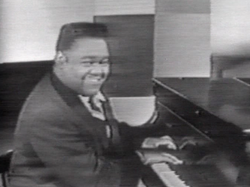
Domino's transition into the pop mainstream was cemented by the 1955 hit "Ain't That a Shame." While a cover by Pat Boone reached number one due to the racial segregation of the time, Domino's original version established him as a powerhouse on the Billboard charts. By 1955, five of his records were certified gold.
Throughout the late 1950s, Domino became a ubiquitous presence in American culture. He appeared in films such as Shake, Rattle & Rock! and The Girl Can't Help It, and performed on Dick Clark's American Bandstand. His grueling tour schedule—often 340 days a year—reflected his massive popularity.
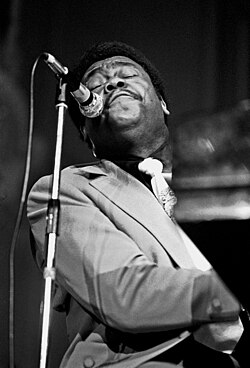
Global Influence and the Beatles
In 1962, while touring Europe, Domino met the Beatles. The young British band would later cite him as a primary inspiration, illustrating how the New Orleans sound traveled across the Atlantic to spark the next wave of musical revolution.
Later Career and Enduring Legacy
After leaving Imperial Records in 1963, Domino recorded for various labels including ABC-Paramount, Mercury, and Reprise. While he saw fewer chart-topping hits in the 1960s and 70s, he remained a beloved live performer, opening for Ike & Tina Turner at Carnegie Hall in 1971 and appearing in the 1980 film Any Which Way You Can.
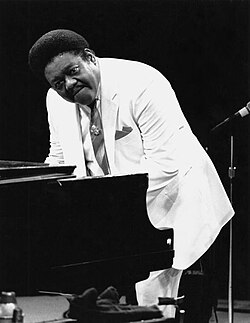
Domino's influence was recognized by his peers most famously by Elvis Presley. At a 1969 press conference, when referred to as "The King," Presley gestured toward Domino and declared him the "real king of rock and roll," admitting that he could not sing like Fats.
Hurricane Katrina and Final Years
The 2005 Hurricane Katrina disaster brought immense hardship to Domino's hometown. The floodwaters claimed many of his possessions, including the original National Medal of Arts awarded to him by President Bill Clinton. In a gesture of support, President George W. Bush replaced the lost medal on August 29, 2006.
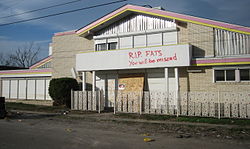
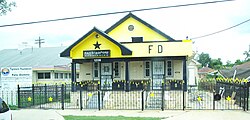
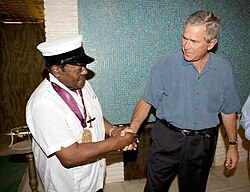
Domino continued to be honored in his later years, appearing as himself in the series Treme (2012) and being inducted into the National Rhythm and Blues Hall of Fame in 2016. He passed away on October 24, 2017, at the age of 89.
Career Summary
| Category | Details |
|---|---|
| Primary Genres | Rock and Roll, New Orleans R&B, Boogie-Woogie, Blues |
| Key Instruments | Piano, Vocals |
| Major Labels | Imperial, ABC, Mercury, Reprise, Warner Bros. |
| Total Record Sales | 65+ Million |
| Defining Single | "The Fat Man" (1949) |
Frequently Asked Questions
Was Fats Domino the first rock and roll artist?
While the origins of rock and roll are debated, many historians cite his 1949 single "The Fat Man" as the first rock and roll record to sell over a million copies, making him one of the genre's earliest and most influential pioneers.
How did Elvis Presley view Fats Domino?
Elvis Presley held Domino in extremely high regard, once referring to him as the "real king of rock and roll" and stating that Domino was a huge influence on him when he first started his career.
What was the significance of the National Medal of Arts in Domino's life?
The original medal, awarded by President Bill Clinton, was lost during the floods of Hurricane Katrina in 2005. It was later replaced by President George W. Bush in 2006.
What was Domino's perspective on the term "rock and roll"?
Domino was not convinced that rock and roll was a brand new genre. In 1957, he stated that what people were calling rock and roll was actually rhythm and blues, a style he had been playing in New Orleans for 15 years.
Which of his songs is considered a Grammy Hall of Fame inductee?
His groundbreaking 1949 hit "The Fat Man" was inducted into the Grammy Hall of Fame in 2015.