Family in Biological Taxonomy
In the complex system of Linnaean taxonomy—the scientific method of naming, defining, and classifying organisms—the family serves as a critical hierarchical rank. Positioned between the broader rank of order and the more specific rank of genus, a family groups together related organisms that share significant evolutionary and structural characteristics.
While families are primary units, they can be further divided into subfamilies to provide finer detail between the family and genus levels. In common language, these are often referred to by popular names; for instance, the Juglandaceae family is widely known as the "walnut family," encompassing both walnut and hickory trees.
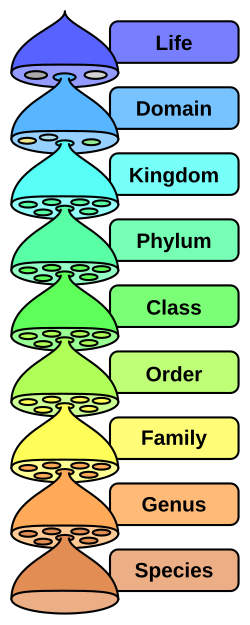
Key Facts
- Position: Located between Order (above) and Genus (below).
- Botanical Suffix: Plant, fungal, and algal families typically end in -aceae.
- Zoological Suffix: Animal families typically end in -idae.
- Determination: Defined by active taxonomists based on vegetative, reproductive, or phylogenetic traits.
- Stability: More stable than species or genera, making them ideal for evolutionary and ecological studies.
Nomenclature and Naming Conventions
The naming of biological families is strictly codified by international bodies to ensure global scientific consistency. These rules vary depending on the kingdom of the organism being classified.
Botanical, Fungal, and Algal Naming
For plants, fungi, and algae, the standard suffix is -aceae. However, some historic names are so deeply embedded in scientific literature that they are conserved alongside their standardized versions. Examples include Palmae (Arecaceae), Cruciferae (Brassicaceae), and Leguminosae (Fabaceae). A few widely used historic names, such as Compositae (Asteraceae) and Gramineae (Poaceae), also persist.
Zoological Naming
In zoology, family names end with the suffix -idae. The zoological "family-group" is more expansive, including several related ranks: superfamily (-oidea), family (-idae), subfamily (-inae), and tribe (-ini). Under the principle of coordination, a name established at any of these ranks can be moved to another while keeping its original author and date, requiring only a suffix change.
Generally, family names are derived from the stem of a type genus within that family. To maintain stability, zoological names established before 1960 may be kept even if the base genus is later found to be a junior synonym (a later name for a taxon already named).
The Evolution of the Family Concept
The use of the term "family" has shifted significantly since its inception. It was first introduced in 1689 by French botanist Pierre Magnol, though his original concept differed from modern usage, as he viewed families as groups to be united into larger genera.
Carl Linnaeus later used familia in his 1751 work Philosophia Botanica to categorize groups like herbs and trees, though he limited this to morphological discussions. Throughout the 18th and 19th centuries, the term was often used interchangeably with ordo (order). It wasn't until after the mid-19th century that "family" became a standardized botanical rank.
In zoology, Pierre André Latreille introduced the family as an intermediate rank between order and genus in 1796. The naming process was further refined in 1813 when William Kirby introduced the -idae suffix, derived from the Greek eidos (meaning "resemblance").
Practical Applications in Science
Families are more than just labels; they are essential tools for researchers across various biological disciplines.
Education and Identification
Because families group organisms with general similarities while remaining specific enough for identification, they are ideal for teaching taxonomy. In botany, identifying a family allows a researcher to recognize related species across different continents due to worldwide distribution patterns. Many field guides use families as the primary level for identification keys.
Ecological and Genetic Research
In biodiversity surveys, families often serve as the foundational level of identification. This is because members of the same family frequently share similar life history traits or occupy similar ecological niches (the specific role and position a species has in its environment). This correlation makes family-level data highly useful for environmental studies.
While family ranks provide stability, they are not static. Modern phylogenetic analyses—the study of evolutionary relationships—and molecular studies occasionally reveal that organisms need to be reclassified, leading to the rare description of entirely new families.
| Kingdom/Group | Standard Suffix | Example Suffixes/Ranks | Key Characteristic |
|---|---|---|---|
| Plants, Fungi, Algae | -aceae | -aceae | Often based on vegetative/reproductive traits |
| Animals | -idae | -oidea, -inae, -ini | Follows the principle of coordination |
Frequently Asked Questions
What is the difference between an order and a family?
An order is a higher, broader taxonomic rank that contains one or more families. A family is a more specific grouping that sits between the order and the genus.
Why do some plant families have two different names?
Some families have a traditional name (like Palmae) and a standardized name (like Arecaceae). Both are often conserved because the traditional names are widely used in historical scientific literature.
How often are new biological families created?
New family descriptions are relatively rare, appearing in fewer than one percent of taxonomic publications. They usually result from the discovery of unique organisms or new phylogenetic evidence.
What is the "principle of coordination" in zoology?
It is a rule allowing a taxonomic name to be moved between the ranks of superfamily, family, subfamily, or tribe while retaining its original date and authorship, changing only the suffix.
Why are families useful for ecological surveys?
Families are useful because members often share similar ecological functions and life history traits, allowing researchers to make broad but accurate assessments of biodiversity and environmental health.