Falklands War: The Surrender of Port Stanley and the End of Hostilities
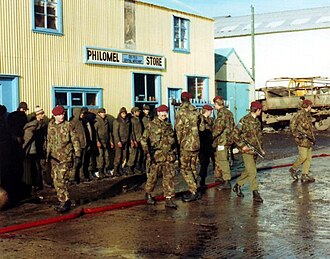
The final stage of the Falklands War culminated in the surrender of the Argentine Governor at Port Stanley. After 74 days of conflict, the military campaign reached its conclusion on June 14, 1982, marking a pivotal moment in the geopolitical history of the South Atlantic.
The Terms of Surrender
At 21:00 on June 14, 1982, General Mario Menéndez, commander of the Argentine garrison in Stanley, surrendered to Major General Jeremy Moore. This decision was a significant departure from the Argentine Army code, which dictated that a commander should not surrender unless more than 50% of their personnel were casualties and 75% of their ammunition had been expended.
Following negotiations by General Menéndez, the language of the surrender document was modified. Specifically, the phrase unconditional surrender was replaced with the simpler term surrender. The negotiated terms granted the Argentine forces several concessions:
- Argentine units were permitted to retain their flags.
- Units remained under the control of their respective officers.
- The surrender ceremony was conducted privately rather than in public.
- Argentine officers were allowed to keep their sidearms.
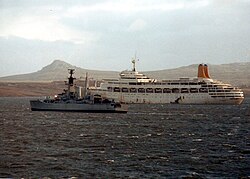
However, the British rejected a request to return the 11,313 prisoners of war (POWs) on their own ships. Instead, the British managed the transport. Notably, 4,167 prisoners were repatriated to Argentina aboard the ocean liner Canberra, contradicting claims by the Argentine junta that the vessel had been crippled during the Battle of San Carlos.
The Instrument of Surrender
The formal signing of the surrender letter involved a group of high-ranking officers and translators from both nations. Key signatories and witnesses included General Mario Menéndez and Vicecomodoro (Wing Commander) Carlos Bloomer-Reeve for Argentina, and Major General Jeremy Moore, Colonel Mike Rose, and Colonel Tom Seccombe for the United Kingdom.
The document specified that all Argentine personnel were to muster at designated assembly points and hand over all arms, ammunition, and warlike equipment. It explicitly stated that all personnel would be treated with honor in accordance with the Geneva Convention of 1949.
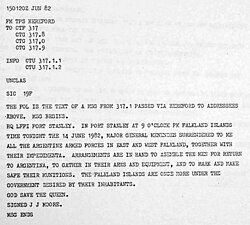
To avoid confusion among troops, the surrender time was backdated by three hours. This ensured that both Zulu time (UTC) and local time were recorded as June 14, preventing any Argentine soldiers from mistakenly believing they could continue fighting into June 15.
Captured Equipment and Military Assets
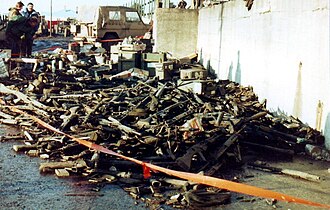
The British forces captured a vast array of Argentine military hardware in Port Stanley. While some equipment was rendered useless by Argentine personnel before the surrender, the volume of captured assets was substantial.
| Category | Key Assets Captured |
|---|---|
| Vehicles | ~100 Mercedes-Benz trucks, 20 Unimogs, 50 G-Class 4x4s, 12 Panhard AML 90mm vehicles |
| Artillery & Air Defense | 3 CITER 155mm guns, >10 Oto Melara 105mm cannons, SAM Roland and Tigercat launchers |
| Radar & Electronics | AN/TPS-43 and AN/TPS-44 air search radars, Skyguard and Super Fledermaus FC radars |
| Aircraft | 14 flyable helicopters (including Chinook and Puma), >10 FMA IA 58 Pucará, 1 Aermacchi MB-339 |
| Small Arms & Ammo | >11,000 personal weapons, >4 million 7.62mm rounds, >11,000 105mm rounds |
| Naval | Coast Guard patrol boat GC82 Islas Malvinas (renamed HMS Tiger Bay) |
Key Facts
- Duration: The war lasted 74 days.
- Casualties: 255 British, 649 Argentine, and 3 civilian Falklanders were killed.
- POWs: 11,313 Argentine personnel were taken as prisoners of war.
- Final Action: Hostilities officially ended on June 20 after the British retook the South Sandwich Islands.
- Commemoration: June 14 is observed as "Liberation Day" in the Falkland Islands.
Aftermath and Legacy
Following the conflict, the Argentine government established the Rattenbach Commission (Informe Rattenbach) to investigate the causes of the defeat. Although the commission recommended severe penalties for certain officers, these recommendations had little impact on subsequent trials.
Diplomatic relations between the UK and Argentina were not restored until 1989. This restoration occurred under an "umbrella formula," which allowed both nations to maintain diplomatic ties while setting aside the ongoing dispute over the sovereignty of the islands.
While the British government originally decreed that classified information would be released in 2082, the Freedom of Information Act has since made much of this material available to the public. The original surrender document is currently preserved and on display at the Imperial War Museum in London.
Frequently Asked Questions
Why did General Menéndez surrender despite the Argentine Army code?
General Menéndez surrendered despite the code—which required 50% casualties and 75% ammunition loss before surrendering—likely due to the strategic collapse of the Argentine position at Port Stanley.
What was the significance of the "umbrella formula"?
The umbrella formula was a diplomatic agreement that allowed the UK and Argentina to restore relations in 1989 by agreeing to ignore the sovereignty dispute over the islands during their diplomatic interactions.
How was the surrender time handled to avoid confusion?
The time was backdated by three hours so that both local time and Zulu time (UTC) fell on June 14. This prevented Argentine troops from thinking they had permission to fight until June 15.
What happened to the captured Argentine patrol boat?
The Argentine Coast Guard patrol boat GC82 Islas Malvinas was captured by the British and renamed HMS Tiger Bay.
What is Liberation Day?
Liberation Day is a public holiday celebrated in the Falkland Islands every June 14, marking the anniversary of the Argentine surrender and the end of the conflict on the islands.