Argentina vs England 1986: The Match of the Hand of God and the Goal of the Century
On June 22, 1986, the Estadio Azteca in Mexico City became the stage for one of the most storied encounters in sporting history. The quarter-final clash between Argentina and England during the 1986 FIFA World Cup was more than just a game; it was a collision of political tension, national pride, and individual genius. The match is immortalized by the performance of Argentina's captain, Diego Maradona, who scored two of the most famous goals in the history of football.
Key Facts
- Date: June 22, 1986
- Venue: Estadio Azteca, Mexico City
- Final Score: Argentina 2 – 1 England
- Maradona's Impact: Scored both Argentine goals, including the "Hand of God" and the "Goal of the Century."
- Tournament Outcome: Argentina went on to win the 1986 World Cup.
- Top Scorer: England's Gary Lineker won the Golden Boot with six goals.
A Rivalry Fueled by Conflict
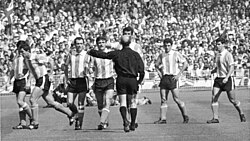
The tension between the two nations was rooted in both sport and geopolitics. The footballing rivalry is often traced back to the 1966 World Cup quarter-final, where Argentine captain Antonio Rattín was sent off by German referee Rudolf Kreitlein. The incident led to a clash of cultures and accusations of bias, with England manager Alf Ramsey famously describing the Argentine players as "animals."
Beyond the pitch, the 1982 Falklands War (known in Argentina as the Malvinas War) had severely damaged Anglo-Argentine relations. The conflict over the South Atlantic archipelago resulted in 285 British and 659 Argentine casualties. For the Argentine squad, the 1986 match was viewed as a form of symbolic revenge for the lives lost during the war.
The Unusual Story of the Argentine Kit
In a strange twist of fate, Argentina's appearance on the day was the result of a last-minute shopping trip. Coach Carlos Bilardo feared the team's official blue cotton shirts would be too heavy for the intense Mexico City heat. Unable to get lighter replacements from their manufacturer in time, staff member Ruben Moschella searched local shops in the capital.
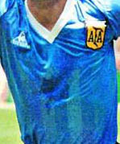
Maradona personally selected a pair of blue jerseys from a local store. The coaching staff bought 38 of them, hurriedly sewing on makeshift Argentine Football Association (AFA) badges and ironing on silver American football numbers before the match.
Match Analysis: A Tale of Two Goals
The first half was a tightly contested affair. While Argentina dominated possession and territory, England's goalkeeper Peter Shilton made several critical saves to keep the game scoreless at halftime.
The "Hand of God"
The deadlock broke in the 51st minute. Following a miscued clearance by England's Steve Hodge, the ball looped into the penalty area. Maradona, despite being significantly shorter than Peter Shilton, leaped and used his left hand to punch the ball into the net. Referee Ali Bin Nasser did not see the infringement and allowed the goal, which Maradona later described as the "Hand of God."
The Goal of the Century
Just four minutes later, Maradona produced a moment of pure brilliance. Receiving the ball in his own half, he embarked on a 60-yard, 10-second dash. He dribbled past Peter Beardsley, Peter Reid, Terry Butcher (twice), and Terry Fenwick before feinting past Shilton to slot the ball home. This goal was voted the "Goal of the Century" by FIFA in 2002.
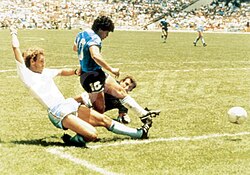
The goal was immortalized by the passionate commentary of journalist Víctor Hugo Morales, who described Maradona as a "cosmic kite."

England's Response
England fought back in the closing stages, utilizing substitutions like John Barnes and Chris Waddle to increase attacking pressure. In the 81st minute, Gary Lineker scored from a Barnes cross, bringing the score to 2–1. However, Argentina held on to secure their victory and a place in the semi-finals.
Legacy and Aftermath
The match cemented Maradona's status as a global icon, described by the French newspaper L'Équipe as "half-angel, half-devil." The emotional weight of the victory remained high in Argentina, where beating England was seen by some players as more important than winning the tournament itself.
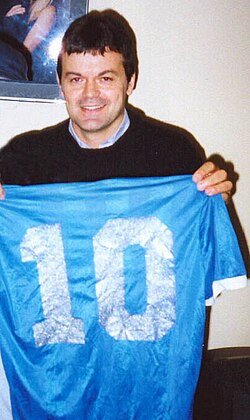
The jersey Maradona wore during the match became one of the most valuable pieces of sports memorabilia in history. Originally swapped with Steve Hodge after the game, the shirt was auctioned by Sotheby's in 2022, selling for a record-breaking £7,142,500 (approximately US$9.2 million).
| Detail | Information |
|---|---|
| Final Score | Argentina 2 – 1 England |
| Argentina Scorers | Diego Maradona (51', 55') |
| England Scorer | Gary Lineker (81') |
| Attendance | 114,580 |
| Referee | Ali Bin Nasser (Tunisia) |
| Venue | Estadio Azteca, Mexico City |
Frequently Asked Questions
Why was the 1986 match so emotionally charged?
The match took place only four years after the Falklands War, a conflict between the UK and Argentina over the Falkland Islands. This political tension, combined with a long-standing football rivalry dating back to 1966, made the game highly symbolic.
What is the "Hand of God" goal?
It is the first goal scored by Diego Maradona in the match, where he used his hand to punch the ball into the net. Because the referee did not see the foul, the goal was allowed, leading to lasting controversy.
Why is Maradona's second goal called the "Goal of the Century"?
The goal is celebrated for its technical brilliance, featuring a solo run where Maradona dribbled past five English players and the goalkeeper over a distance of 60 yards in just 10 seconds.
What happened to the shirt Maradona wore in the match?
Maradona swapped shirts with England's Steve Hodge after the game. The shirt was later lent to the National Football Museum before being sold at auction in 2022 for over £7.1 million.
Did Argentina win the 1986 World Cup?
Yes, after defeating England in the quarter-finals, Argentina progressed through the tournament and eventually won the World Cup by defeating West Germany in the final.