F-84F Thunderstreak and RF-84F Thunderflash: Evolution of a Swept-Wing Fighter
In the late 1940s, the United States Air Force (USAF) sought to elevate the performance of its fleet to match the capabilities of the F-86. This ambition led to the transformation of the straight-wing F-84 into a swept-wing powerhouse. The result was a complex development journey that produced two distinct aircraft: the F-84F Thunderstreak fighter and the RF-84F Thunderflash reconnaissance variant.
The Path to the Thunderstreak
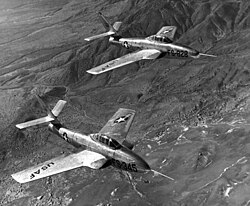
The evolution began in 1948 with the creation of the XF-96A. This prototype was based on the last production F-84E but featured a swept tail and a new wing with a 38.5-degree leading edge sweep and 3.5 degrees of anhedral (a downward angle of the wings). Powered by a J35-A-25 engine producing 5,300 pound-force (23.58 kN) of thrust, the XF-96A first flew on June 3, 1950, piloted by Oscar P. Haas.
While the aircraft reached speeds of 602 knots (693 mph; 1,115 km/h), the performance increase over the F-84E was modest. Despite this, the USAF ordered the aircraft into production in July 1950 as the F-84F Thunderstreak. The F-84 designation was kept because officials expected the fighter to be a cost-effective upgrade, anticipating that over 55 percent of the tooling from the original straight-wing Thunderjet could be reused.
To enhance high-altitude performance, the USAF integrated the British Armstrong Siddeley Sapphire turbojet, manufactured in the U.S. as the Wright J65. This larger engine required a vertically stretched fuselage and an oval-shaped air intake. Due to production delays with the F-84F, the USAF temporarily relied on straight-wing F-84Gs as an interim solution.
Production Struggles and Technical Refinements
The transition to production was fraught with difficulties. The expected 55 percent tooling commonality proved unrealistic, with only 15 percent of tools actually being reusable. Furthermore, the F-84F relied on press-forged wing spars and ribs; however, with only three capable presses in the country, priority was given to the Boeing B-47 Stratojet bomber.
Engine availability also lagged, as the improved J65-W-3 did not arrive until 1954. When the first production F-84F finally took flight on November 22, 1952, it featured several changes from the test aircraft, including fuselage-side airbrakes and a unique canopy that pivoted up and backward via hydraulic rams and a lever arm.
Early operational versions faced severe stability issues. The first 275 aircraft used conventional stabilizer-elevator tailplanes, which caused poor turning and accelerated stall pitch-up at combat speeds. These issues were mitigated starting with Block 25 through the introduction of a hydraulically powered one-piece stabilator (a combined horizontal stabilizer and elevator) and the addition of spoilers for better high-speed control. The F-84F was finally declared operational on May 12, 1954.
The RF-84F Thunderflash
Parallel to the fighter's development, a second YF-84F prototype was built with wing-root air intakes. While these intakes caused a loss of thrust unsuitable for a fighter, they created vital space in the nose for reconnaissance equipment. This led to the RF-84F Thunderflash, which first flew in February 1952.
The Thunderflash was a sophisticated intelligence platform, capable of carrying up to 15 cameras while retaining four machine guns for defense. It featured cutting-edge innovations for its time, including computerized controls that automatically adjusted for altitude, speed, and light, a periscope for target visualization, and a voice recorder for pilot observations.
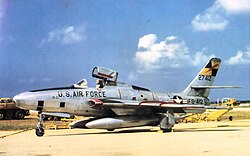
Sharing the same engine and production hurdles as the Thunderstreak, the Thunderflash entered service in March 1954. It was retired from active duty in 1957, reactivated in 1961, and eventually retired from the Air National Guard (ANG) in 1972. Some modified Thunderflashes were also utilized in the specialized FICON project.
Key Facts
- Top Speed: The XF-96A prototype reached 602 knots (693 mph).
- Engine Evolution: Transitioned from the J35-A-25 to the more powerful Wright J65.
- Design Change: Block 25 introduced the one-piece hydraulically powered stabilator to fix stability issues.
- Tooling Gap: Expected 55% tooling reuse dropped to an actual 15%.
- Reconnaissance Capability: The RF-84F could carry up to 15 cameras and featured computerized settings.
| Feature | F-84F Thunderstreak | RF-84F Thunderflash |
|---|---|---|
| Primary Role | Fighter | Reconnaissance |
| Air Intake Location | Nose | Wing-root |
| Operational Date | May 12, 1954 | March 1954 |
| Special Equipment | High-speed spoilers | Up to 15 cameras & periscope |
Frequently Asked Questions
Why did the RF-84F use wing-root intakes instead of a nose intake?
The wing-root intakes were used to clear space in the nose of the aircraft, allowing for the installation of reconnaissance cameras.
What was the primary stability issue with early F-84F models?
The first 275 aircraft suffered from poor turning ability and accelerated stall pitch-up due to their conventional stabilizer-elevator tailplanes.
How was the stability issue eventually resolved?
Starting with Block 25, the aircraft were equipped with a hydraulically powered one-piece stabilator and spoilers for improved high-speed control.
Why were there significant production delays for the F-84F?
Delays were caused by a lack of reusable tooling (only 15% instead of the expected 55%) and a shortage of presses capable of manufacturing the wing spars and ribs, which were prioritized for the B-47 bomber.
What made the RF-84F's camera system advanced for its time?
It utilized computerized controls that automatically adjusted camera settings based on the aircraft's speed, altitude, and available light.