F-8 Crusader: The Last of the Gunfighters
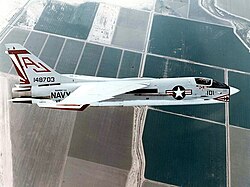
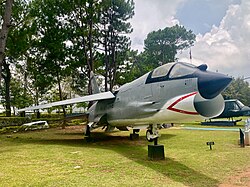
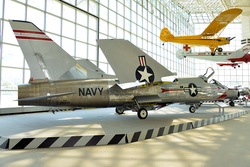
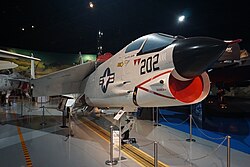
The F-8 Crusader stands as a legendary chapter in naval aviation, representing the pinnacle of the single-seat, carrier-based fighter before the era of multi-role heavy interceptors. Manufactured by Vought, this supersonic powerhouse served as the primary air superiority tool for the United States Navy and Marine Corps for nearly two decades, earning a reputation for agility and raw power.
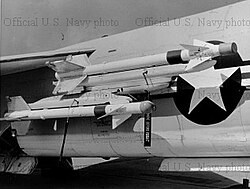
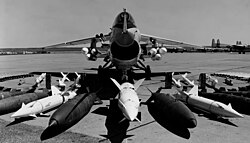
From breaking national speed records to engaging in the intense dogfights of the Vietnam War, the Crusader was more than just a machine; it was the "Last of the Gunfighters," maintaining a reliance on internal cannons in an age increasingly dominated by missiles.
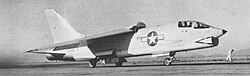
Key Facts
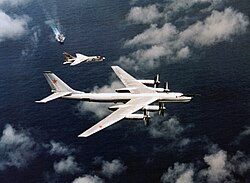
- Manufacturer: Vought
- Total Built: 1,219 aircraft
- Top Speed: Mach 1.8 (approximately 1,227 mph)
- Primary Role: Fighter / Photo Reconnaissance
- Service Life: 1957 to 1999 (across various operators)
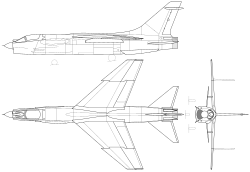
- Distinctive Feature: Variable-incidence wing for improved carrier take-offs and landings.
Development and Design
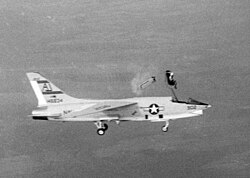
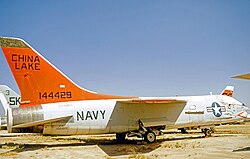
The Crusader's journey began with the XF8U-1 prototypes, which underwent rigorous evaluation by VX-3 starting in late 1956. The aircraft quickly proved its potential for extreme speed. On August 21, 1956, Commander "Duke" Windsor flew a China Lake F8U-1 to a U.S. National Level Flight Speed Record of 1,015.428 mph, significantly surpassing the previous record held by the USAF F-100.
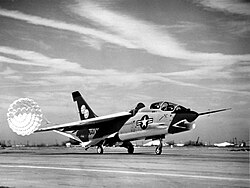
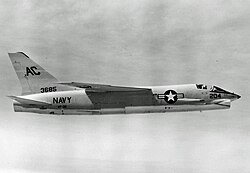
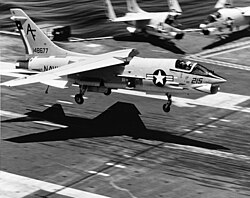
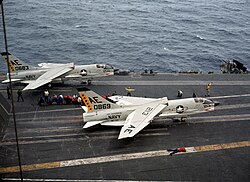
One of the most innovative aspects of the F-8 was its variable-incidence wing. This design allowed the wing to pivot upward, increasing the angle of attack during takeoff and landing without requiring the entire fuselage to pitch up, which greatly improved pilot visibility and safety during carrier operations.
Technical Specifications (F-8E Variant)
The F-8E was one of the most refined versions of the aircraft, balancing speed with heavy armament.
| Characteristic | Specification |
|---|---|
| Crew | 1 |
| Max Speed | Mach 1.8 (1,227 mph) |
| Service Ceiling | 58,000 ft |
| Empty Weight | 18,800 lb |
| Max Takeoff Weight | 34,000 lb |
| Armament | 4 × 20mm Colt Mk 12 cannons |
Operational History
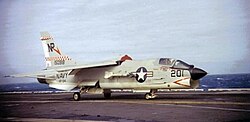
US Navy and Marine Corps
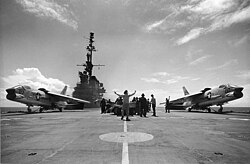
The F8U-1 entered service in December 1956, with VX-3 becoming the first unit to operate the type from the USS Franklin D. Roosevelt in April 1957. While the aircraft was highly capable, its early career was marked by a challenging mishap rate during carrier qualifications.
During the Vietnam War, the Crusader became a staple of American air power. It was prized for its dogfighting capabilities, often intercepting enemy aircraft and providing critical air cover. The F-8E variant, equipped with an Infrared Search and Track (IRST) sensor, allowed pilots to detect targets without alerting them via radar.
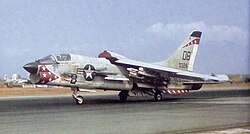
The fighter variants were gradually phased out of active US Navy service by 1976, replaced by the F-4 Phantom II and later the F-14 Tomcat. However, the photo reconnaissance version, the RF-8G, remained vital. These "eyes of the fleet" continued to serve in the Naval Reserve until March 29, 1987.
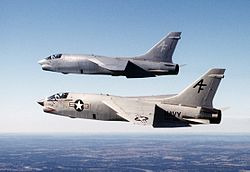
International Service: France and the Philippines
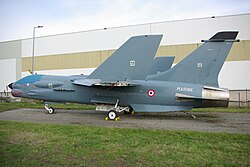
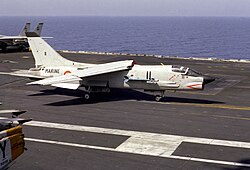
The French Navy (Aéronavale) adopted the Crusader in the early 1960s. The F-4 Phantom was deemed too large for the French carriers Clemenceau and Foch, leading France to order 42 F-8s. These aircraft remained in service until December 19, 1999.
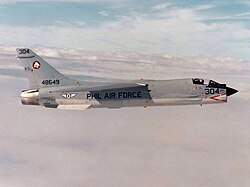
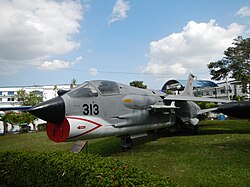
The Philippine Air Force also operated the F-8H, utilizing the aircraft for national defense until their retirement in 1991.
Variants and Evolution
- F8U-1 (F-8A): The initial production version with 318 units built.
- F8U-1E (F-8B): Introduced limited all-weather capability via the AN/APS-67 radar.
- RF-8G: A specialized photo reconnaissance variant that outlasted the fighter models.
- XF8U-3 Crusader III: An advanced design capable of Mach 2.39, though it was canceled in favor of the F-4 Phantom II.
- QF-8A: Retired F-8As converted into remote-controlled target drones.
NASA's Research Legacy
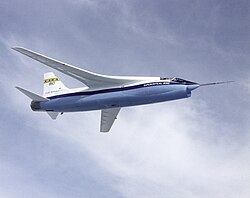
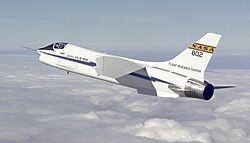
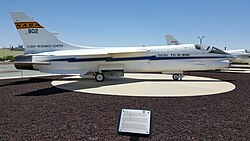
Beyond combat, the F-8 served as a critical testbed for NASA. It was used to develop supercritical wings (wings designed to reduce drag at high speeds) and pioneered digital fly-by-wire technology, which replaced manual flight controls with an electronic interface—a foundation for almost every modern fighter jet today.
Frequently Asked Questions
Why was the F-8 called the "Last of the Gunfighters"?
The F-8 was one of the last frontline naval fighters to prioritize internal cannons (four 20mm Colt Mk 12s) as a primary weapon, whereas subsequent generations shifted focus almost entirely toward air-to-air missiles.
What was the purpose of the variable-incidence wing?
The wing could be tilted upward to allow the aircraft to take off and land at a higher angle of attack without pitching the nose up too steeply, which gave the pilot a better view of the carrier deck.
How did the F-8 differ from the F-4 Phantom II?
The F-8 was a smaller, single-seat aircraft optimized for agility and dogfighting, while the F-4 was a larger, two-seat interceptor designed for speed and missile engagement.
Which countries operated the F-8 Crusader?
The primary operators were the United States (Navy and Marine Corps), France (Aéronavale), and the Philippines (Philippine Air Force).
What was the F-8's role at NASA?
NASA used the F-8 as a flying laboratory to test supercritical wing designs and develop the first digital fly-by-wire flight control systems.