Extra-Pair Copulation in Socially Monogamous Species
In the animal kingdom, the concept of monogamy is often more complex than it appears. While many species are socially monogamous—meaning a male and female form a pair bond to share resources and raise offspring—they are rarely genetically monogamous. This discrepancy is driven by extra-pair copulation (EPC), a mating behavior where an individual in a pair bond breeds with an organism outside of that relationship.
When EPC occurs in species with sustained social bonds, it can lead to extra-pair paternity (EPP), where the female produces extra-pair offspring (EPO) sired by a male other than her social partner. While once thought to be a male-driven strategy to maximize reproductive success, research shows that females also seek EPCs under certain conditions.
Key Facts
- Social vs. Genetic Monogamy: Social monogamy involves pair-bonding for resource sharing, while genetic monogamy is the rare state of mating exclusively with one partner.
- Prevalence: EPC is common in birds and certain mammals, including primates and treeshrews.
- Male Motivation: Males may seek EPCs to increase offspring count with minimal parental investment.
- Female Motivation: Theories include seeking "good genes" or the result of intersexual antagonistic pleiotropy.
- Defense Mechanisms: Males use mate guarding and sperm competition to ensure their own paternity.
Costs and Benefits of Extra-Pair Mating
The evolutionary drivers of EPC differ significantly between genders. For males, the benefit is straightforward: by copulating with multiple females, they maximize their reproductive success. Because their parental investment is generally lower than that of the female, the risk to the male is minimal.
Females face a higher cost. Copulating outside the pair bond can jeopardize the resources and support provided by their social mate. This has led to significant scientific debate regarding why females seek EPCs. One theory suggests sexual selection, where females seek genetic benefits for their offspring. Evidence for this exists in some bird species, where extra-pair males often possess more attractive traits.
However, other research challenges the "good genes" hypothesis. A meta-analysis of 55 bird species found that extra-pair offspring were not significantly more likely to survive than within-pair offspring, nor did extra-pair males consistently possess superior traits, aside from being slightly larger on average.
Genetic Constraints and Pleiotropy
Some scientists propose that EPC is not an adaptation for benefit, but a result of intersexually pleiotropic alleles. Under the hypothesis of intersexual antagonistic pleiotropy, the reproductive gains for males outweigh the negative effects for females, allowing the allele to persist. Similarly, intrasexual antagonistic pleiotropy suggests the allele controlling EPC in females also controls a beneficial behavior, such as receptiveness to their social partner.
Reproductive Strategies and Defense
To protect their genetic investment, males have developed strategies to prevent EPP while simultaneously attempting to achieve their own extra-pair fertilizations (EPFs).
Mate Guarding
Mate guarding occurs when a male closely follows the female during her fertile period to thwart other suitors. This behavior intensifies when other competing pairs live nearby. In the western bluebird, this strategy increases the female's acceptance of the social mate. In Seychelles warblers, artificial interruption of mate guarding directly increased the probability of extra-pair eggs in the nest.
![Seychelles warblers (Acrocephalus sechellensis) display effective mate guarding strategies.[13]](/images/48/fb/48fbc51a96c93daf62cab1b0e308b136053020d7aadc03999b4d42172d52ab39.jpg)
Sperm Competition
When mate guarding fails, sperm competition begins. This generally follows two biological systems:
- Sneaks and Guarders: Roles are fixed. "Guarders" maintain pairs and nests, while "sneaks" mate opportunistically. In bluegill sunfish, sneaks mimic females to dart into nests and ejaculate, often fertilizing more eggs than the guarding males.
- Fluid Roles: All males are bounded in pairs but may act as sneaks if the opportunity arises. In this system, males often invest more resources into the sperm used for EPCs to increase their chances of paternity against other competitors.
![Bluegill sunfish (Lepomis macrochirus) have a sneak-guarder dynamic.[14]](/images/38/bb/38bb0b696bfe99ded56f43e0ffa24c385800a5c8c8e3b319403a1d66a9fd839a.png)
EPC Across Different Species
Observations in Birds
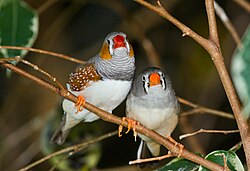
Birds exhibit high rates of EPC. Zebra finches, for instance, engage in extra-pair courtship; studies show that a single copulation with an extra-pair male can result in a disproportionately high number of fertilized eggs. The rate of EPP varies wildly: eastern bluebirds show roughly 35% EPP, while the New Zealand hihi (stitchbird) can reach up to 79%.
![In tree swallow (Tachycineta bicolor) nests, most broods contain at least one extra-pair egg.[1]](/images/b5/99/b599a43c90bbe58aa6d0bdbc3e8f57c1e55066c8e769f90a44cc7d284ebba6a3.jpg)
Physical traits often play a role in selection. In swallows, males with longer tails are more frequently involved in EPCs. Similarly, in black-capped chickadees, extra-pair males typically hold a higher social rank than the within-pair males.
Observations in Mammals
While rare in mammals overall, social monogamy is more common in treeshrews and primates (approximately 62% of 177 classified species). The white-handed gibbon and large treeshrew both exhibit EPC. In large treeshrews, nearly half of the offspring are sired by extra-pair males, partly because the species forage and sleep alone, rendering mate guarding ineffective.

Research indicates that social structure is a better predictor of EPC rates than the type of pair bond. Species living in solitary or family structures tend to have higher EPC rates than those living in strict pairs.
Summary of EPC Dynamics
| Strategy/Species | Primary Mechanism | Key Outcome/Observation |
|---|---|---|
| Mate Guarding | Physical proximity/monitoring | Reduced EPP in Seychelles warblers |
| Sneaks & Guarders | Opportunistic mating (e.g., Bluegill sunfish) | Sneaks can fertilize more eggs than guards |
| Bird Selection | Trait-based (e.g., Tail length in swallows) | Higher rank/better traits correlate with EPC success |
| Mammalian Structure | Social organization (e.g., Large treeshrew) | Solitary foraging increases EPC probability |
Frequently Asked Questions
What is the difference between social and genetic monogamy?
Social monogamy refers to a behavioral pair bond where two individuals share a territory and raise offspring together. Genetic monogamy occurs when those same individuals mate exclusively with each other, meaning all offspring are sired by the social partner.
Why would a female animal seek a mate outside her pair bond?
Theories include the pursuit of "good genes" to improve offspring fitness or genetic constraints known as antagonistic pleiotropy, where the genes driving the behavior provide a benefit to the male that outweighs the cost to the female.
How does sperm competition work in "sneaks and guarders" systems?
In these systems, guarders provide parental care and nest protection, while sneaks use mimicry or stealth to ejaculate in the female's reproductive tract, competing directly with the guarder's sperm to fertilize the eggs.
Which bird species has one of the highest rates of extra-pair paternity?
The New Zealand hihi, also known as the stitchbird (Notiomystis cincta), exhibits some of the highest levels, with up to 79% of offspring sired by extra-pair males.
Does social structure affect EPC in mammals?
Yes. EPC rates are generally lower in mammal species that live in constant pairs compared to those that live in solitary or family-based social structures.