Evolutionary Taxonomy: Principles of Biological Classification and Serial Descent
Evolutionary taxonomy, also known as evolutionary systematics or Darwinian classification, is a sophisticated approach to biological classification. Unlike simple cataloging, it seeks to organize organisms by integrating three critical dimensions: phylogenetic relationships (shared descent), progenitor-descendant relationships (serial descent), and the overall degree of evolutionary change. This methodology allows scientists to analyze entire taxa—groups of organisms—to infer how one group may have given rise to another.
While traditional Linnaean taxonomy focuses on creating orderly lists, evolutionary taxonomy constructs evolutionary trees. A key distinction lies in its treatment of descendants. In strict phylogenetic nomenclature, a group must include an ancestor and all its descendants. Evolutionary taxonomy, however, permits paraphyletic taxa—groups where some descendants are excluded. For example, in this framework, dinosaurs are viewed as the ancestors that gave rise to birds, rather than a group that includes birds.
Key Facts
- Core Focus: Combines shared descent, serial descent, and evolutionary change to classify life.
- Paraphyly: Allows for groups to be excluded from parent taxa (e.g., dinosaurs as ancestors to birds).
- Historical Roots: Influenced by early thinkers like Lamarck and Erasmus Darwin before being solidified by the modern evolutionary synthesis of the 1940s.
- Visual Tools: Utilizes spindle diagrams (Romerograms) and Besseyan cacti to map evolutionary history.
- Modern Shift: Recent decades have seen a move toward molecular phylogeny and Hennig's phylogenetic systematics.
The Origin and Evolution of Taxonomic Thought
The transition from static lists to evolutionary trees began in the late 18th century. Long before Charles Darwin published On the Origin of Species, Pierre-Louis Moreau de Maupertuis suggested common descent in 1751. This idea gained traction through Erasmus Darwin's Zoönomia (1796) and Jean-Baptiste Lamarck's Philosophie Zoologique (1809).
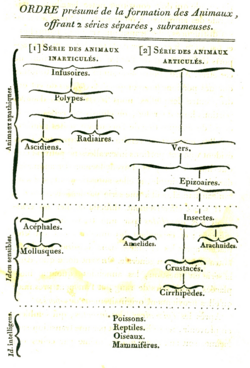
By 1844, Robert Chambers' Vestiges of the Natural History of Creation popularized these concepts in the English-speaking world. While Darwin's own work focused on the general principles of evolution using theoretical examples, later scientists like Thomas Henry Huxley applied these ideas to the fossil record. Huxley used Archaeopteryx and Hesperornis to argue that birds descended from dinosaurs, establishing the hallmark of evolutionary taxonomy: the concept of one group "giving rise to" another.
Modern Methods in Evolutionary Systematics
In recent years, researchers have sought to merge classical taxonomy with modern DNA analysis and cladistics. Cladistics is a method of grouping taxa by shared traits using a dichotomous branching model. However, critics like Richard H. Zander argue that cladistics only shows shared ancestry, not the serial ancestry (the direct line from ancestor to descendant) required for a true evolutionary tree.
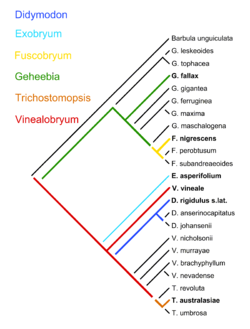
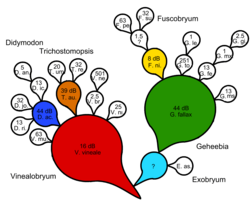
To address these limitations, Zander proposes a pluralistic systematics. He argues that because evolution is not always dichotomous (splitting into two), a different visual representation is needed. The Besseyan cactus (or commagram) is designed to show both shared and serial ancestry. In this model, generalized ancestral taxa are identified, and specialized descendants are mapped as branching off the lineage.
Comparing Systematic Approaches
| Method | Primary Basis | View on Paraphyly | Key Visual Tool |
|---|---|---|---|
| Linnaean Taxonomy | Physical characteristics | Not applicable (list-based) | Hierarchical lists |
| Evolutionary Taxonomy | Shared & serial descent | Accepted as signal of descent | Spindle diagrams / Cacti |
| Cladistics | Shared derived traits | Rejected | Cladograms |
| Phylogenetics | Molecular/DNA sequences | Generally rejected | Molecular trees |
Mapping the Tree of Life
As paleontology advanced in the 19th and 20th centuries, scientists began linking fossil groups to map the history of life. This often involved the use of spindle diagrams, also known as Romerograms (named after Alfred Romer). In these diagrams, the width of the spindle represents the abundance of a taxon (such as the number of families) plotted against time.
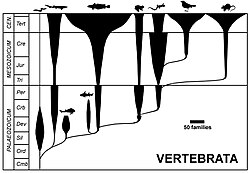
While vertebrate and plant sequences were mapped relatively early, the integration of these into a single "Tree of Life" only became possible with the mid-20th-century advancements in biochemistry and microbiology.
Terminological Distinctions
A significant point of contention between evolutionary taxonomy and phylogenetic systematics is the definition of monophyletic. In evolutionary taxonomy, a group is monophyletic if it is derived from a single common ancestor. In phylogenetic nomenclature, a group is only monophyletic if it includes the ancestor and all its descendants (a concept sometimes called holophyletic).
For example, amphibians are considered monophyletic in evolutionary taxonomy because they evolved from fish only once. However, they are not monophyletic in phylogenetic taxonomy because the amniotes (reptiles, birds, and mammals) evolved from amphibian ancestors but are not classified as amphibians.
Frequently Asked Questions
What is the difference between evolutionary taxonomy and cladistics?
Evolutionary taxonomy considers both shared ancestry and the degree of evolutionary change, allowing for paraphyletic groups. Cladistics focuses strictly on shared derived traits and requires that all descendants of a common ancestor be included in a group.
What is a paraphyletic taxon?
A paraphyletic taxon is a group that includes a common ancestor but not all of its descendants. An example is the traditional classification of dinosaurs, which excludes birds despite birds being descendants of dinosaurs.
What is a Romerogram?
A Romerogram is a spindle diagram used to show the evolution and distribution of taxa over time. The width of the spindles typically indicates the diversity or abundance of the group, such as the number of families present.
How does the Besseyan cactus differ from a cladogram?
While a cladogram shows branching based on shared traits (dichotomies), a Besseyan cactus (or commagram) is designed to represent both shared and serial ancestry, identifying generalized ancestors and the specialized descendants that evolved from them.
Why is DNA analysis important to modern systematics?
Modern genomics allows scientists to use molecular phylogeny and multiple sequence alignment to track evolutionary changes with high precision, often guiding research across all branches of biology.