Evolutionary Radiation: The Mechanisms of Biological Diversification
In the history of life on Earth, biological diversity does not always increase at a steady pace. Instead, nature often experiences bursts of rapid expansion known as evolutionary radiation. This process occurs when there is a significant increase in taxonomic diversity driven by elevated rates of speciation—the formation of new and distinct species in a clade.
While these radiations increase the number of species, they may or may not lead to an increase in morphological disparity, which refers to the variety of physical forms and structures within a group. When a radiation is exceptionally large and occurs within a short geologic timeframe, such as a specific epoch or period, scientists refer to it as an "explosion."
Key Facts
- Evolutionary radiation is an increase in taxonomic diversity caused by high speciation rates.
- Adaptive radiations are rapid diversifications driven by a lineage adapting to its environment.
- Explosions are large-scale radiations occurring over relatively short geologic timescales.
- Geographic radiations are driven by isolation and new environmental opportunities.
- Homeomorphy occurs when unrelated species evolve similar forms due to similar selective pressures (convergent evolution).
Types of Evolutionary Radiation
Not all radiations are driven by the same biological or environmental pressures. Researchers categorize these events based on their drivers and outcomes.
Adaptive vs. Nonadaptive Radiation
Adaptive radiation occurs when a clade's speciation rate increases alongside the divergence of morphological features directly related to ecological habits. These events typically happen in sympatry (where species overlap geographically) rather than being driven by geographic barriers. They are often triggered by the acquisition of a "key trait" that allows the organism to exploit new resources.
Conversely, nonadaptive radiations encompass diversifications that do not follow this ecological pattern. If a specific mechanism is known, such as increasing opportunities for geographic isolation, the event is more precisely termed a geographic radiation.
Concordant and Discordant Patterns
- Concordant radiations: Both taxonomic diversity (number of species) and morphological disparity (variety of forms) increase at a similar rate.
- Discordant radiations: Diversity and disparity increase independently of one another.
In cases where the diversification mechanism is ambiguous but the species remain closely related, biologists may use terms like species flock, species complex, or species radiation.
Historical Examples in the Fossil Record
Paleontologists frequently study marine invertebrate fossils to understand radiations because they are more numerous and easier to collect than large land vertebrates. For example, brachiopods experienced major bursts of radiation during the Early Cambrian, Early Ordovician, and again in the Carboniferous and earliest Permian.
These brachiopods often exhibited homeomorphy, where different species independently evolved similar morphologies and lifestyles. This is a result of convergent evolution, where similar selective pressures lead different organisms to develop similar adaptations.
Other notable fossil examples include:
- Trilobites: Rapidly evolved during the Cambrian into forms that occupied niches similar to modern crustaceans.
- Ammonites: Repeatedly re-diversified following a series of extinction events.
Major Radiations Across Earth's History
From the depths of the ocean to the colonization of land, several "explosions" have shaped modern biodiversity.
| Event/Group | Approximate Timing / Context | Key Characteristic |
|---|---|---|
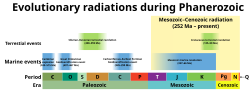
| Cambrian Explosion | Early Paleozoic | Rapid appearance of most major animal phyla. |
| Placental Mammals | Post-Cretaceous (66 Ma) | Small insectivores evolved into whales, bats, and horses by the Eocene. |
| Insects | Since the Devonian (400 Ma) | Continuous diversification with few interruptions. |
| Angiosperms | Cretaceous | Rapid radiation of flowering plants. |
| Land Plants | Post-colonization of land | Diversification following the move from aquatic environments. |
Other significant events include the Avalon Explosion, the Great Ordovician Biodiversification Event, the Carboniferous-Earliest Permian Biodiversification Event, and the Mesozoic–Cenozoic Radiation.
Recent and Modern Radiations
Evolutionary radiation is not limited to the distant past; it continues in modern ecosystems. Cichlid fish in Lake Malawi are a primary example, having evolved into diverse forms including algal grazers, snail eaters, and filter feeders.
Similarly, Caribbean anoline lizards demonstrate adaptive radiation through ecological specialization. In the plant kingdom, grasses have radiated in parallel with the evolution of grazing herbivores, such as antelope and horses.
Frequently Asked Questions
What is the difference between an evolutionary radiation and an explosion?
An evolutionary radiation is a general increase in taxonomic diversity. An "explosion" is a specific type of radiation that is significantly large and occurs within a relatively short geologic timeframe, such as a single period or epoch.
How does adaptive radiation differ from geographic radiation?
Adaptive radiation is driven by ecological adaptation and often occurs in sympatry (the same area), whereas geographic radiation is driven by geographic isolation and the creation of new physical opportunities for speciation.
What is homeomorphy in the context of radiation?
Homeomorphy occurs when different species evolve similar physical forms independently. This is usually the result of convergent evolution, where different lineages face similar environmental pressures and develop similar solutions.
Why are marine invertebrates often used to study these events?
Marine invertebrate fossils are typically much more numerous and easier to collect in large quantities than the fossils of large land vertebrates, providing a more statistically robust record for paleontologists.
Can a radiation increase the number of species without changing their appearance?
Yes. This is known as a discordant radiation, where taxonomic diversity (the number of species) increases, but morphological disparity (the variety of physical forms) does not increase at the same rate.