Estonian National Flag: A History of Symbolism and Sovereignty
The blue, black, and white tricolour of Estonia is more than just a national symbol; it is a visual chronicle of the nation's struggle for identity and independence. From its origins in student circles to its role as a defiant emblem against occupation, the flag represents the enduring spirit of the Estonian people.
The Academic Origins of the Tricolour
The tradition of using specific colours to represent Baltic provinces began in the 1820s at the University of Tartu (then known as Dorpat). German-speaking student corporations, or corps, were established for the provinces of Estonia, Livonia, and Curonia. Each group adopted its own set of "colours," which eventually served as informal visual representations of their respective regions.
These colour combinations were often viewed with suspicion by the Russian Empire. Authorities banned the public display of these colours during several periods: between 1821 and 1862, from 1887 to 1904, and finally during a comprehensive anti-German propaganda campaign in 1915 following the start of World War I.
In 1870, the first Estonian-speaking student organisation—the predecessor to the Estonian Students' Society—was founded at the University of Tartu. By 1881, this group adopted the blue, black, and white tricolour. Unlike the earlier German corps, the Estonian students ascribed specific symbolic meanings to each of their three colours. The first physical tricolour flag was crafted in the spring of 1884 and consecrated in Otepää on June 4 of that year.
The Path to National Recognition
As Estonian nationalism grew at the turn of the 20th century, the student flag transitioned from an academic symbol to the de facto flag of the Estonian-speaking people. By the time the Estonian Declaration of Independence was issued on February 23–24, 1918, it was already widely recognized as the rahvuslipp, or "the nation's flag."
The Estonian Provisional Government formally designated the tricolour as the national flag on November 21, 1918. Its most symbolic display occurred on December 12, 1918, when it was first raised atop the Pikk Hermann tower in Tallinn. This status was later codified into law by the Estonian parliament on July 16, 1922.
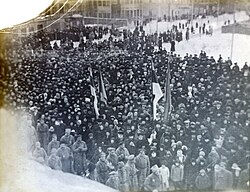
Eras of Occupation and Suppression
The flag's presence on the Pikk Hermann tower became a barometer for the country's sovereignty. Following the Soviet invasion on June 16–17, 1940, occupation authorities banned the flag. It was removed from the tower on June 21, 1940, and briefly flown alongside the red Soviet flag on June 22 before being completely replaced by the Soviet Union's red flag on July 27, 1940.
During the German occupation (1941–1944), the tricolour was used freely by the people as a national symbol. However, the Nazi regime did not recognize Estonia as an independent state, meaning only the German war ensign flew from the Pikk Hermann tower. After the German retreat in September 1944, the Estonian flag returned to the tower for only a few days before the Soviet army reconquered Tallinn on September 22, 1944.
For the next several decades, the blue-black-white flag was erased from public view. Under Soviet law, the display or distribution of the flag was a punishable crime. This repression continued until the late 1980s, with a pivotal moment occurring on October 21, 1987, when Soviet forces refrained from removing the flag during a public event for the first time.
The Restoration of the National Symbol
The tide turned in October 1988, when local authorities officially permitted the public use of the tricolour once again. On February 23, 1989, the Soviet red flag was permanently lowered from the Pikk Hermann tower. The following morning, February 24, 1989—marking the 70th anniversary of the Declaration of Independence—the blue-black-white flag was hoisted in its place.
The flag was formally redeclared as the national flag on August 7, 1990, shortly before Estonia fully restored its independence.
Key Facts
- Colours: Blue, black, and white.
- Origin: Adopted by an Estonian student organisation at the University of Tartu in 1881.
- First Consecration: June 4, 1884, in Otepää.
- Official Adoption: Formally designated by the Provisional Government on November 21, 1918.
- Primary Landmark: The Pikk Hermann tower in Tallinn is the most symbolic site for the flag's display.
- Legal Confirmation: Official status was confirmed by parliamentary law on July 16, 1922.
| Year | Event | Status of Flag |
|---|---|---|
| 1881 | Adopted by Estonian students | Student symbol |
| 1918 | Declaration of Independence | De facto national flag |
| 1922 | Parliamentary law passed | Legally confirmed national flag |
| 1940 | Soviet occupation | Banned/Replaced by red flag |
| 1941-1944 | German occupation | Used by people; not recognized by state |
| 1989 | Return to Pikk Hermann tower | Restored public symbol |
| 1990 | Formal redeclaration | Official national flag |
Frequently Asked Questions
Where did the blue, black, and white colours originate?
The colours were adopted in 1881 by the predecessor of the Estonian Students' Society at the University of Tartu, following a tradition of student corporations using specific colours to represent Baltic provinces.
What is the significance of the Pikk Hermann tower?
Located in Tallinn, the Pikk Hermann tower is the most symbolic site for the Estonian flag. Its presence or absence from the tower has historically signaled whether Estonia was independent or under foreign occupation.
Was the flag used during the German occupation?
Yes, the tricolour was widely and freely used by the Estonian people between 1941 and 1944. However, the Nazi authorities did not recognize Estonia as an independent state and flew only the German war ensign from the Pikk Hermann tower.
When did the flag officially become the national symbol?
It was formally designated as the national flag by the Estonian Provisional Government on November 21, 1918, and its status was later reconfirmed by law on July 16, 1922.
How was the flag treated during the Soviet era?
The flag was banned starting in 1940, and its display or distribution was a punishable crime under Soviet law until the late 1980s.