Baltic States Re-occupation and the Struggle for Independence (1944–1993)
During the closing stages of World War II, the Baltic states—Estonia, Latvia, and Lithuania—became the center of a geopolitical tug-of-war. In 1944, the Soviet Union launched a massive military campaign to re-annex these territories, ending a period of German occupation but initiating a decades-long struggle for sovereignty. While local resistance movements fought on the ground, the fate of the region was largely decided in secret meetings between the world's most powerful leaders.
Soviet Offensives and Re-occupation
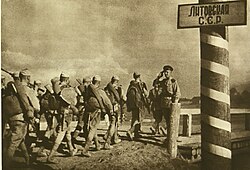
Following the end of the siege of Leningrad in February 1944, Soviet forces pushed toward the Estonian border. After an initial failure to break through, the USSR launched the Tartu Offensive on August 10 and the broader Baltic Offensive on September 14, deploying 1.5 million troops. In response, the German Army issued Operation Aster to cover their withdrawal from the region.
As the Red Army regained control of the Baltic capitals, the NKVD (the Soviet secret police) immediately moved to secure the territory. In Estonia, the NKVD focused on preventing citizens from escaping to Sweden or Finland. In Lithuania, the Soviets introduced immediate conscription after occupying Vilnius in July 1944; however, only 14% of eligible men responded, leading the Soviets to execute over 400 draft evaders. By the end of 1945, 82,000 Lithuanians had been conscripted.
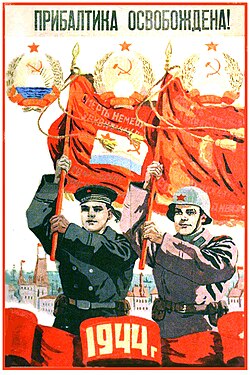
The military campaign culminated in the encirclement of retreating Wehrmacht and Latvian forces in the Courland Pocket, where they remained until the final German surrender.
The Fight for Sovereignty
Throughout the German occupation, Baltic leaders sought ways to restore their independence, hoping that by resisting the Soviets, they could attract support from Western Allies.
Estonia's National Committee
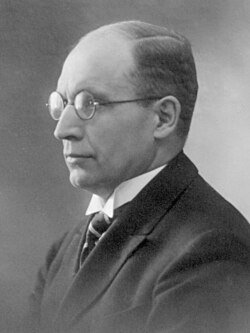
The National Committee of the Republic of Estonia was founded on March 23, 1944. Many Estonians who refused to align with the Nazis joined the Finnish Defence Forces, specifically the Infantry Regiment 200, known as the "Finnish Boys." Under the leadership of Prime Minister Jüri Uluots, Estonia attempted to establish a government led by Otto Tief in September 1944. They declared neutrality in English via radio and raised the Estonian flag in Tallinn, though the Soviets removed it four days later.
Latvia's Central Council
In Latvia, the Latvian Central Council was formed in August 1943. On March 17, 1944, 189 leaders signed a memorandum calling for the restoration of de facto sovereignty (actual control) to prevent Soviet re-occupation. On September 8, 1944, they adopted a Declaration on the Restoration of the Republic of Latvia, designating the Satversme as the fundamental law.
Lithuania's Resistance
Lithuania saw early attempts at independence in 1941, when locals overthrew Soviet rule just before German arrival. Later, the Supreme Committee for the Liberation of Lithuania emerged in November 1943 to coordinate resistance efforts.
The Role of the Western Allies
Despite the Welles Declaration of 1940, in which the U.S. refused to recognize the forcible incorporation of the Baltic states into the USSR, the Western Allies eventually prioritized their relationship with Joseph Stalin over Baltic independence.
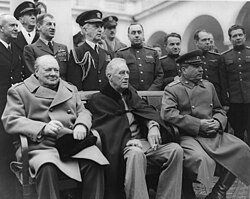
British Prime Minister Winston Churchill and U.S. President Franklin D. Roosevelt viewed the Baltic states as disposable assets to ensure Soviet cooperation against Nazi Germany. In 1943, Roosevelt told a confidante that European people would simply have to endure Russian domination. This sentiment was solidified during the Yalta Conference in February 1945, which paved the way for Soviet hegemony in Eastern Europe.
While the West maintained a policy of not recognizing the annexation de jure (by law), they accepted it de facto (in practice). This left the Baltic states to maintain their continuity through diplomatic services in exile in the U.S. and UK until the 1990s.
Key Facts
- Military Force: The Soviet Baltic Offensive utilized 1.5 million troops to re-occupy the region.
- Resistance: The Estonian Forest Brothers and Latvian partisans fought against the NKVD post-1945.
- Diplomacy: Latvia's diplomatic service in exile, led by Ambassador Kārlis Zariņš, remained the only continuous government body from 1940 to 1991.
- Western Policy: The U.S. followed the Stimson Doctrine via the Welles Declaration to officially deny the legality of the Soviet annexation.
- Final Withdrawal: The last combat units of the Russian Armed Forces left Lithuania on August 31, 1993.
| Country | Key Organization | Primary Goal | Outcome |
|---|---|---|---|
| Estonia | National Committee of the Republic of Estonia | Neutrality and restoration of statehood | Brief government under Otto Tief; later government-in-exile. |
| Latvia | Latvian Central Council | De facto sovereignty and international recognition | Diplomatic service in exile maintained continuity. |
| Lithuania | Supreme Committee for the Liberation of Lithuania | Restoration of independence | Active resistance and diplomatic presence in US/UK. |
Frequently Asked Questions
What was the Baltic Offensive?
The Baltic Offensive was a major Soviet military operation launched in September 1944 involving 1.5 million troops to reclaim Estonia, Latvia, and Lithuania from German occupation.
Who were the Forest Brothers?
The Forest Brothers were Estonian resistance fighters established in 1941 who conducted a campaign against Soviet senior armed forces and NKVD officers following the re-occupation.
Why didn't the US and UK help the Baltic states?
The Western Allies prioritized the defeat of Nazi Germany and viewed the Baltic territories as necessary concessions to ensure Joseph Stalin's cooperation in the war effort.
What is the difference between de facto and de jure recognition?
De facto recognition means acknowledging a situation as it exists in reality (the Soviets controlled the land), while de jure recognition means acknowledging a situation as legally valid (the West refused to legally accept the annexation).
When did the Russian military finally leave Lithuania?
The last combat unit of the Russian Armed Forces departed Lithuanian territory on August 31, 1993, with the final military objects handed over on November 26, 1993.