Post-Soviet States: Navigating the Legacy of the Former USSR
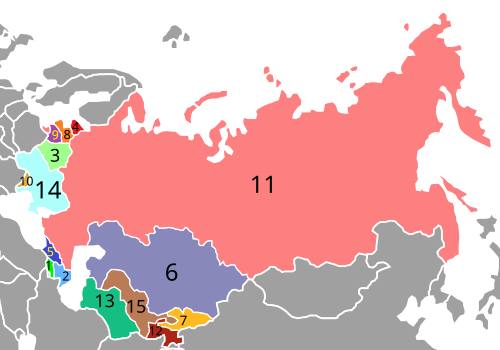
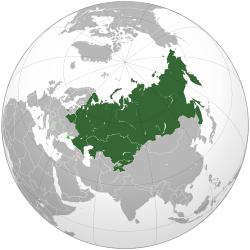
The dissolution of the Soviet Union in 1991 marked a seismic shift in global geopolitics, giving rise to 15 independent sovereign states. These post-Soviet states emerged from the former Union Republics, transitioning from constituent parts of a single communist superpower to distinct nations with unique political, economic, and social trajectories.
While these nations share a common history, their paths since 1991 have diverged significantly. From the Baltic states' integration into Western institutions to the complex regional dynamics in Central Asia and the Caucasus, the landscape of the former Soviet territory remains one of the most intricate areas of modern international relations.
Key Facts
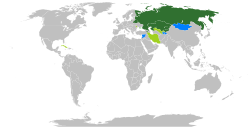
- Total States: 15 independent countries emerged from the dissolution of the USSR.
- Succession: Russia is recognized as the sole continuator state of the Soviet Union, maintaining its UN and UNSC membership.
- The Baltic Path: Estonia, Latvia, and Lithuania pursued near-total disengagement from the Russian sphere, joining the EU and NATO in 2004.
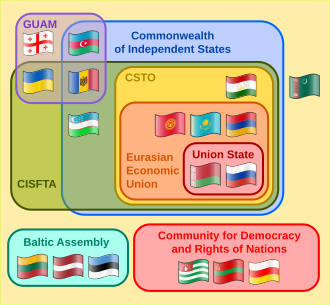
- Regional Blocs: Integration varies between the Commonwealth of Independent States (CIS) and the Eurasian Economic Union (EAEU).
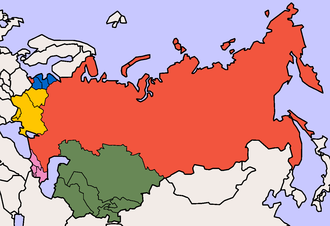
- Geographic Diversity: The region spans Eastern Europe, the South Caucasus, and Central Asia.
The Emergence of Sovereignty
Before 1991, these territories existed as Union Republics, such as the Russian SFSR or the Ukrainian SSR. The process of independence began in earnest with the Baltic states—Estonia, Latvia, and Lithuania—which proclaimed the restoration of their national independence in 1990. They asserted legal continuity from their original pre-annexation status, a stance that facilitated their eventual integration into Western structures.
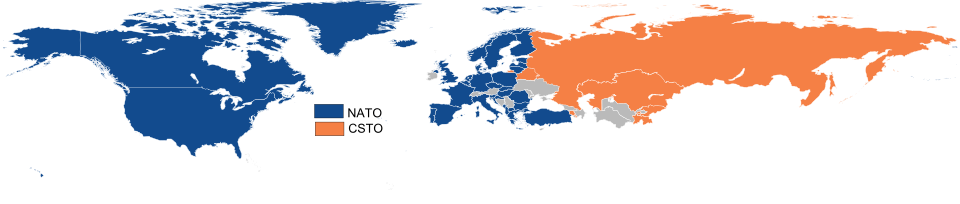
Following the Baltic secession, the remaining 12 republics moved toward independence. Most participated in the formation of the Commonwealth of Independent States (CIS), a regional organization designed to manage the transition. However, the level of cooperation with Russia varies; while many joined the Russian-led Collective Security Treaty Organization (CSTO), others, like Georgia and Ukraine, have sought closer ties with NATO due to regional tensions.
Regional Categorization and Geopolitics
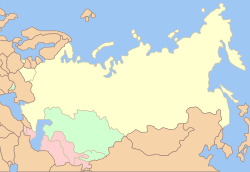
To understand the post-Soviet landscape, it is helpful to categorize the states by their geographic and political alignments:
The Baltic States
Estonia, Latvia, and Lithuania are characterized by their strong integration with the European Union (EU) and NATO. They represent the most successful shift away from the former Soviet sphere of influence.
Eastern Europe
This group includes Belarus, Moldova, and Ukraine. These nations occupy a critical space between Western Europe and the Russian Federation, often navigating complex political transitions and security challenges.
The South Caucasus
Armenia, Azerbaijan, and Georgia form this vital corridor. The region is marked by significant geopolitical activity and various territorial disputes.
Central Asia
Comprising Kazakhstan, Kyrgyzstan, Tajikistan, Turkmenistan, and Uzbekistan, this region is characterized by vast territories and varying degrees of political governance. Many of these states maintain close economic and security ties through regional organizations.
![Life expectancy and healthy life expectancy in post-Soviet countries in 2019[73]](/images/85/b4/85b4d36b28e8b1ad64596056178a4f4055d19dc0723e1ae87c50d53c83005134.png)
Economic and Demographic Landscapes
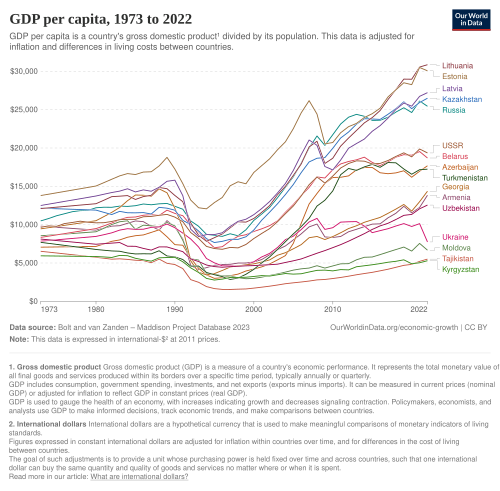
The economic recovery of post-Soviet states has been uneven. Since the 1990s, many nations have experienced a "turnaround year" where GDP transitioned from decline to growth. For instance, Kazakhstan and Azerbaijan saw significant economic shifts in the mid-to-late 1990s.
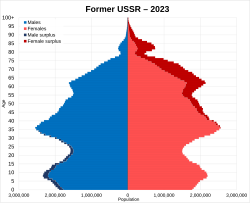
Demographically, the region shows diverse trends. While some nations maintain large urban population centers like Moscow or Kyiv, others face different challenges regarding life expectancy and population structures. The transition from the Soviet ruble to various national currencies—such as the Kazakhstani tenge or the Armenian dram—was a fundamental step in establishing economic sovereignty.
| Country | Capital | Form of Government | HDI (2025) | Population (2025) |
|---|---|---|---|---|
| Estonia | Tallinn | Unitary parliamentary republic | 0.905 | 1,369,995 |
| Kazakhstan | Astana | Semi-presidential republic | 0.837 | 20,426,568 |
| Russia | Moscow | Federal semi-presidential republic | 0.832 | 146,028,325 |
| Ukraine | Kyiv | Unitary semi-presidential republic | 0.779 | 32,862,000 |
| Uzbekistan | Tashkent | Unitary presidential republic | 0.740 | 37,859,698 |
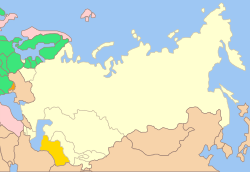
Integration and International Organizations
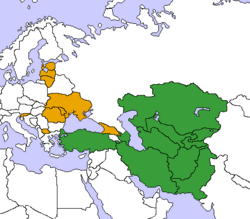
Post-Soviet states participate in a variety of supranational organizations, which can be divided into political, security, and economic blocs.
Economic Unions
The Eurasian Economic Union (EAEU) serves as a major economic integration project, with members including Russia, Belarus, Kazakhstan, Armenia, and Kyrgyzstan. This bloc aims to facilitate the movement of goods, services, and capital across borders.
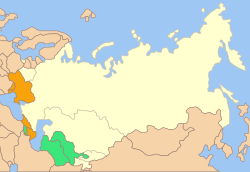
Security Alliances
The Collective Security Treaty Organization (CSTO) is a primary security alliance in the region, largely led by Russia. In contrast, the Baltic states and several other nations have prioritized membership in NATO to ensure collective defense through Western frameworks.
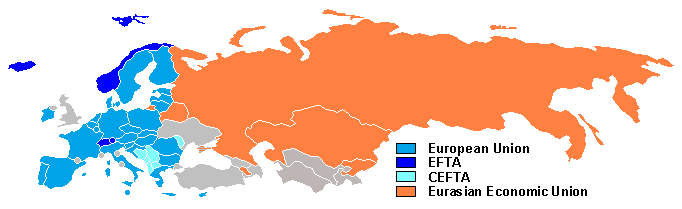
Frequently Asked Questions
What is the difference between a continuator state and a successor state?
In the context of the Soviet Union, Russia is recognized as the continuator state, meaning it inherits the legal identity and international obligations (such as UN membership) of the USSR. The other 14 states are considered successor states, meaning they succeeded their specific Union Republics but not the Soviet Union as a whole.
Which post-Soviet states are members of the European Union?
The three Baltic states—Estonia, Latvia, and Lithuania—are members of the European Union, having joined in 2004.
What is the "near abroad"?
The term "near abroad" (blizhneye zarubezhye) is sometimes used in Russia to refer to the independent states that were formerly part of the Soviet Union.
How many countries are in the Commonwealth of Independent States (CIS)?
As of late 2024, nine countries are full members of the CIS. Turkmenistan is an associate member, and Georgia left the organization in 2009.
What are the main regional groupings of these states?
The states are generally grouped into the Baltics, Eastern Europe, the South Caucasus, and Central Asia.