Eurasia: The World's Largest Landmass and Geopolitical Powerhouse
Spanning a vast expanse of the Earth's surface, Eurasia represents a massive continuous landmass that serves as the heart of human civilization. Covering approximately 55 million square kilometers (21 million square miles), it accounts for roughly 36.2% of the planet's total land area. As of 2025, this region is home to a staggering 5.6 billion people, representing about 70% of the global population.
From its ancient geological formations to its modern role as a center of global economic and political influence, Eurasia is a complex tapestry of diverse cultures, extreme landscapes, and shifting borders. Whether viewed through the lens of geography, history, or geopolitics, the continent remains central to the story of humanity.
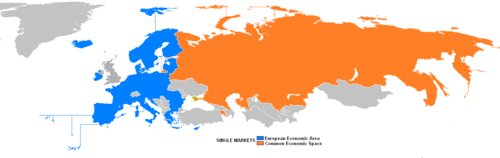
Key Facts
- Total Area: 55,000,000 km² (21,000,000 sq mi)
- Population: 5.6 billion (as of 2025)
- Population Density: 102/km² (260/sq mi)
- Geological Origin: Formed 375–325 million years ago
- Global Share: Contains ~70% of the human population
- Time Zones: UTC−1 to UTC+12
Geography and Geology
Eurasia is part of the larger Afro-Eurasia landmass. Historically and culturally, scholars often divide the region into Western Eurasia and Eastern Eurasia. The landmass is incredibly diverse, containing some of the world's most extreme topographical features.
Geological Formation
In geological terms, Eurasia is often debated as a single rigid mega block. It began forming between 375 and 325 million years ago through the merging of Siberia, Kazakhstania, and Baltica. This combined mass eventually joined with Laurentia (North America) to form Euramerica.
Mountain Ranges and Peaks
Eurasia is home to the world's most formidable mountains. Remarkably, all 100 of the highest mountains on Earth are located here. The most prominent ranges include the Himalayas, Karakoram, Hindu Kush, Pamir, Hengduan, and Tian Shan. All peaks exceeding 7,000 meters are found within these ranges or the Transhimalaya.
The Alpide belt, a massive mountain system, stretches 15,000 km across southern Eurasia, reaching from the Iberian Peninsula in Western Europe to Java in Maritime Southeast Asia. Other significant ranges include the Caucasus, Altai, and Scandinavian Mountains.
Major River Systems
The continent is carved by massive river systems that have sustained civilizations for millennia. The following table highlights the longest rivers in Eurasia, all exceeding 3,000 km in length:
| Rank | River | Countries | Length (km) | Length (mi) |
|---|---|---|---|---|
| 1 | Yangtze | China | 6,300 | 3,915 |
| 2 | Yellow River | China | 5,464 | 3,395 |
| 3 | Mekong | China, Myanmar, Laos, Thailand, Cambodia, Vietnam | 4,909 | 3,050 |
| 4 | Lena | Russia | 4,294 | 2,668 |
| 5 | Irtysh | Mongolia, China, Kazakhstan, Russia | 4,248 | 2,640 |
| 6 | Brahmaputra | China, India, Bangladesh | 3,969 | 2,466 |
| 7 | Ob | Russia | 3,700 | 2,299 |
| 8 | Volga | Russia | 3,531 | 2,194 |
| 9 | Yenisey | Mongolia, Russia | 3,487 | 2,167 |
| 10 | Indus | China, India, Pakistan | 3,150 | 1,957 |
Historical Evolution
New connections between Eurasian subregions emerged significantly during the Age of Discovery. In the 1490s, Iberian explorers discovered new maritime routes, and the 1869 completion of the Suez Canal facilitated direct passage through the Indo-Mediterranean. This era paved the way for Western European "New Imperialism," which dominated much of Africa and Asia until the mid-20th century.
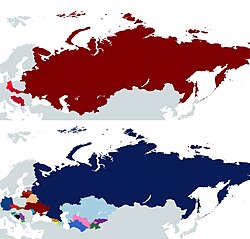
In the 20th century, the communist presence—driven primarily by the Soviet Union—dominated much of the continent until the end of the Cold War in 1991.
Geopolitics and Regional Alliances
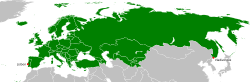
Because Eurasia contains the majority of the world's physical wealth and approximately 75% of the world's people, it is a focal point of global strategy. Geopolitician Zbigniew Brzezinski noted that controlling Eurasia would grant dominance over two of the world's most economically productive regions.
Key Organizations
Various alliances have formed to manage the economic and security interests of the region:
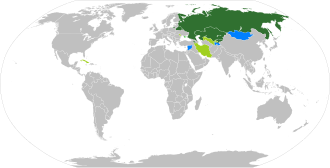
- Asia-Europe Meeting (ASEM): An organization involving most Asian and European countries, held every two years since 1996.
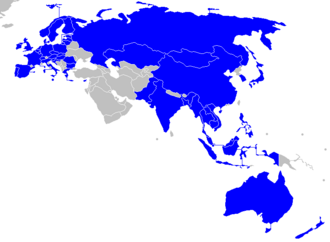
ASEM Partners - Commonwealth of Independent States (CIS): A political and economic association of 10 post-Soviet republics formed after the dissolution of the Soviet Union.
- Eurasian Economic Union (EAEU): An economic union established in 2015 including Russia, Armenia, Belarus, Kazakhstan, and Kyrgyzstan.
- Shanghai Cooperation Organization (SCO): A major political, economic, and security alliance covering three-fifths of the continent.
The Greater Eurasian Partnership
An initiative proposed by Russian President Vladimir Putin in 2015, the Greater Eurasian Partnership aims to create a broad integration framework. Beyond trade and logistics, recent discussions have focused on forming a Eurasian security architecture to create an equal and indivisible system of cooperation.
Frequently Asked Questions
What is the difference between Eurasia and Afro-Eurasia?
Eurasia refers specifically to the combined landmass of Europe and Asia. Afro-Eurasia is a broader term that includes Africa, as it is connected to Eurasia via the Suez Peninsula.
How many people live in Eurasia?
As of 2025, the estimated population of Eurasia is 5.6 billion people.
What are the highest mountains in Eurasia?
The highest mountains are located in the Himalayas, Karakoram, Hindu Kush, Pamir, Hengduan, and Tian Shan ranges. All of the world's peaks above 7,000 meters are located in these Eurasian ranges.
What is the Eurasian Economic Union?
The Eurasian Economic Union is an economic union established in 2015 to promote integration among its members, which include Russia, Armenia, Belarus, Kazakhstan, and Kyrgyzstan.
Is Eurasia a single continent?
While many geographers treat Europe and Asia as separate continents, others consider them a single continent known as Eurasia. In some educational systems, Eurasia is taught as one of the five primary continents.