Estadio Alberto José Armando: The History and Legacy of La Bombonera
In the heart of the La Boca district in Buenos Aires stands one of the most intimidating and iconic venues in world football: the Estadio Alberto José Armando. More famously known as La Bombonera (The Chocolate Box), this stadium is not merely a sports venue but a symbol of passion for Club Atlético Boca Juniors and a landmark of Argentine culture.
From its unique architectural shape to its thunderous atmosphere, La Bombonera has hosted some of the most significant moments in South American football. Its journey from a railway shunting yard to a global sporting cathedral is a testament to the club's enduring spirit.
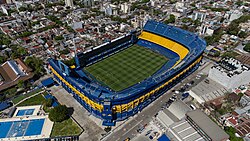
Key Facts
- Official Name: Estadio Alberto José Armando.
- Nickname: La Bombonera (The Chocolate Box).
- Capacity: 58,305 spectators.
- Opened: May 25, 1940.
- Location: Brandsen 805, La Boca, Buenos Aires, Argentina.
- Primary Tenant: CA Boca Juniors.
The Origins of the Stadium
Boca Juniors spent years searching for a permanent home, moving through various locations including Dársena Sur and Isla Demarchi. By 1924, the club had settled at the intersection of Brandsen and Del Crucero streets, where they built a stadium with wooden grandstands.
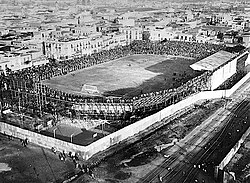
Financial struggles in the early 1920s led to a successful fundraising drive, allowing the club to eventually purchase land from Ferro Carril del Sud. This land, formerly used as a shunting yard (a railway area where cars are sorted), provided the foundation for the current stadium. In 1931, the steering committee acquired the land from the Municipality of Buenos Aires for A$ 2,200,000.
The architectural project was awarded to the firm of José Luis Delpini, Viktor Sulčič, and Raúl Bes. Construction began on February 18, 1938, following the demolition of the old wooden stands. During the building process, Boca Juniors played their home matches at the Ferro Carril Oeste stadium.
Opening and Evolution
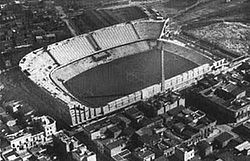
La Bombonera officially opened on May 25, 1940, with a friendly match against San Lorenzo. Boca Juniors won 2–0, with both goals scored by Ricardo Alarcón. Interestingly, because the stadium lacked a lighting system at the time, the match was shortened to 70 minutes.
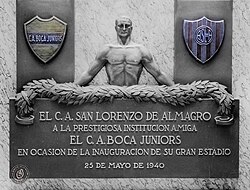
The stadium underwent several expansions to meet the growing demand of its fanbase:
- 1941: A second tier was added to the north side, named the "Natalio Pescia" grandstand.
- 1953: A third tier and a lighting system were completed, giving the stadium its definitive shape and the nickname La Bombonera.
- 1996: Under the presidency of Mauricio Macri, a fourth tier was added, along with VIP boxes, a press area, and a museum, expanding capacity to 57,500.
- 2008: An electronic screen was installed, making it the third stadium in Argentina to feature this technology.
The Story Behind the Name
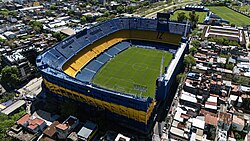
The nickname La Bombonera translates to "The Chocolate Box." The most widely accepted origin story involves architect Viktor Sulčič. On his birthday, a friend gifted him a box of chocolates; Sulčič subsequently used the box during project meetings to demonstrate how the stadium's unique, steep vertical stands mirrored the shape of the chocolate box.
Other theories suggest the name came from the resemblance of the stands to horse-dung collection carts used in Buenos Aires, or that it was coined by journalists Hugo Marini or Joaquín Carballo Serantes. Regardless of the origin, the name was embraced by club executives from the opening day.
Stadium Facilities and Character
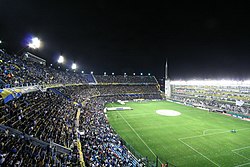
The stadium is renowned for its steep inclination and proximity of the fans to the pitch, which creates a vibrating atmosphere. Currently, it has a gross capacity of 58,305. The exterior and interior are adorned with murals by artist Pérez Celis, depicting legendary players and the Italian immigrant culture of the La Boca district.
The Boca Juniors Museum
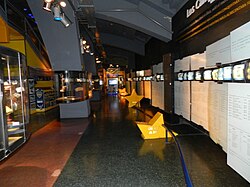
Opened in 2001, the Museo de la Pasión Boquense (Passion of Boca Juniors Museum) spans two floors beneath the grandstands. It chronicles the club's history since 1905 and features a Hall of Fame, a large mural of Diego Maradona, and a blue and gold guitar played by Lenny Kravitz in 2005.
The stadium grounds also feature monuments to club idols, including Diego Maradona, Román Riquelme, and the all-time top scorer Martín Palermo. In 2016, manager Carlos Bianchi—the most successful coach in the club's history—was also honored with a statue.
The Argentina National Team at La Bombonera
The Argentina national football team has a long history at the venue, playing there frequently from the 1950s through the 1970s. While the majority of home games shifted to the Estadio Monumental after the 1978 World Cup due to its larger capacity, La Bombonera remains a key venue for qualifiers and friendlies.
| Metric | Statistic |
|---|---|
| Total Matches Played | 27 |
| Wins | 18 |
| Draws | 7 |
| Losses | 2 |
| Goals Scored | 67 |
| Goals Conceded | 27 |
Frequently Asked Questions
Why is the stadium called La Bombonera?
It is popularly believed that architect Viktor Sulčič used a box of chocolates as a model to show his colleagues the intended shape of the stadium's steep stands.
Who is the stadium officially named after?
The stadium is officially named Estadio Alberto José Armando, in honor of a club president who led the team during its resurgence in the 1960s.
How many people can the stadium hold?
The stadium has a gross capacity of 58,305, with approximately 57,200 seats available for matches.
Does the stadium have a museum?
Yes, the Museo de la Pasión Boquense is located within the stadium and chronicles the club's history from 1905 to the present.
Which manager has a statue at the stadium?
Carlos Bianchi, the most winning manager in Boca Juniors' history, was honored with a statue unveiled in October 2016.