Emperor Taishō: The Life and Reign of Japan's First Tokyo Emperor
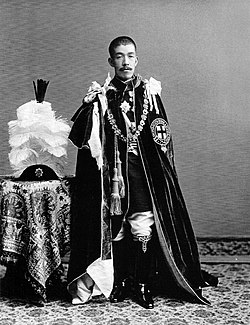
Emperor Taishō, born as Prince Yoshihito, served as the Emperor of Japan from July 29, 1912, until his death in December 1926. His tenure is most remembered for a significant domestic political shift toward liberal democracy, a period known as Taishō Democracy. Despite the era's progressive leanings, the Emperor's own life was marked by chronic health struggles that limited his ability to govern and perform public duties.
Throughout his reign, Japan navigated the complexities of the early 20th century, including its participation in World War I as an Ally, the devastating Spanish flu epidemic, and the catastrophic Great Kantō Earthquake of 1923. Because of his lifelong neurological issues, Emperor Taishō often remained in the background, leaving much of the political steering to the Imperial Diet and democratic parties.
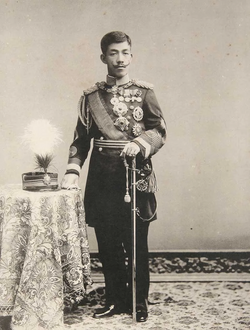
Key Facts
- Reign: July 29, 1912 – December 25, 1926.
- Era Name: Taishō.
- Political Legacy: Oversaw the rise of Taishō Democracy.
- Health: Suffered from cerebral meningitis as an infant and lifelong neurological problems.
- Family: Son of Emperor Meiji; father of Emperor Shōwa (Hirohito).
- Distinction: Known as the first "Tokyo Emperor" for living his entire life in or near the city.
Early Life and Education
Prince Yoshihito was born on August 31, 1879, at the Tōgū Palace in Tokyo. He was the son of Emperor Meiji and his concubine, Yanagiwara Naruko, though Empress Shōken was officially regarded as his mother. His early years were fraught with illness; he contracted cerebral meningitis within three weeks of birth, which set a pattern of poor health that persisted throughout his life.
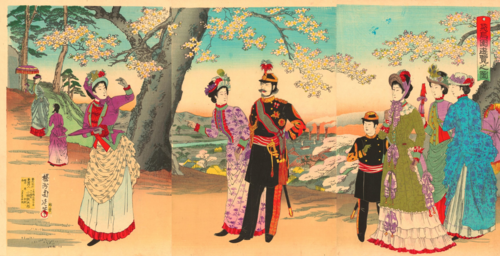
Due to his fragility, Yoshihito was raised by his great-grandfather, Marquess Nakayama Tadayasu, until age seven. His education was tailored to his health needs, with tutors providing lessons in reading, writing, and morals at the Aoyama Detached Palace. While he struggled with higher-level academic thought, he showed a notable aptitude for languages, specifically French and Chinese.
As he matured, Yoshihito was introduced to the political machinery of Japan. Starting in 1898, he attended sessions of the House of Peers of the Diet to learn about military and political affairs. He also conducted tours of Japan's naval sites and industrial centers, such as the Mitsubishi shipyards in Nagasaki. His fascination with Western culture and habit of using French phrases often caused friction with his father, Emperor Meiji.
Marriage and Family
On May 10, 1900, the 20-year-old Crown Prince married 15-year-old Sadako Kujō. A member of the prestigious Fujiwara clan, Sadako was chosen for her intelligence and dignity to complement the Prince's perceived shortcomings. The couple resided in the Akasaka Palace, a lavish European rococo-style residence.
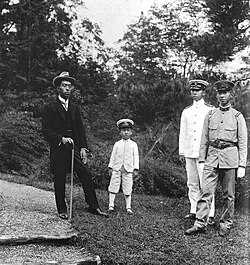
The marriage produced four sons: Hirohito (the future Emperor Shōwa), Yasuhito, Nobuhito, and Takahito. During his time as Crown Prince, Yoshihito also made history in 1907 by becoming the first heir apparent to leave Japan, touring Korea and attempting to study the Korean language.
The Imperial Reign
Yoshihito ascended the throne in 1912. However, his reign was characterized by a gradual withdrawal from public life. His neurological condition led to eccentricities and a lack of charisma that sometimes resulted in incidents of lèse majesté (offenses against the dignity of the sovereign). A famous example occurred during the 1913 opening of the Imperial Diet, where he was seen looking through his rolled-up speech as if it were a spyglass.
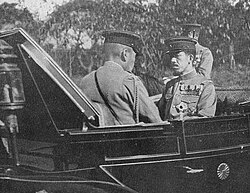
By 1919, the Emperor had ceased all official duties. This power vacuum allowed the genrō (elder statesmen) and the Imperial Diet to take a more prominent role in governance, fueling the democratic movements of the era. In 1921, his eldest son, Crown Prince Hirohito, was appointed as regent (sesshō) to manage the affairs of state.
Despite the chaos of the 1923 Great Kantō Earthquake, the Emperor remained safe at the Tamozawa Imperial Villa in Nikko, receiving updates on the devastation via carrier pigeons while his son, Hirohito, remained at the heart of the disaster in Tokyo.
Death and Legacy
Emperor Taishō died of a heart attack on December 25, 1926, at the age of 47, following a bout of pneumonia. His state funeral on February 7, 1927, was a massive event featuring a four-mile procession with 20,000 mourners.
He was buried in the Musashi Imperial Graveyard in Hachiōji. Unlike his father, whose mausoleum is in Kyoto, Taishō's burial in Tokyo solidified his status as the first "Tokyo Emperor."
| Category | Details |
|---|---|
| Birth Name | Yoshihito, Prince Haru |
| Reign Dates | 1912 – 1926 |
| Spouse | Sadako Kujō |
| Successor | Emperor Shōwa (Hirohito) |
| Key Era | Taishō Democracy |
| Burial Site | Musashi Imperial Graveyard, Tokyo |
Frequently Asked Questions
What was Taishō Democracy?
Taishō Democracy refers to a period of liberal political shift in Japan during Emperor Taishō's reign, where power moved away from the monarchy and elder statesmen toward the Imperial Diet and democratic political parties.
Why was Emperor Taishō called the first "Tokyo Emperor"?
He is called the first Tokyo Emperor because he was the first member of the imperial line to spend his entire life in or near Tokyo and to be buried there, rather than in the traditional imperial burial grounds of Kyoto.
How did health issues affect his reign?
Chronic neurological problems and a history of meningitis limited his public appearances and mental capacity for governance. This led to his total withdrawal from official duties by 1919 and the eventual appointment of his son as regent.
Who succeeded Emperor Taishō?
He was succeeded by his eldest son, Hirohito, who became Emperor Shōwa.
What major global events occurred during his reign?
His reign saw Japan's involvement in World War I on the side of the Allies, the global Spanish flu pandemic of 1918, and the Great Kantō Earthquake of 1923.