Electronics: The Science and Evolution of Controlling Electrons
Electronics is a specialized branch of physics and electrical engineering dedicated to the study and application of principles used to design, create, and operate devices that manipulate electrons and other electrically charged particles. Unlike basic electrical engineering, which often deals with the large-scale flow of electricity, electronics focuses on using active devices to control and amplify current, converting it between different forms—such as transforming alternating current (AC) to direct current (DC) or converting analog signals into digital data.
Today, electronic devices are the backbone of modern society, driving advancements in telecommunications, healthcare, education, industry, and security. This progress is fueled by the massive semiconductor industry, which saw annual revenues exceeding $481 billion in 2018. Furthermore, the digital revolution has enabled the explosion of e-commerce, a sector that generated over $29 trillion in online sales in 2017.
Key Facts
- Core Function: Manipulates electrons using active devices like transistors and diodes.
- Semiconductor Impact: The industry generated over $481 billion in 2018.
- The MOSFET: The most widely used electronic device in the world.
- Historical Milestone: The first all-transistorized commercial calculator was the IBM 608 (1955).
- Digital Logic: Uses binary systems (0 and 1) to represent logical states.
The History of the Electron Age
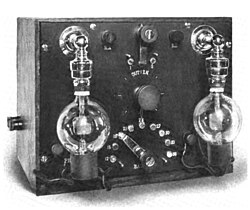
The field of electronics began with foundational discoveries in the late 19th century. Karl Ferdinand Braun developed the crystal detector (the first semiconductor device) in 1874, and Sir Joseph John Thomson identified the electron in 1897. These breakthroughs paved the way for the invention of the vacuum tube, or thermionic valve, which could amplify and rectify small electrical signals.
Vacuum tubes were the first active components capable of controlling current flow. They enabled the birth of radio, television, radar, and long-distance telephony. By the 1920s, commercial radio broadcasting had become widespread, utilizing electronic amplifiers for music recording and telecommunications.
The Transition to Solid-State Technology
While vacuum tubes remained dominant in high-power and microwave applications until the mid-1980s, the invention of the point-contact transistor by John Bardeen and Walter Houser Brattain at Bell Labs in 1947 changed everything. This marked the beginning of the shift toward solid-state devices—components made from solid semiconductor material rather than vacuum tubes.
A major turning point occurred in April 1955 with the IBM 608, the first IBM product to use transistor circuits without vacuum tubes. This machine, believed to be the first all-transistorized commercial calculator, contained more than 3,000 germanium transistors. Following this, IBM transitioned almost all future products to transistor-based designs, primarily for computer logic circuits.
The Rise of the MOSFET and Integrated Circuits
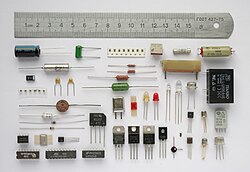
The invention of the MOSFET (metal-oxide-semiconductor field-effect transistor) at Bell Labs between 1955 and 1960 revolutionized the industry. As a compact, scalable, and affordable device, the MOSFET became the fundamental building block of modern electronics. Between 1960 and 2018, an estimated 13 sextillion MOSFETs were manufactured.
As circuits became more complex, engineers faced the challenge of size and speed. Larger components required longer wires, which slowed down signal transmission. This was solved by the invention of the integrated circuit (IC) by Jack Kilby and Robert Noyce. By creating all components on a single block (monolith) of semiconductor material, manufacturing could be automated and circuits could be miniaturized. This led to a progression from small-scale integration (SSI) to medium-scale (MSI), and eventually to Very Large-Scale Integration (VLSI). By 2008, processors containing billions of transistors were commercially available.
Types of Electronic Circuits
Electronic systems are generally categorized into two primary types: analog and digital.
Analog Electronics
Analog circuits deal with continuous signals. They are essential for signal amplification in the entertainment industry and for conditioning signals from analog sensors used in industrial measurement and control.
Digital Electronics
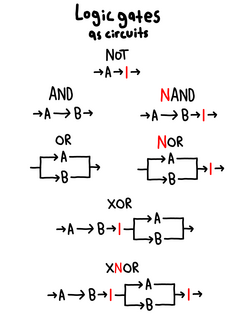
Digital circuits operate using a binary system, where two voltage levels represent logical states: 0 (often referred to as "Low") and 1 (often referred to as "High"). While these definitions are arbitrary and can be reversed by designers, they allow for complex logical operations using components such as:
- Logic gates: The basic building blocks of digital circuits.
- Adders, Flip-flops, and Counters: Used for mathematical and memory functions.
- Highly integrated devices: Including microprocessors, microcontrollers, and Systems on Chip (SoC).
Manufacturing and Industry Trends
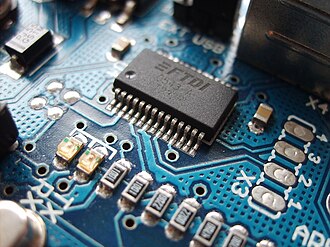
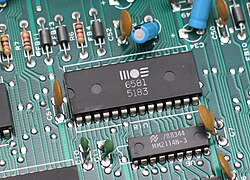
In the early days, electronics were constructed using point-to-point wiring on wooden breadboards. Modern electronics almost exclusively use Printed Circuit Boards (PCBs) made from materials like FR-4. Components are mounted to these boards using either through-hole technology or surface mount technology.
The global landscape of the industry has shifted significantly over time. While U.S. manufacturers led semiconductor development in the 1980s, the industry moved toward East Asia in the 1990s due to labor availability and technological sophistication. Consequently, the United States' share of global semiconductor manufacturing capacity fell from 37% in 1990 to 12% in 2022, with companies like TSMC leading in manufacturing technology.
| Era/Technology | Primary Component | Key Characteristics |
|---|---|---|
| Early Electronics | Vacuum Tubes | Amplification and rectification; bulky; high power. |
| Mid-20th Century | Discrete Transistors | Solid-state; smaller than tubes; harder to mass-produce. |
| Modern Era | Integrated Circuits (IC) | Miniaturized; automated manufacturing; high density. |
| Current Standard | MOSFET / VLSI | Extremely high density; billions of transistors per chip. |
Frequently Asked Questions
What is the difference between analog and digital electronics?
Analog electronics process continuous signals, which are often used for amplification and sensor data. Digital electronics use a binary system of discrete voltage levels (0 and 1) to represent information.
What is a MOSFET?
The metal-oxide-semiconductor field-effect transistor (MOSFET) is a type of transistor that is the most widely used active device in modern electronics, particularly in digital integrated circuits.
Why were integrated circuits important?
Integrated circuits allowed multiple components to be placed on a single block of semiconductor material. This solved the problem of circuit size and speed, as shorter interconnecting wires allowed signals to travel faster.
Are vacuum tubes still used today?
Yes, although they have been largely replaced by solid-state devices, vacuum tubes are still used in specialist applications such as high-power RF amplifiers, certain audio equipment, and guitar amplifiers.
What is a Printed Circuit Board (PCB)?
A PCB is a modern method of connecting electronic components. Instead of manual wiring, components are mounted onto a board made of materials like FR-4 using through-hole or surface mount techniques.