Electorate of Brunswick-Lüneburg: The Hanoverian Link to the British Crown
The Electorate of Brunswick-Lüneburg, more commonly known as the Electorate of Hanover, was a pivotal state within the Holy Roman Empire located in northwestern Germany. Emerging from the Principality of Calenberg, this territory became globally significant not only for its strategic position in Northern Europe but for its unique political relationship with Great Britain. For over a century, the rulers of Hanover also wore the British crown, creating a complex personal union that intertwined German and British interests.
The state's identity was defined by the House of Welf, a dynasty that managed to consolidate power through strategic inheritance and imperial favor. From its elevation to an electorate in 1692 to its eventual transformation into the Kingdom of Hanover in 1814, the territory navigated the turbulent waters of European power struggles, including the Seven Years' War and the Napoleonic era.
Key Facts
- Official Name: Electorate of Brunswick-Lüneburg (colloquially the Electorate of Hanover).
- Capital: Hanover.
- Period: 1692–1814 (as an electorate).
- Political Status: State of the Holy Roman Empire; in personal union with Great Britain and Ireland from 1714 to 1807.
- Religion: Lutheran.
- Motto: Nec Aspera Terrent ("Difficulties do not daunt").
- Succession: Followed male primogeniture to ensure the territory remained indivisible.
Foundations and Elevation
The origins of the electorate lie in the Duchy of Brunswick-Lüneburg, which had been split among various branches of the House of Welf since 1269. The Principality of Calenberg emerged as the most powerful of these branches. In 1692, Emperor Leopold I elevated Duke Ernest Augustus to the rank of prince-elector—a high-ranking noble with the right to elect the Holy Roman Emperor—as a reward for his support during the Nine Years' War.
While the elevation occurred in 1692, it faced protests and was not formally approved by the Imperial Diet until 1708. Although the official name remained the Electorate of Brunswick-Lüneburg, the capital city of Hanover became the namesake for the state in common usage.
The Personal Union with Great Britain
The trajectory of Hanover changed forever due to the Act of Settlement 1701 and the Act of Union 1707. These British laws designated the Electress Sophia of Hanover and her descendants as the heirs to the British throne, provided they were Protestant. In 1714, George Louis (George I) ascended the British throne, initiating a personal union where one monarch ruled two separate sovereign states.
Despite sharing a monarch, Hanover remained a distinct entity with its own government and laws. The British government often viewed the union with reluctance, as it frequently compelled Britain to defend the King's German lands from foreign invasion. To manage this, the "German Chancery" was established at St James's Palace in London to maintain direct contact between the monarch and the electorate.

Territorial Expansion and Geography
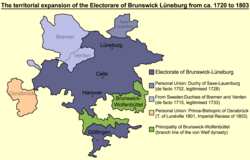
The electorate primarily covered what is now the German state of Lower Saxony. Over time, it expanded through inheritance and purchase:
- 1705: George I inherited the Principality of Lüneburg and the Duchy of Saxe-Lauenburg.
- 1715/1719: The purchase of Bremen-Verden from Denmark provided the previously landlocked state with vital access to the North Sea.
- 1731: The acquisition of Land Hadeln.
- 1803: The addition of the Prince-Bishopric of Osnabrück during the German Mediatisation.
In 1700, the territory adopted the "Improved Calendar" (the Gregorian calendar), though Protestants referred to it by this name to avoid associating it with Pope Gregory XIII.
Conflict and the Napoleonic Era
Hanover's link to Britain made it a target during European conflicts. During the Seven Years' War, French forces invaded Hanover in 1757, defeating the Anglo-Hanoverian army at the Battle of Hastenbeck. However, British and Prussian forces successfully expelled the occupants the following year.
The Napoleonic Wars brought more severe disruptions. Between 1801 and 1813, Hanover was occupied and annexed multiple times by Prussia and France. In 1807, it was merged into the Kingdom of Westphalia, a client state ruled by Napoleon's brother, Jérôme Bonaparte. By 1810, Napoleon annexed the North Sea coast directly into the French Empire to enforce the Continental System (a blockade against British trade).
Despite the occupation, the Hanoverian government continued to operate from London. Many soldiers formed the King's German Legion, the only German army to fight continuously against Napoleon throughout the wars.
Transition to the Kingdom of Hanover
Following the defeat of Napoleon at the Battle of Leipzig in 1813, the House of Hanover was restored. At the Congress of Vienna in 1814, the former electorate was elevated to the Kingdom of Hanover. The personal union with the British crown continued until 1837.
| Elector | Reign | Key Achievements/Events |
|---|---|---|
| Ernest Augustus | 1692–1698 | First Prince-Elector; elevated by Emperor Leopold I. |
| George I Louis | 1708–1727 | Became King of Great Britain (1714); acquired Bremen-Verden. |
| George II Augustus | 1727–1760 | Acquired Land Hadeln (1731). |
| George III William Frederick | 1760–1806 | Acquired Osnabrück (1803); saw the state's dissolution and restoration. |
Frequently Asked Questions
What was the difference between the Electorate of Brunswick-Lüneburg and the Electorate of Hanover?
They are the same entity. Brunswick-Lüneburg was the official dynastic name of the electorate, while "Hanover" was the colloquial name derived from the capital city.
How did the personal union with Great Britain work?
A personal union meant that the two states shared the same monarch but remained legally and administratively separate. Hanover had its own government, and treaties were required whenever Hanoverian troops fought alongside British forces.
Why was the electorate's succession based on male primogeniture?
To prevent the territory from being split among multiple heirs—a common occurrence in earlier Brunswick-Lüneburg history—the state was declared indivisible, with the eldest son inheriting the entire electorate.
What happened to Hanover during the Napoleonic Wars?
Hanover was occupied several times, eventually becoming part of the Kingdom of Westphalia and then being directly annexed by the French Empire before being restored as the Kingdom of Hanover in 1814.
What was the King's German Legion?
The King's German Legion was a military unit formed in England by officers and soldiers from the dissolved Hanoverian Army, fighting against Napoleon throughout the Napoleonic Wars.