Robert Walpole: The First De Facto Prime Minister of Great Britain
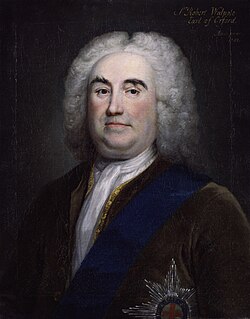
Robert Walpole, the 1st Earl of Orford, stands as one of the most influential figures in British political history. Serving from 1721 to 1742, he is generally regarded as the de facto (in practice, though not necessarily by official title) first Prime Minister of Great Britain. A master of parliamentary maneuver and financial administration, Walpole's tenure of over 20 years remains the longest of any prime minister in UK history.
Throughout his career, Walpole held several critical roles, including First Lord of the Treasury, Chancellor of the Exchequer, and Leader of the House of Commons. While he famously denied the title of "prime minister"—which was originally used as a term of abuse—his centralized control over the government established the blueprint for the modern office.
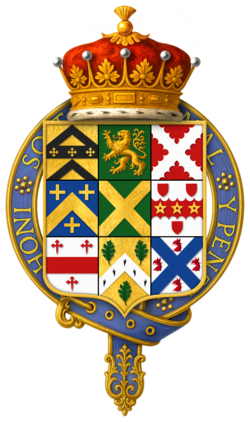
Key Facts
- Tenure: Served as prime minister from April 3, 1721, to February 11, 1742.
- Political Affiliation: A prominent member of the Whig Party.
- Longest Reign: Holds the record for the longest-serving prime minister in UK history.
- Official Residence: Established 10 Downing Street as the official residence of the First Lord of the Treasury.
- Education: Attended Eton College as a King's Scholar and later King's College, Cambridge.
Early Life and Education
Born on August 26, 1676, in Houghton, Norfolk, Robert Walpole was the son of Robert Walpole. His early education began at a private school in Massingham before he entered Eton College in 1690. In 1696, he matriculated at King's College, Cambridge.
Walpole originally intended to enter the clergy. However, following the death of his older brother Edward in 1698, he abandoned these plans to help his father manage the family estates. Upon his father's death in November 1700, Robert inherited the Walpole estate, which consisted of nine manors in Norfolk and one in Suffolk.
The Rise to Power
Walpole's political ascent was marked by his ability to act as a mediator. A member of the Whig Party, he was appointed by Queen Anne in 1705 to the council for Prince George of Denmark. His skill in reconciling the government with Whig leaders earned him the respect of Lord Godolphin, leading to his appointment as Secretary at War in 1708.
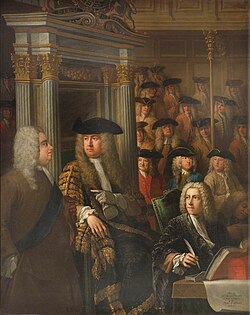
By 1710, he briefly held the position of Treasurer of the Navy. His trajectory continued upward through the Stanhope–Sunderland ministry, eventually positioning him as the most powerful figure in the administration following the resignation of Sunderland and the death of Stanhope in 1721.
The Premiership (1721–1742)
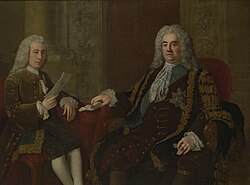
On April 3, 1721, Walpole was appointed First Lord of the Treasury, Chancellor of the Exchequer, and Leader of the House of Commons. This trifecta of power allowed him to dominate domestic and financial policy.
Stability and Prosperity
Walpole's early years in power were defined by a drive for stability. He successfully navigated the threat of the Jacobites—supporters of the exiled House of Stuart—particularly after the exposure of a plot by Francis Atterbury, the Bishop of Rochester. By maintaining peace and avoiding costly wars, Walpole fostered a period of economic prosperity that secured the favor of King George I.
Diplomacy and Honors
While Walpole focused on internal stability, his brother-in-law, Lord Townshend, managed foreign affairs. Together, they worked to neutralize opposing political factions. In recognition of his service, Walpole was invested in the revived Order of the Bath in 1725 and became a Knight of the Garter in 1726, which earned him the nickname "Sir Bluestring."
Decline and Later Years
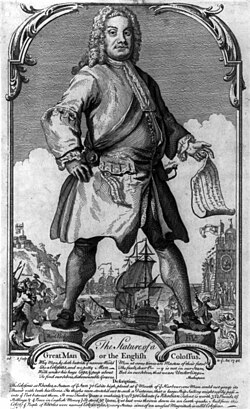
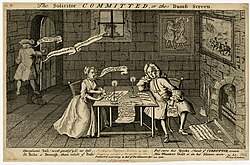
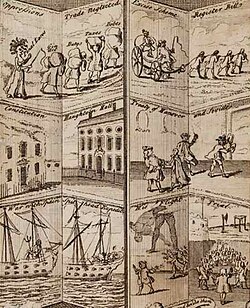
Despite his long dominance, Walpole eventually faced increasing opposition. His reluctance to engage in military conflict with Spain and France became a point of contention, often depicted in contemporary political satires.
Walpole's health declined rapidly in 1744. He died in London on March 18, 1745, at the age of 68, due to a bladder stone. He was buried at the Church of St Martin at Tours on the Houghton Hall estate.
Legacy and 10 Downing Street
One of Walpole's most enduring legacies is 10 Downing Street. In 1732, King George II offered the house to Walpole as a personal gift. Walpole accepted it only on the condition that it serve as the official residence of the First Lord of the Treasury. He moved in on September 22, 1735, cementing the address as the symbolic heart of British political power.
![Arms of Shorter, of Bybrook, Kent: Sable, a lion rampant or ducally crowned argent between three battle axes of the last headed of the second[93]](/images/1f/03/1f03f068d02562263073311c8423d22f4d878a6f7b1c5c92c66720752e4e03b4.webp)
![Arms of Skerritt: Or, a chief indented sable[107]](/images/85/ce/85cedb95fd3ebb8651590f45f82cda5c4826e3a31fb821e97420239b61822213.webp)
Summary of Robert Walpole's Career
| Office | Term(s) | Key Role/Context |
|---|---|---|
| Prime Minister (de facto) | 1721–1742 | Longest serving PM in UK history |
| First Lord of the Treasury | 1721–1742 | Chief financial and administrative officer |
| Chancellor of the Exchequer | 1715–1717, 1721–1742 | Management of national finances |
| Secretary at War | 1708–1710 | Early administrative leadership |
| Member of Parliament | 1701–1742 | Represented Castle Rising and King's Lynn |
Frequently Asked Questions
Was Robert Walpole officially called the Prime Minister?
No. At the time, the title "Prime Minister" was often used as a term of abuse to imply someone had too much power. Walpole explicitly denied the title in 1741, stating he was not the "sole and prime minister," though he functioned as such in practice.
How did Robert Walpole acquire 10 Downing Street?
King George II offered the house to Walpole as a personal gift in 1732. Walpole accepted it specifically as the official residence for the First Lord of the Treasury, moving in during 1735.
What was Walpole's primary political goal during his premiership?
Walpole focused on maintaining national stability, avoiding expensive foreign wars, and ensuring economic prosperity, which helped him maintain the favor of the monarchy and the Whig party.
Who inherited the Earldom of Orford after his death?
The earldom first passed to his eldest son, Robert (the 2nd Earl), then to his grandson George (the 3rd Earl). Finally, it was inherited by his younger son, Horace Walpole, the famous diarist, before the title became extinct in 1797.