Einsteinium: The Radioactive Element Born from Nuclear Fire
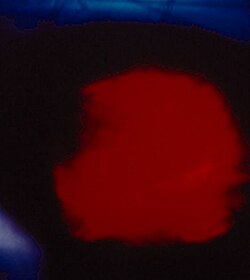
Einsteinium is a synthetic, highly radioactive element that occupies a unique place in the periodic table. As a member of the actinide series—the group of heavy, metallic elements found in the f-block—it is characterized by its silvery appearance and a striking ability to glow blue in the dark due to its intense radiation.
Unlike the elements that make up the bulk of our planet, einsteinium does not occur naturally. It is a transuranium element, meaning its atomic number is greater than that of uranium, and it must be created through artificial means in nuclear reactors or during high-energy nuclear events.

Key Facts
- Atomic Number: 99
- Symbol: Es
- Appearance: Silvery metal; glows blue in the dark
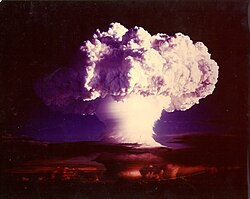
- Discovery: Found in the debris of the first hydrogen bomb test (1952)
- Primary Isotope: Einsteinium-253 (half-life of 20.47 days)
- Common Oxidation States: +3 (most common), +2, and +4
- Primary Use: Basic scientific research
Discovery and History
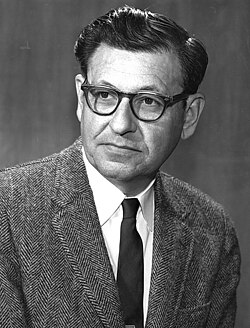
Einsteinium was first identified in 1952 as a component of the debris from the Ivy Mike nuclear test, the first detonation of a hydrogen bomb. The discovery was made by a team at the Lawrence Berkeley National Laboratory, headed by Albert Ghiorso.
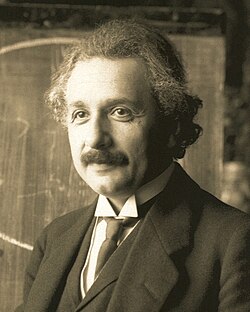
In honor of the physicist whose theories of relativity laid the groundwork for nuclear physics, the element was named after Albert Einstein.
Physical and Chemical Properties
Einsteinium is a solid at standard temperature and pressure (STP) with a face-centered cubic (fcc) crystal structure. It has an estimated boiling point of 1269 K (996 °C) and a melting point of 1133 K (860 °C). Its density is approximately 8.84 g/cm³.
Chemically, einsteinium is most stable in the +3 oxidation state, though +2 and +4 states are possible. One of its most notable physical characteristics is its paramagnetic behavior. Studies on its metal, oxide, and fluoride forms have shown Curie–Weiss paramagnetic behavior from liquid helium temperatures up to room temperature. In fact, the effective magnetic moments of its compounds, such as Es₂O₃ and EsF₃, are the highest among all the actinides.
![Glow due to the intense radiation from ~300 μg of 253Es[27]](/images/c7/83/c783119cf54a4640bb744e61bc6ccbc1f1c22a4da9f401b04c5174978d838b0f.jpg)
Chemical Compounds
Einsteinium forms various compounds, often characterized by distinct colors. For example, einsteinium(III) iodide (EsI₃) appears amber, while einsteinium(III) bromide (EsBr₃) is yellow and einsteinium(III) chloride (EsCl₃) is orange.
Synthesis and Isotopes
Because of its instability, einsteinium is produced in very small quantities. The most common isotope, einsteinium-253, is synthesized in high-power nuclear reactors via the decay of californium-253. This process is incredibly demanding, yielding only about one milligram per year and requiring complex chromatographic separation to isolate the element from other actinides.
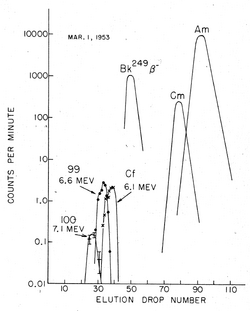
Other isotopes are created in laboratories by bombarding heavy actinide elements with light ions. In total, eighteen isotopes and four nuclear isomers are known, ranging from mass numbers 240 to 257. All are radioactive. The most stable isotope is Es-252, with a half-life of 471.7 days.
![Early evolution of einsteinium production in the U.S.[49]](/images/e3/e2/e3e258ce1136fdd41c1905d47a8ea53d43bd0dbfa36a16bda84dcd8ac3ccb151.png)
![Estimated yield of transuranium elements in the U.S. nuclear tests Hutch and Cyclamen[66]](/images/01/b9/01b9401b24bf2c2f14109edd243a1b95099fa2dc4f9e1cd39ac75fe4a26f39ea.png)
Scientific Applications
Due to its extreme scarcity and short half-life, einsteinium has no commercial or industrial applications. Its value lies entirely in basic scientific research. Its most significant contribution to chemistry occurred in 1955, when researchers used a target of approximately 10 atoms of einsteinium in a cyclotron to synthesize 17 atoms of the element mendelevium (atomic number 101).
| Property | Value/Detail |
|---|---|
| Atomic Number | 99 |
| Atomic Mass | [252] |
| Phase at STP | Solid |
| Melting Point | 1133 K (860 °C) |
| Most Stable Isotope | Es-252 (Half-life: 471.7 days) |
| Common Oxidation State | +3 |
| Crystal Structure | Face-centered cubic (fcc) |
Frequently Asked Questions
Why does einsteinium glow blue?
The blue glow is caused by the intense radiation emitted by the element, which excites the surrounding environment (such as air or the material itself), resulting in visible light.
How is einsteinium produced today?
It is primarily produced artificially in dedicated high-power nuclear reactors through the decay of californium-253, or in laboratories by bombarding heavy actinides with light ions.
What is the most stable isotope of einsteinium?
The most stable known isotope is einsteinium-252, which has a half-life of 471.7 days.
Does einsteinium have any practical uses?
No, it has no practical applications outside of basic scientific research due to the tiny amounts produced and its high radioactivity.
How was einsteinium first discovered?
It was discovered in 1952 by analyzing the debris from the first hydrogen bomb explosion, known as the Ivy Mike test.