Einstein vs. Bohr: The Battle Over Quantum Indeterminacy
The evolution of quantum mechanics was not a linear path of agreement, but rather a series of intellectual collisions between the era's greatest minds. At the center of this storm were Albert Einstein and Niels Bohr. While Einstein played a pivotal role in the birth of quantum theory, he spent years attempting to dismantle its most unsettling conclusion: quantum indeterminism—the idea that certain physical properties cannot be known simultaneously with absolute precision.
Einstein's quest was not to deny the mathematics of the theory, but to prove that the uncertainty principle could be bypassed. Through a series of ingenious thought experiments, he sought to demonstrate that one could determine incompatible variables, such as position and velocity, or reveal the wave and particle aspects of a process at the same time.
Key Facts
- The Conflict: Einstein sought to prove that the uncertainty principle could be violated; Bohr argued it was an absolute limit of nature.
- The 1927 Debate: Einstein proposed using the conservation of momentum to determine a particle's path without destroying its interference pattern.
- Bohr's Rebuttal: Bohr showed that measuring the measuring device itself introduces uncertainty, preserving the principle.
- Time-Energy Relation: The uncertainty principle also applies to time and energy (ΔE Δt ≥ h).
- The Light Box: Einstein's 1930 attempt to bypass time-energy uncertainty was defeated by Bohr using General Relativity.
The First Challenge: The Recoil Experiment
During the Fifth Solvay International Conference in 1927, Einstein launched a serious attack on the orthodox quantum view. He proposed a setup involving a beam of light passing through a narrow slit in a screen (S1), which then diffracts and hits a second screen (S2) with two slits, eventually forming an interference pattern on a final screen (F).
In standard quantum mechanics, if you determine which slit a particle passes through (the corpuscular aspect), the interference pattern (the wave aspect) disappears. Einstein argued that by measuring the recoil of the first screen (S1), one could deduce the particle's trajectory. Because the law of conservation of momentum dictates that the screen must recoil in the opposite direction of the particle's deflection, measuring the screen's movement would reveal the particle's path without directly interfering with the particle itself.
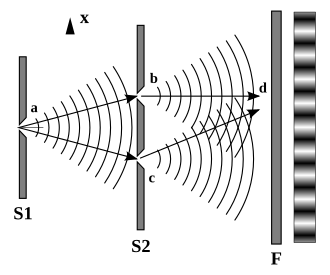
Einstein believed this would allow the observer to know the particle's path while the interference pattern remained intact on screen F, thereby violating the principle of indeterminacy.
Bohr's Counter-Argument
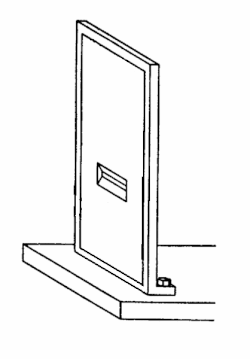
Bohr responded by pointing out a flaw in Einstein's logic: the screen S1 is not an external observer, but part of the quantum system. To measure the recoil of the screen with enough precision to know the particle's path, the screen's own initial velocity must be known with extreme accuracy.
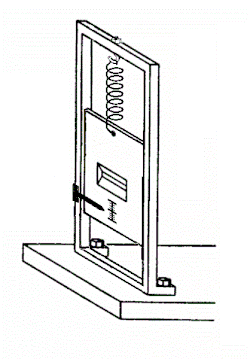
According to the uncertainty principle, a precise knowledge of the screen's velocity implies an inevitable imprecision in its position. Bohr argued that this positional uncertainty would shift the phase of the waves, causing the interference patterns to overlap and blur into a uniform grey. Thus, the attempt to observe the particle's path inevitably destroyed the interference pattern.
The Time-Energy Uncertainty Relation
Beyond position and momentum, quantum mechanics posits a relationship between time and energy. This is best understood through a wave packet—a spatially limited wave created by superimposing multiple waves of different frequencies.
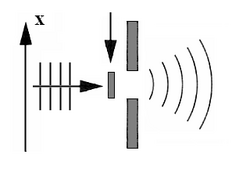
If a shutter remains open for a very brief interval (Δt), it creates a wave with a limited spatial extension. Mathematically, this requires a range of frequencies (Δν). Since energy is proportional to frequency (E = hν), this frequency spread results in an uncertainty in energy (ΔE). This leads to the fundamental relation:
ΔE Δt ≥ h
Einstein's Second Attack: The Light Box
At the 1930 Solvay Congress, Einstein targeted the time-energy relation with a thought experiment known as Einstein's Box. He imagined a box filled with radiation and a clock-controlled shutter. The shutter opens for a precise time (Δt), allowing a single photon to escape.
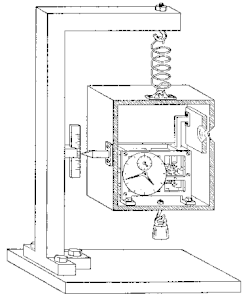
Einstein proposed that by weighing the box before and after the photon's escape, one could use mass-energy equivalence (E = mc²) to determine the exact energy (ΔE) the photon carried away. Since the clock provides the exact time (Δt), Einstein argued that the product ΔE Δt could be made smaller than the limit set by the uncertainty principle.
Bohr's Final Triumph
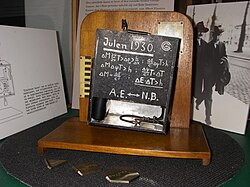
Bohr's rebuttal was a masterstroke, as he used Einstein's own theories of relativity to defeat him. Bohr argued that to weigh the box, it must be suspended in a gravitational field. He pointed out that the movement of the box in a gravitational field causes gravitational redshift, which affects the rate of the clock inside the box.
Bohr demonstrated that the uncertainty in the clock's time (Δt) caused by the gravitational shift exactly compensates for the precision gained in measuring the energy (ΔE). Once again, the relation ΔE Δt ≥ h was preserved.
Summary of the Einstein-Bohr Debates
| Experiment | Einstein's Goal | Bohr's Resolution | Key Principle Used |
|---|---|---|---|
| Recoil Screen | Determine path without losing interference | Screen position uncertainty blurs the pattern | Position-Momentum Uncertainty |
| Light Box | Measure energy and time simultaneously | Gravitational redshift affects clock timing | General Relativity / Equivalence Principle |
Frequently Asked Questions
What was Einstein's primary goal in these thought experiments?
Einstein sought to prove that the uncertainty principle was not a fundamental law of nature but a limitation of current theory, aiming to show that incompatible variables could be measured simultaneously.
How did Bohr use General Relativity to answer Einstein?
Bohr used the principle of equivalence and gravitational redshift to show that the act of weighing Einstein's light box would introduce an uncertainty in the time kept by the box's internal clock.
What is a wave packet in the context of time-energy uncertainty?
A wave packet is a spatially limited wave formed by the superposition of waves with different frequencies. The shorter the time the wave is created (Δt), the wider the range of frequencies (and thus energies) it must contain.
Did Einstein eventually accept the uncertainty principle?
While Einstein engaged in these debates to find flaws in the principle, historical accounts suggest he accepted the mathematical utility of the theory, though he remained philosophically opposed to the idea of fundamental indeterminism.
What is the 'measurement problem' mentioned in the text?
The measurement problem arises from the ambiguity of where the quantum world ends and the classical world begins, specifically regarding whether macroscopic measuring devices must also obey quantum laws.