Atomic Theory: The Evolution of Our Understanding of Matter
Atomic theory is the scientific framework asserting that all matter is composed of discrete particles called atoms. While the concept seems fundamental today, the definition of an atom has shifted dramatically over centuries. It began as a philosophical hypothesis of an indivisible particle, evolved into a chemical tool for understanding elements, and eventually became a complex physics model revealing a rich internal structure.
The significance of this theory cannot be overstated. Nobel laureate Richard Feynman described the atomic hypothesis as the single most prolific scientific concept in history, serving as the cornerstone for nearly all physical sciences.
Key Facts
- John Dalton established the first scientific atomic theory in 1808, focusing on relative atomic weights.
- Brownian motion, theorized by Albert Einstein in 1905, provided critical evidence for the physical existence of atoms.
- J.J. Thomson discovered the electron, proving that atoms are divisible.
- Ernest Rutherford discovered the nucleus, revealing that most of an atom's mass and positive charge are concentrated in a tiny center.
- Niels Bohr introduced quantized electron orbits to explain atomic spectral lines.
- James Chadwick identified the neutron in 1932, completing the basic model of the nucleus.
The Foundations of Chemical Atomism
In 1808, John Dalton published A New System of Chemical Philosophy, moving atomism from philosophy to science. Dalton proposed that all atoms of a specific element possess the same weight, while different elements have different weights. He asserted that atoms are neither created nor destroyed during chemical reactions.
Dalton's system relied on relative weights. For example, he observed that 7 grams of oxygen combined with 1 gram of hydrogen to form 8 grams of water. Based on this, he assigned hydrogen a weight of 1 and oxygen a weight of 7. However, this system was limited; had he analyzed hydrogen peroxide (H2O2) instead of water, his calculations for oxygen would have differed, highlighting the insufficiency of his method for determining unambiguous chemical structures.
![From A New System of Chemical Philosophy (John Dalton 1808); Dalton's symbols were integral to his theory.[7]: 83](/images/8a/f4/8af4b6074f8861982cc363a217b73abd23f5fa9cb16c4e2205e8207cf2bf85ad.gif)
Proving the Existence of Atoms
Despite Dalton's work, the physical reality of atoms remained debated. A breakthrough occurred in 1827 when Robert Brown observed dust particles in water jiggling randomly, a phenomenon now known as Brownian motion. In 1905, Albert Einstein theorized that this movement was caused by water molecules continuously colliding with the grains. This was experimentally validated in 1908 by Jean Perrin, who used Einstein's mathematical models to calculate the actual size of atoms.
| Molecule | Perrin's 1909 Measurements (m) | Modern Measurements (m) |
|---|---|---|
| Helium | 1.7 × 10⁻¹⁰ | 2.6 × 10⁻¹⁰ |
| Argon | 2.7 × 10⁻¹⁰ | 3.4 × 10⁻¹⁰ |
| Mercury | 2.8 × 10⁻¹⁰ | 3 × 10⁻¹⁰ |
| Hydrogen | 2 × 10⁻¹⁰ | 2.89 × 10⁻¹⁰ |
| Oxygen | 2.6 × 10⁻¹⁰ | 3.46 × 10⁻¹⁰ |
| Nitrogen | 2.7 × 10⁻¹⁰ | 3.64 × 10⁻¹⁰ |
| Chlorine | 4 × 10⁻¹⁰ | 3.20 × 10⁻¹⁰ |
The Discovery of Subatomic Particles
The Electron and the Plum Pudding Model
In 1899, J.J. Thomson demonstrated that negative electricity produced by the photoelectric effect had a mass-to-charge ratio identical to cathode rays. He found that these particles, later named electrons, were only 0.0014 times the mass of a hydrogen ion. This discovery proved that atoms were not indivisible. Thomson proposed the "plum pudding model," where electrons were embedded in a sphere of positive charge.
The Nucleus and the Planetary Model
Between 1908 and 1913, Ernest Rutherford challenged Thomson's model by bombarding thin metal foils with alpha particles. While Thomson's model predicted negligible deflection, Rutherford observed some particles deflecting at angles greater than 90°. He concluded that the atom's positive charge and most of its mass are concentrated in a tiny, dense nucleus.
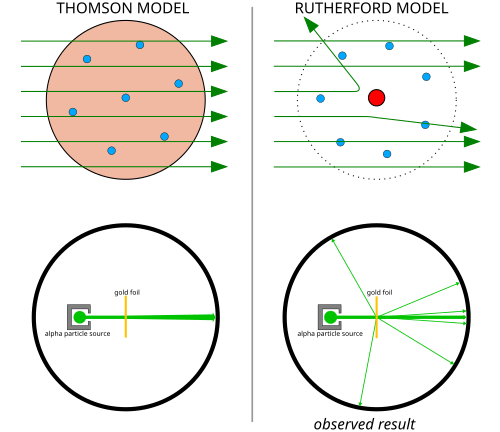
This led to the conceptualization of the atom as a miniature solar system, though it lacked a mechanism to explain why electrons didn't simply spiral into the nucleus.
Refining the Model: Quantum Leaps
The Bohr Model and Atomic Number
Niels Bohr refined Rutherford's work by incorporating the concept of quanta—discrete amounts of energy. Bohr proposed that electrons exist in specific, quantized orbits. This model successfully explained atomic spectral lines, which are the unique patterns of light emitted by elements.
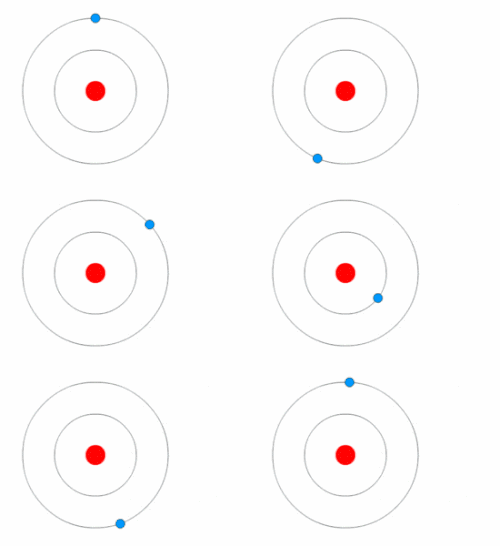
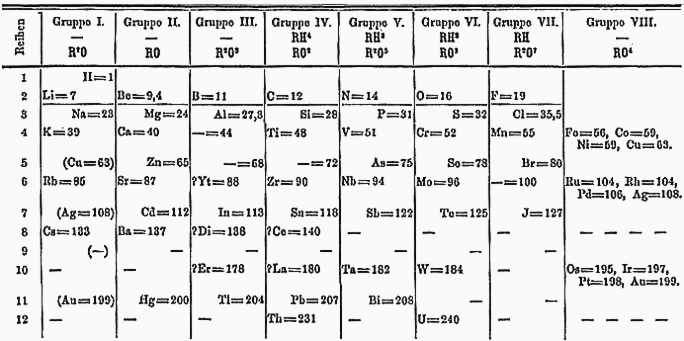
Simultaneously, the understanding of the periodic table shifted. While Mendeleev originally organized elements by atomic weight, Antonius van den Broek hypothesized in 1913 that the table should be organized by atomic number (nuclear charge, denoted as Z). This resolved inconsistencies, such as the ordering of cobalt and nickel.
Protons and Neutrons
The discovery of isotopes (atoms of the same element with different masses) in 1913 revived William Prout's earlier hypothesis that elements were built from hydrogen-like particles, leading to the identification of the proton. Finally, in 1932, James Chadwick discovered the neutron—an electrically neutral particle with a mass similar to the proton—by observing radiation emitted from beryllium.

Modern Atomic Theory
The current theoretical model has moved beyond simple orbits to quantum mechanical models. Instead of fixed paths, electrons are described as existing in probabilistic "clouds" or orbitals, where their exact position is not fixed but defined by probability zones.
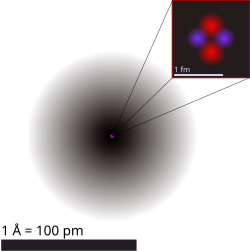

Frequently Asked Questions
What is the main difference between Dalton's theory and modern atomic theory?
Dalton viewed the atom as an indivisible, solid sphere with a specific weight. Modern theory recognizes that atoms are divisible into subatomic particles (protons, neutrons, and electrons) and that electrons exist in probabilistic clouds rather than solid structures.
How did Rutherford discover the nucleus?
Rutherford used alpha particle scattering experiments. By observing that some particles were deflected at sharp angles when hitting a thin metal foil, he deduced that there must be a concentrated positive charge and mass at the center of the atom.
Why is the atomic number more important than atomic weight in the periodic table?
The atomic number (Z), representing the nuclear charge, more accurately reflects the chemical properties and behavior of an element. Organizing by atomic weight caused errors, such as the reversed placement of cobalt and nickel.
What is the role of the neutron in the atom?
The neutron is an electrically neutral particle located in the nucleus. It contributes to the atom's mass without changing its charge, and its presence allows for the existence of isotopes.
What was the significance of Brownian motion?
Brownian motion provided the first physical evidence that atoms exist. Albert Einstein's mathematical explanation of the random movement of pollen grains proved that they were being pushed by invisible water molecules.