Einstein-Szilard Refrigerator: The History of the No-Moving-Parts Cooler
In the early 20th century, home refrigeration was a dangerous venture. Many early appliances relied on toxic gases and mechanical seals that were prone to failure. In response to these safety concerns, Albert Einstein and his former student Leó Szilárd collaborated to design a safer alternative: the Einstein-Szilard refrigerator.
This device is an absorption refrigerator—a system that uses a heat source rather than a mechanical compressor to move refrigerant. By eliminating moving parts, Einstein and Szilárd aimed to remove the risk of seal leaks, creating a machine that operated at constant pressure and offered unprecedented reliability.
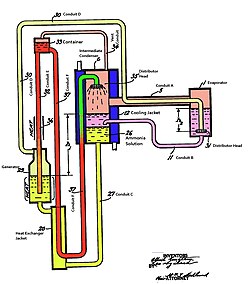
Key Facts
- Inventors: Albert Einstein and Leó Szilárd (patented in the U.S. on November 11, 1930).
- Working Fluids: A three-fluid system consisting of water, ammonia, and butane.
- Core Innovation: No moving parts, meaning no mechanical seals to fail and no electricity required for compression.
- Legacy: While not a commercial success, its pump technology was later used to cool breeder reactors.
- Modern Revival: Oxford University researchers are exploring the design for use in rural areas without electricity.
The Origins and Motivation
The partnership between Einstein and Szilárd began in 1926. Their motivation was sparked by tragic news reports from Berlin, where a family died after a refrigerator seal failed, leaking toxic fumes into their home. To prevent such disasters, the duo sought a refrigeration cycle that required no moving parts.
Drawing on Einstein's professional experience at the Swiss Patent Office, the pair navigated the complex legal landscape of intellectual property. They eventually secured 45 patents across six different countries for three distinct models. While some historians suggest Szilárd performed the bulk of the inventing while Einstein acted as a consultant, others maintain that Einstein contributed significantly to the design work.
Technical Design and Commercial Challenges
The Einstein-Szilard design was a modification of an earlier three-fluid absorption system developed by Swedish engineers Baltzar von Platen and Carl Munters. The system utilized the chemical properties of ammonia, water, and butane to create a cooling effect using only a heat source.
Despite its reliability, the refrigerator faced several hurdles that prevented it from dominating the market:
- Efficiency: It was less efficient than the mechanical appliances of the time.
- Competition: The introduction of Freon, a non-toxic refrigerant gas, made mechanical refrigerators safer and more attractive.
- Economic Crisis: The Great Depression of 1929 severely limited development funding.
- Political Turmoil: The rise of Nazi Germany and the subsequent persecution of Jewish scientists forced both Einstein and Szilárd to flee the country in the early 1930s.
The Swedish company Electrolux eventually purchased the most promising patents. For their work, Einstein and Szilárd earned $750, which is roughly equivalent to $10,000 in 2017 currency.
Variants and Modern Applications
Beyond the standard absorption model, the inventors developed the Einstein-Szilard electromagnetic refrigerator. This version used an electromagnetic pump to compress pentane (a working gas). While the refrigerator itself didn't succeed commercially, the electromagnetic pump became highly valuable in the nuclear industry for cooling breeder reactors due to its safety and reliability.
In 2008, the design saw a resurgence at Oxford University. Led by Malcolm McCulloch, electrical engineers in the Energy and Power Group revisited the Einstein refrigerator to determine if it could provide cooling for rural populations lacking access to electricity. McCulloch noted that while the design had never been fully commercialized, modern improvements could potentially quadruple the efficiency of the original 1926 model.
| Feature | Details |
|---|---|
| Mechanism | Absorption (Heat-driven) |
| Working Fluids | Ammonia, Water, Butane |
| Primary Advantage | No moving parts (no seal failure) |
| U.S. Patent | 1,781,541 (1930) |
| Modern Use Case | Off-grid rural refrigeration |
Frequently Asked Questions
Why did Einstein and Szilard want to build a refrigerator?
They were motivated by safety. After reports of families dying from toxic gas leaks caused by failing refrigerator seals, they wanted to create a device with no moving parts to eliminate the possibility of such leaks.
How does the Einstein refrigerator differ from a standard fridge?
Unlike standard refrigerators that use a mechanical compressor powered by electricity, the Einstein-Szilard model is an absorption refrigerator. It operates at constant pressure and requires only a heat source to function.
Why wasn't the Einstein-Szilard refrigerator a commercial success?
It was less efficient than its competitors, and the invention of Freon removed the safety advantage of having no moving parts. Additionally, the Great Depression and the political climate in Nazi Germany hindered its development.
What happened to the technology after the inventors fled Germany?
The Swedish company Electrolux bought many of the patents. Furthermore, the electromagnetic pump developed for a variant of the fridge was later adapted for use in cooling nuclear breeder reactors.
Is the Einstein refrigerator still relevant today?
Yes. Researchers at Oxford University have explored the design as a potential solution for providing refrigeration in rural areas that do not have access to an electrical grid.