Einstein and Oppenheimer: A Complex Legacy of Science and Power
The twentieth century was defined by leaps in physics that reshaped the human understanding of the universe. At the center of this era were Albert Einstein and J. Robert Oppenheimer, two pioneering physicists whose lives and careers intersected at the Institute for Advanced Study (IAS) in Princeton from 1947 to 1955. While they shared a professional environment and a common heritage, they represented two distinct archetypes of the scientist: the contemplative theorist and the practical architect of power.
Einstein, the elder statesman of physics, became a global icon in 1919 after his predictions regarding the gravitational bending of light were verified. Oppenheimer, once the "boy-wonder" of American physics in the 1930s, rose to international prominence after 1945 as the scientific director of the Manhattan Project, the secret program that developed the first nuclear weapons.
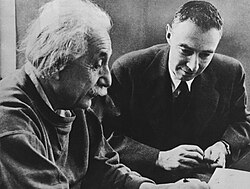
Key Facts
- Professional Link: Both were colleagues at the Institute for Advanced Study (IAS) in Princeton between 1947 and 1955.
- Scientific Divergence: Einstein remained skeptical of quantum mechanics, while Oppenheimer was a strong advocate for quantum field theory.
- Black Hole Theory: In 1939, Einstein argued against the existence of black holes, while Oppenheimer and Hartland Snyder used Einstein's own general relativity to prove how they form.
- Nuclear Legacy: Einstein's mass-energy equivalence formula provided the theoretical basis for the atomic bomb, while Oppenheimer oversaw its practical creation.
- Personal Dynamic: Their relationship was characterized by mutual respect for their intellects but significant disagreement over scientific methods and personal philosophies.
The Intersection of Science and Power
The relationship between Einstein and Oppenheimer serves as a case study in the tension between contemplation (knowledge for its own sake) and utility (the application of science for practical or political ends). Einstein viewed himself as a convinced pacifist, later stating that when he formulated the relationship between mass and energy in 1905, he never imagined it would be used for military purposes.
In contrast, Oppenheimer became the face of the "instrumental power of science." As the director of the Los Alamos Laboratory, he bridged the gap between theoretical physics and state-sponsored military application. Despite their different roles, the public often linked them due to the Einstein-Szilard letter, which urged the U.S. government to begin the Manhattan Project.
Professional Friction at the Institute for Advanced Study
Despite their proximity—their offices were located down the same hall at the IAS—their professional relationship was often strained. Oppenheimer, as director, viewed general relativity (Einstein's theory of gravitation) as a field with limited immediate benefit due to a lack of observational data. Consequently, he discouraged other researchers at the institute from pursuing these problems and occasionally restricted their contact with Einstein.
Their personal interactions were a mix of kindness and distance. Oppenheimer once gifted Einstein an FM radio to listen to New York Philharmonic concerts, yet he declined to contribute to a 1949 publication honoring Einstein's 70th birthday and avoided attending an honorary doctorate ceremony for Einstein in 1954.
Conflicting Views on Modern Physics
The primary source of their intellectual friction was quantum field theory. Einstein famously never accepted the completeness of quantum theory, believing it did not reach the "bottom of things." Oppenheimer, however, championed the theory and privately criticized Einstein for wasting his final decades attempting to find a unified field theory that combined gravity and electromagnetism without relying on experimental evidence.
In his later years, Oppenheimer even became skeptical of general relativity, suggesting that the Brans-Dicke theory offered a better explanation of gravitation.
Mutual Respect and Humanism
Despite their scientific clashes, the two men were allied as humanists. Einstein admired Oppenheimer's administrative capabilities and his efforts to contain the nuclear arms race through the Acheson-Lilienthal Report. Conversely, in a public eulogy after Einstein's death in 1955, Oppenheimer praised the general theory of relativity as the "single greatest theoretical synthesis in the whole of science" and lauded Einstein's faith in the harmony of the natural world.
Einstein's view of Oppenheimer was similarly nuanced. While he once called Oppenheimer a "narr" (Yiddish for fool) for cooperating with the Atomic Energy Commission (AEC) during security hearings, he also expressed a grudging respect for his multifaceted education and capability.
| Feature | Albert Einstein | J. Robert Oppenheimer |
|---|---|---|
| Primary Role | Theoretical Physicist / Pacifist | Scientific Director / Administrator |
| Key Contribution | General Relativity & Mass-Energy Equivalence | Manhattan Project & Black Hole Formation |
| View on Quantum Theory | Skeptical; believed it was incomplete | Advocate; championed quantum field theory |
| Approach to Science | Contemplative / Solitary | Utilitarian / Collaborative |
| IAS Position | Professor | Director and Professor |
Frequently Asked Questions
Did Einstein and Oppenheimer agree on the existence of black holes?
No. In 1939, Einstein published a paper arguing against their existence. Shortly after, Oppenheimer and Hartland Snyder used Einstein's own general theory of relativity to demonstrate how black holes could actually form.
What was the nature of their relationship at the Institute for Advanced Study?
Their relationship was cordial but complicated. While they were colleagues and occasional social acquaintances, Oppenheimer discouraged other staff from studying general relativity and limited their interactions with Einstein.
Why did Einstein criticize Oppenheimer's handling of the AEC hearings?
Einstein believed Oppenheimer was foolish for cooperating with the Atomic Energy Commission's investigation into his loyalty, famously remarking that Oppenheimer "loves a woman who doesn’t love him—the United States government."
How did their views on quantum mechanics differ?
Einstein believed quantum theory was a useful tool but not a true conception of nature. Oppenheimer advocated for quantum field theory and believed Einstein's refusal to accept it led him to isolate himself from the wider physics community.
Did they ever collaborate on the atomic bomb?
While Einstein did not work on the Manhattan Project, his mass-energy equivalence formula provided the theoretical foundation. He also signed the Einstein-Szilard letter urging the U.S. to develop the weapon, and served as an advisor to the ensuing research.