Ecological Footprint: Measuring Humanity's Demand on Nature
The ecological footprint is a critical metric used to quantify human demand on natural capital—the total quantity of nature required to support people and their economies. By utilizing an ecological accounting system, this metric tracks how much of the Earth's biologically productive area is needed to satisfy human consumption compared to the area available to regenerate those resources.
This balance is measured against biocapacity, which is the productive area capable of regenerating what humans demand from nature. When human activities exceed this regenerative capacity, the result is a measure of environmental impact that serves as a central indicator for global sustainability.
![The natural resources of Earth are finite, and are being used unsustainably given current levels of use.[27]](/images/82/0d/820d8b1153d550080325eb15007531da5b292fbc6f29f1a47ce35bfca4d76350.jpg)
Key Facts
- Current Demand: As of 2022, humanity is using natural capital 71% faster than Earth can renew it.
- Planetary Scale: Humanity's current ecological footprint is equivalent to 1.71 planet Earths.
- Primary Driver: The carbon footprint is the fastest-growing component, accounting for approximately 60% of the total ecological footprint.
- Growth Trends: Since 1961, the total ecological footprint has grown by an average of 2.1% per year.
- Biocapacity Gap: While the footprint has grown rapidly, biocapacity has only increased by an average of 0.5% per year.
The Mechanics of Ecological Accounting
The Global Footprint Network promotes the standards for these measurements to ensure results are comparable across different regions. National assessments of footprints and biocapacity are currently provided by FoDaFo, with support from the Global Footprint Network and York University.
These metrics can be analyzed at various scales, including individual, regional, national, and global levels. The demand on biocapacity fluctuates annually based on four primary factors: the total population, per capita consumption, production efficiency, and the inherent productivity of ecosystems.
![Ecological Footprint per person and HDI of countries by world regions (2014) and its natural resource consumption.[42]](/images/a2/26/a22601a604a758067302f3b4f4380fb91a8f42683f4119a09f0fe4d48e51152c.jpg)
Ecological Overshoot
When the human demand on nature exceeds the available biocapacity, the planet enters a state known as ecological overshoot. This means humanity is depleting stocks of natural capital rather than living off the "interest" provided by the Earth's regenerative processes.
![Humans' overconsumption of Earth's resources has grown progressively over decades.[51]](/images/23/e3/23e38ce4201815fa9c7ac7d1312d2040ddcc057711ed294934dbaa8b0fd9b2b9.webp)
Global Trends and Measurements
Data from the National Footprint Accounts shows a significant upward trend in resource use. In 1961, humanity's ecological footprint was 7.0 billion global hectares (gha), which surged to 20.6 billion gha by 2014. This increase is attributed to both population growth and higher per capita resource consumption.
In contrast, biocapacity grew from 9.6 billion gha in 1961 to 12.2 billion gha in 2016, largely due to agricultural intensification. Because the footprint is growing much faster than the Earth's ability to regenerate, the gap continues to widen.
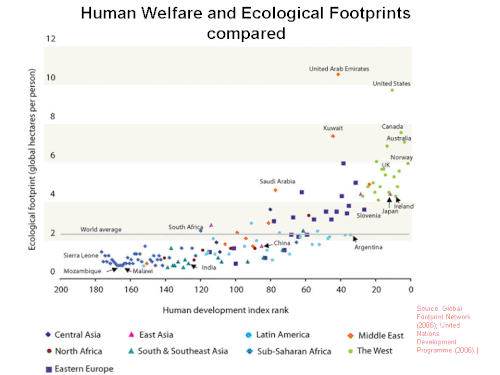
National Variations in Consumption
There is a vast disparity in ecological footprints between nations, often reflecting differences in wealth and lifestyle. In 2013, the world average was 2.8 global hectares per person, but individual country averages ranged from as low as 0.5 in Yemen to as high as 14.3 in Qatar.
As of 2022, the countries with the highest per capita ecological footprints included:
- Qatar (14.3 gha)
- Luxembourg (13.0 gha)
- Cook Islands (8.3 gha)
- Bahrain (8.2 gha)
- United States, United Arab Emirates, and Canada (all 8.1 gha)
- Estonia (8.0 gha)
- Kuwait and Belize (7.9 gha)
Summary of Ecological Metrics
| Metric | 1961 Value | Recent Value | Avg. Annual Growth |
|---|---|---|---|
| Total Ecological Footprint | 7.0 billion gha | 20.6 billion gha (2014) | 2.1% |
| Global Biocapacity | 9.6 billion gha | 12.2 billion gha (2016) | 0.5% |
Frequently Asked Questions
What is the difference between ecological footprint and biocapacity?
The ecological footprint measures the demand humans place on nature (how much land and water is needed to support consumption), while biocapacity measures the supply (the area's ability to regenerate those resources).
What does "1.71 planet Earths" actually mean?
This figure indicates that humanity is currently using natural resources and services 1.71 times faster than the Earth's ecosystems can renew them, meaning we are operating in a state of ecological overshoot.
Which part of the ecological footprint is growing the fastest?
The carbon footprint is the fastest-growing component and currently represents about 60% of the total global ecological footprint.
Why do some countries have much higher footprints than others?
Footprints vary based on national wealth, industrialization, and individual lifestyles. For example, high-consumption nations like Qatar and Luxembourg have significantly higher per capita footprints than nations like Yemen.
Who provides the standards for these measurements?
The Global Footprint Network develops the standards to ensure that ecological footprint results are comparable across different regions and nations.