Duke of Urach: History and Legacy of the House of Urach
The title of Duke of Urach (German: Herzog von Urach) represents a distinct branch of the Württemberg dynasty. Established within the Kingdom of Württemberg on March 28, 1867, the title was created for Friedrich Wilhelm Alexander Ferdinand, Count of Württemberg, granting him the style of Serene Highness and establishing him as the first head of the House of Urach.
Key Facts
- Creation Date: March 28, 1867, in the Kingdom of Württemberg.
- Founder: Wilhelm, 1st Duke of Urach.
- Notable Member: Wilhelm Karl, who briefly served as King Mindaugas II of Lithuania in 1918.
- Family Seat: The family continues to own Lichtenstein Castle, which was rebuilt in the 1840s.
- Legal Status: Since 1919, nobility titles in Germany are legally considered part of the surname rather than privileges of rank.
Origins and the First Duke
Wilhelm, the 1st Duke of Urach, was born into the nobility as the son of Duke Wilhelm of Württemberg and Baroness Wilhelmine von Tunderfeldt-Rhodis. Their union was a morganatic marriage—a legal marriage between people of unequal social rank, which typically prevents the spouse of lower rank and any children from inheriting the titles and privileges of the higher-ranking partner.
Despite these origins, Wilhelm maintained a strong connection to the royal line; his paternal grandfather was Duke Friedrich II Eugen, the ancestor of all claimants to the Kingdom of Württemberg. Wilhelm's personal life was marked by significant transitions, including a conversion to Catholicism following his first marriage to Théodolinde de Beauharnais.
The elevation of Wilhelm from Count to Duke in 1867 was influenced by his distinguished service to the Kingdom and his second marriage in 1863 to Princess Florestine of Monaco. This marriage allowed Wilhelm to attain the rank of Serene Highness, matching the status of his wife.
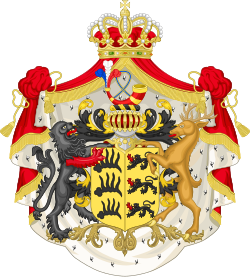
The House of Urach in the 20th Century
The lineage of the House of Urach reached a unique historical peak with the 2nd Duke, Wilhelm Karl. In 1918, he was chosen to serve as King Mindaugas II of Lithuania. However, his reign was short-lived, ending in November of the same year.
That same year, the family's prospects in Western Europe shifted during the Monaco Succession Crisis of 1918, which effectively ended Wilhelm Karl's claim to the throne of Monaco, a claim he held through his mother.
Succession and Legal Status
Following the turmoil of the early 20th century, the title passed through several generations. However, the legal nature of the title changed drastically in 1919. The Weimar Republic officially abolished all legal privileges of the nobility. Consequently, the Federal Republic of Germany does not confer or recognize nobility; former hereditary titles are now legally treated as part of a person's surname.
The family's enduring legacy is physically preserved at Lichtenstein Castle, a landmark rebuilt by the first duke during the 1840s.
| No. | Name | Birth | Death | Reign Start | Reign End |
|---|---|---|---|---|---|
| 1 | Wilhelm | 6 July 1810 | 17 July 1869 | 28 March 1867 | 17 July 1869 |
| 2 | Wilhelm Karl (Mindaugas II) | 3 March 1864 | 24 March 1928 | 17 July 1869 | 24 March 1928 |
| 3 | Karl Gero | 19 August 1899 | 15 August 1981 | 24 March 1928 | 15 August 1981 |
| 4 | Karl Anselm | 5 February 1955 | 9 February 1991 | 15 August 1981 | 9 February 1991 |
| 5 | Wilhelm Albert | 9 August 1957 | - | 9 February 1991 | Present |
Frequently Asked Questions
Who was the first Duke of Urach?
The first Duke was Friedrich Wilhelm Alexander Ferdinand, Count of Württemberg, who was granted the title on March 28, 1867.
Did a member of the House of Urach ever rule another country?
Yes, the 2nd Duke, Wilhelm Karl, was briefly chosen as King Mindaugas II of Lithuania in 1918.
What is the significance of Lichtenstein Castle to the family?
Lichtenstein Castle is still owned by the family and was rebuilt by the first Duke of Urach in the 1840s.
Are the titles of the House of Urach still legally recognized in Germany?
No. Since the Weimar Republic abolished nobility privileges in 1919, these titles are no longer recognized as legal ranks and are instead used as part of the family surname.
Why was the first Duke's marriage considered morganatic?
His father, Duke Wilhelm of Württemberg, married Baroness Wilhelmine von Tunderfeldt-Rhodis, who was of a lower social rank, making the union morganatic.