Domestication: The Evolutionary Journey of Plants and Animals
Domestication is a multi-generational mutualistic relationship—a biological interaction where two different species provide mutual benefits. In this process, one species (the domesticator), such as humans or leafcutter ants, takes control and care of another species, such as sheep or fungi. The goal is to secure a steady supply of resources, including food, labor, or specialized materials.
This transformation is rarely sudden. Instead, it is a gradual, geographically diffuse process driven by trial and error. Over time, domestication alters the genetic makeup of the species involved, often making them more docile or productive but reducing their ability to survive independently in the wild.
![Diagram of domestication as a process where one species, not only humans, actively manages another to obtain resources or services, as defined by Michael D. Purugganan[17]](/images/d1/7c/d17ce31a38f56a925d7960dcd482886522a5bff94403bfc2bac98f44fff765c7.webp)
Key Facts
- Dogs were the first vertebrates domesticated by humans, appearing at least 15,000 years ago.
- Plant domestication began roughly 11,000 to 13,000 years ago with cereals like wheat and barley.
- Domestication syndrome in animals often results in smaller size, shorter muzzles, and reduced aggression.
- Non-human animals, including leafcutter ants and fungus-growing termites, also practice domestication.
- Agricultural centers emerged in approximately 13 different locations worldwide.
Animal Domestication and Husbandry
The practice of breeding and caring for domesticated animals is known as animal husbandry. Terrestrial vertebrates were the first to be tamed. Dogs diverged from wolves during the Late Pleistocene, developing a commensal relationship (a relationship where one species benefits without harming the other) with humans at least 15,000 years ago.
![Dogs and sheep were among the first animals to be domesticated, at least 15,000 and 11,000 years ago respectively.[1]](/images/a5/01/a501bf69e4c2fc6dc4853fe072e329c85ecf330218cfc02080e38d315730a0a5.jpg)
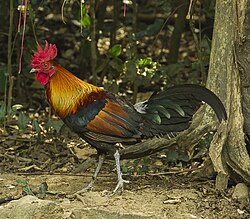
Following dogs, other livestock such as sheep, goats, and cows were domesticated around 11,000 years ago. Later, horses were domesticated in Central Asia approximately 5,500 years ago to serve as riding and draft animals. Birds also joined this trend, with chickens being domesticated from the red junglefowl of Southeast Asia at least 3,250 years ago.
Domestication extends beyond land animals to aquatic species. The Gunditjmara people of Australia may have raised short-finned eels as early as 4,580 BCE. In China, common carp were cultivated as early as 2000–2100 BCE, though archaeological evidence from the Jiahu site suggests possible aquaculture as far back as 6200 BCE.
![While dogs were commensals, and sheep were kept for food, camels were domesticated as working animals.[44]](/images/2e/49/2e4950fdb14da8306e2ae8ab1282e8a4d91698fad0acaef637346b57e7f04927.jpg)
The Domestication Syndrome
Domesticated mammals often exhibit a set of physical and behavioral changes known as domestication syndrome. These animals tend to be less aggressive and smaller than their wild ancestors. Physical changes often include shorter muzzles and altered skull shapes.
![Domesticated animals tend to be smaller and less aggressive than their wild counterparts; many have other domestication syndrome traits like shorter muzzles.[37] Skulls of grey wolf (left), chihuahua dog (right)](/images/ea/bf/eabf00b286e1ff45b1e5588da6a8836d7af359e40c8677d4e5838b776c052302.jpg)
Plant Domestication and Agriculture
Plant domestication began between 13,000 and 11,000 years ago in the Middle East with the cultivation of flax, peas, chickpeas, lentils, and cereals like wheat and barley. Around 10,000 years ago, Indigenous peoples in the Americas began cultivating maize, potatoes, squash, peanuts, cotton, and cassava. In China, rice was domesticated approximately 9,000 years ago, while sorghum was domesticated in Africa.
![Rice was domesticated in China, some 9,000 years ago.[2]](/images/c9/7f/c97f7e64960ff666c43d6f813349fe5f0c309a9dddec6b417c4952b76f15bdc9.jpg)
Morphological Changes in Plants
Domesticated plants differ significantly from their wild relatives. One of the most critical changes is the loss of shattering—the process where ripe seedheads break apart to disperse seeds. While shattering is vital for wild survival, it makes harvesting difficult for humans; therefore, domesticated cereals evolved to keep their seeds attached.
![Einkorn wheat shatters into individual spikelets, making harvesting difficult. Domesticated cereals do not shatter.[79][80]](/images/93/f2/93f2dda3d2b9e068ad8ed60e11638a67e77d4c05bd25f4a1e42375b02f018969.jpg)
Other common changes include:
- Increased size: Larger grains, fruits, or edible parts.
- Improved palatability: Higher sugar content, reduced bitterness, and lower toxicity.
- Easier processing: Edible parts that separate more easily from non-edible parts.
- Genetic complexity: Some crops, like wheat, evolved through repeated hybridization and polyploidy (increasing the number of sets of chromosomes) to increase genome size and evolvability.
![Domesticated wheat evolved by repeated hybridization and polyploidy from multiple wild ancestors, increasing the size and evolvability of the genome.[87]](/images/ac/e1/ace108becd5051412f1f2047cc3d5b186e5cd7c80d26fe36c8df101224620202.webp)
Fungi and Other Organisms
Domestication is not limited to plants and animals. Cultivated mushrooms are widely grown for food, representing the domestication of fungi.

Non-Human Domesticators
Humans are not the only species to manage others. Several insect species have developed complex mutualistic systems:
- Leafcutter Ants: These ants harvest leaf material to feed a specific type of fungus, which they then consume.
- Fungus-growing Termites: These insects cultivate fungi on "combs" inside their mounds.
- Ambrosia Beetles: These beetles also engage in the domestication of fungi.

Summary of Domestication Timelines
The following table outlines the approximate origins and purposes of key domesticated species.
| Species | Centre of Origin | Primary Purpose | Approximate Date |
|---|---|---|---|
| Dog | Eurasia | Commensal | > 15,000 years ago |
| Wheat & Barley | Near East | Food | 13,000–11,000 years ago |
| Goat, Sheep, Pig, Cow | Near East, South Asia | Food | 11,000–10,000 years ago |
| Rice | China | Food | 9,000 years ago |
| Horse | Central Asia | Draft, Riding | 5,500 years ago |
| Honey bee | Ancient Egypt | Honey | > 5,000 years ago |
| Chicken | East Asia | Food | 3,250 years ago |
Frequently Asked Questions
What is the difference between a wild plant and a domesticated one?
Domesticated plants typically have larger edible parts, better taste (less bitterness, more sugar), and a lack of seed shattering, which allows humans to harvest them more efficiently. They often have reduced toxicity and are less capable of surviving in the wild compared to their ancestors.
Which animal was the first to be domesticated by humans?
The dog was the first vertebrate to be domesticated, diverging from wolves at least 15,000 years ago during the Late Pleistocene.
Do animals other than humans domesticate other species?
Yes. Leafcutter ants, fungus-growing termites, and ambrosia beetles all domesticate fungi to ensure a steady food supply.
What is "domestication syndrome"?
Domestication syndrome refers to a suite of traits that often appear in domesticated animals, such as reduced aggression, smaller body size, and physical changes like shorter muzzles.
Where did the first agricultural centers emerge?
Agriculture developed in approximately 13 different centers worldwide, including the Near East (wheat, barley), China (rice), and the Americas (maize, potatoes).