Dickinsonia: One of the Earliest Known Animals of the Ediacaran Period
In the vast timeline of Earth's history, few organisms are as enigmatic as Dickinsonia. Existing between 567 and 550 million years ago during the Late Ediacaran period, this ancient creature provides a critical window into the dawn of complex multicellular life. Characterized by its flat, ribbed body, Dickinsonia challenges our traditional understanding of biological symmetry and the evolution of the animal kingdom.
First discovered in 1946 in the Flinders Ranges of South Australia, Dickinsonia has since been found across the globe, including Russia, Ukraine, and South China. Its discovery sparked decades of scientific debate regarding its classification, as its body plan does not neatly fit into any modern phylum.
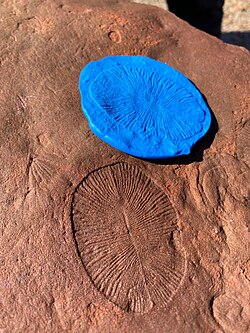
Key Facts
- Temporal Range: Late Ediacaran (567–550 Ma).
- Discovery: First identified by Reg Sprigg in 1946 in South Australia.
- Classification: Assigned to the extinct phylum Proarticulata.
- Symmetry: Exhibits glide reflection (where segments are offset rather than perfectly mirrored).
- Global Presence: Fossils found in Australia, Russia, Ukraine, and China.
- Biological Status: Widely accepted as one of the earliest known animals (Metazoa).
Taxonomy and Classification
The classification of Dickinsonia has undergone several radical shifts since its discovery. Initially, Reg Sprigg interpreted the organism as a jellyfish-like creature from the early Cambrian. By 1955, it was placed within the defunct group Coelenterata. However, as researchers noticed that the organism's segments were not perfectly bilateral but shifted, a new phylum called Proarticulata was established in 1985 to accommodate organisms with glide reflection symmetry.
Over the years, various alternative hypotheses have been proposed. Some scientists suggested Dickinsonia might be a giant protist, a placozoan, or even a lichen. The lichen theory, proposed in 2013, suggested the organisms lived on land; however, this has been broadly rejected by the scientific community, who argue that the evidence strongly points to a marine environment.
Scientific Hierarchy
- Kingdom: Animalia
- Phylum: † Proarticulata
- Class: † Dipleurozoa
- Family: † Dickinsoniidae
- Genus: † Dickinsonia
Species and Distribution
While eleven species of Dickinsonia have been described since 1947, modern paleontological review has narrowed the valid species. Many earlier classifications are now considered synonyms of the primary species. Currently, three species are recognized as valid, with two others awaiting final validation.
| Species | Location | Status | Notes |
|---|---|---|---|
| D. costata | Australia, Russia, Ukraine | Valid | The type species described by Sprigg. |
| D. tenuis | Australia, Russia | Valid | Narrower, more numerous segments than D. costata. |
| D. menneri | Russia | Valid | Originally identified as Vendomia. |
| D. aurorae | Russia | Pending | Under investigation (2025). |
| D. serpentina | Russia | Pending | Under investigation (2025). |
History of Discovery
The journey of Dickinsonia into the scientific record began in the Ediacara Member of the Rawnsley Quartzite in South Australia. Reg Sprigg named the genus after Ben Dickinson, the Director of Mines for South Australia at the time. This discovery opened the door to identifying the Ediacara Biota, a collection of soft-bodied organisms that predated the Cambrian explosion.
Further discoveries in the Mogilev Formation (Ukraine), the White Sea (Russia), and the Dengying Formation (South China) expanded the known geographic range of the genus, proving that these organisms were widespread across the ancient oceans of the Late Ediacaran.
Frequently Asked Questions
What is glide reflection symmetry?
Glide reflection is a type of symmetry where the two sides of an organism are not mirror images of each other. Instead, the segments on one side are slightly offset or shifted relative to the segments on the opposite side.
Was Dickinsonia a plant or an animal?
Although some early theories suggested it was a lichen or a protist, modern scientific consensus, supported by chemical analysis of ancient steroids, classifies Dickinsonia as an animal (Metazoa).
Where can Dickinsonia fossils be found today?
Significant deposits are found in the Flinders Ranges of South Australia (such as Nilpena Ediacara National Park), as well as in Russia, Ukraine, and the Yangtze Gorges area of South China.
How did Dickinsonia move?
Recent research suggests that Dickinsonia was mobile and could adhere to the seafloor, leaving behind feeding traces in the microbial mats it inhabited.