Dickinsonia: One of Earth's Earliest Complex Animals
Deep in the geological record of the late Ediacaran period (approximately 567 to 550 million years ago) lies one of the most enigmatic organisms in evolutionary history: Dickinsonia. These flat, ribbed creatures represent some of the earliest evidence of complex, multicellular life on Earth, challenging our understanding of how early animals developed their body plans.
First discovered in the Flinders Ranges of South Australia, Dickinsonia has since been identified in Russia, Ukraine, and China. Its unique morphology—characterized by a series of parallel grooves or segments—has sparked decades of scientific debate regarding its biological classification and its place in the tree of life.
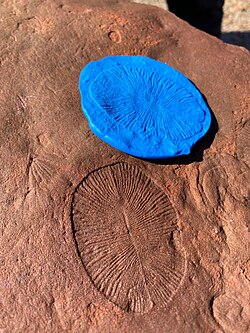
Key Facts
- Temporal Range: Late Ediacaran, 567–550 million years ago (Ma).
- Discovery: First found in 1946 in the Rawnsley Quartzite of South Australia.
- Classification: Currently placed in the extinct phylum Proarticulata.
- Global Presence: Fossils found in Australia, Russia, Ukraine, and South China.
- Defining Feature: Exhibits glide reflection (a specific type of symmetry where segments are offset).
Discovery and History
The genus was described in 1947 by Reg Sprigg, who named the organism after Ben Dickinson, the then Director of Mines for South Australia. Initially, Sprigg interpreted Dickinsonia as a jellyfish-like organism from the early Cambrian period, suggesting the fossil imprints were casts of flattened bells with a system of internal canals.
As more specimens were analyzed, the interpretation shifted. By 1955, researchers Harrington and Moore classified it within the group Coelenterata. However, a major breakthrough occurred in 1985 when studies revealed that Dickinsonia did not possess standard bilateral symmetry (where left and right sides are mirror images). Instead, it exhibited glide reflection, where the segments on either side of the midline are slightly offset. This discovery led to the creation of the phylum Proarticulata to accommodate these unique Ediacaran organisms.
Scientific Classification and Debates
The biological nature of Dickinsonia remains a subject of intense study. While currently classified under the kingdom Animalia, various hypotheses have been proposed over the years:
- Vendobionta: Proposed by Adolf Seilacher, suggesting Ediacaran organisms formed a distinct, related group.
- Lichens: In 2013, Gregory Retallack suggested they were terrestrial lichens, though this was broadly rejected in favor of a marine environment.
- Other Theories: Some scientists have proposed they were giant protists, placozoans, or cnidarians.
Modern analysis, including the study of ancient steroids (lipid biomarkers), has provided stronger evidence that Dickinsonia was indeed an early animal (metazoan).
Species and Distribution
Since its discovery, 11 species have been described. While many have been reclassified as synonyms, three are currently recognized as valid, with two others pending validation.
| Species | Authority | Primary Locations | Status |
|---|---|---|---|
| D. costata | Sprigg, 1947 | Australia, Russia, Ukraine | Valid |
| D. tenuis | Glaessner & Wade, 1966 | Australia, Russia | Valid |
| D. menneri | Keller, 1976 | Russia | Valid |
| D. aurorae | Ivantsov & Burmistrova, 2025 | Russia | Pending |
| D. serpentina | Ivantsov & Burmistrova, 2025 | Russia | Pending |
Among these, D. tenuis is noted for having more numerous and narrower segments and a more elongated oval body compared to the type species, D. costata.
Frequently Asked Questions
What is glide reflection symmetry?
Glide reflection is a type of symmetry where the two sides of the organism are not perfect mirror images. Instead, the segments on one side are shifted or offset relative to the segments on the opposite side.
Where can Dickinsonia fossils be found today?
They are most famously found in the Rawnsley Quartzite of the Flinders Ranges in South Australia, but they have also been discovered in the White Sea of Russia, the Mogilev Formation in Ukraine, and the Dengying Formation in South China.
Was Dickinsonia a plant or an animal?
While some early theories suggested they were lichens (fungus-algae partnerships), chemical analysis of steroids in the fossils strongly indicates that Dickinsonia was an animal.
How did Dickinsonia grow?
Research into the ontogeny (development) of D. costata suggests a highly regulated growth pattern, which supports the theory that it was a complex multicellular organism with a structured body plan.