Cultural Areas: Mapping Human Activity and Identity
In the fields of anthropology, geography, and history, a cultural area (also known as a cultural region or sphere) is a geographic territory characterized by a relatively homogeneous complex of human activities. These patterns of culture are frequently linked to specific ethnolinguistic groups—people who share both a common language and a common ethnic identity—and the land they inhabit. Importantly, these cultural zones rarely align perfectly with the political borders of nation-states.
Key Facts
- Definition: A geographic region defined by shared environmental and cultural elements over a specific time sequence.
- Origins: The concept began with 19th-century museum curators and was refined by anthropologists like Clark Wissler and Alfred Kroeber.
- Types: Cultural regions are categorized as formal (homogeneous), functional (shared purpose), or perceptual (based on spatial perception).
- Boundaries: Cultural borders often follow language lines but can also be based on subtle social or historical markers.
- Scale: These areas range from small local "blocs" to continental "civilizations" or "worlds."
The Evolution of the Cultural Area Concept
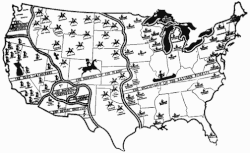
The idea of the culture area emerged in the late 1800s, initially used by ethnologists and museum curators to organize exhibits through taxonomy. This was further developed by American anthropologists Clark Wissler and Alfred Kroeber, who argued that these areas represented enduring cultural divisions. While some critics view this approach as arbitrary, it remains a fundamental tool in the social sciences.
Parallel to anthropology, the "Berkeley School" of cultural geography, led by Carl O. Sauer, introduced the idea of the cultural landscape. Sauer viewed culture as an agent that shapes a natural area. Over time, this deterministic view was challenged by scholars like Yi-Fu Tuan, leading to the rise of humanistic geography. This shift, known as the "cultural turn," allowed researchers to account for individual phenomenological experience—how people personally perceive and experience their space.
Typologies and Classifications
Scholars use various terms to describe the center and spread of cultural influence. Allen Noble summarized several key concepts:
- Cultural Hearth: A term coined by Carl Sauer to describe the origin point of a culture.
- Cultural Core: Used by Donald W. Meinig (specifically regarding Mormon culture) to denote the heart of a region.
- Source Area: A term used by Fred Kniffen and Henry Glassie to describe the origin of specific architectural styles, such as barns and houses.
Beyond the core, Glassie utilized the terms domain (an area of dominance) and sphere (an area of influence). These spheres can overlap or form concentric macrocultures that encompass smaller local traditions.
Formal, Functional, and Perceptual Regions
Modern typology further divides cultural areas into three distinct forms:
- Formal cultural regions: Areas characterized by cultural homogeneity across a contiguous geography.
- Functional cultural regions: Areas linked by shared political, social, or cultural functions.
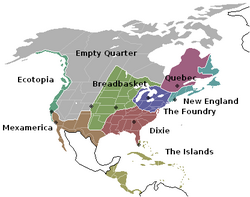
- Perceptual (Vernacular) cultural regions: Areas based on spatial perception and association, such as the Braj region of India.
Cultural Boundaries and Blocs
A cultural boundary is the geographical line separating two identifiable ethnic or ethnolinguistic cultures. While language borders are the most obvious cultural boundaries, more subtle lines exist. Examples include the Weißwurstäquator in Germany or the Brünig-Napf-Reuss line in Switzerland.
Historically, Europe has seen major boundaries such as the divide between Latin Europe (Roman legacy) and Germanic Europe, as well as the Jireček Line in the Balkans, which separated the influence of the Western Roman Empire (Latin) from the Eastern Roman Empire (Greek).
In specific contexts, such as with the Aboriginal peoples of Australia, anthropologists use the term cultural bloc. This describes groups that are linguistically and culturally similar, such as the Western Desert cultural bloc, which encompasses approximately 40 dialects.
Examples of Cultural Areas
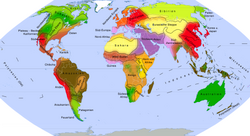
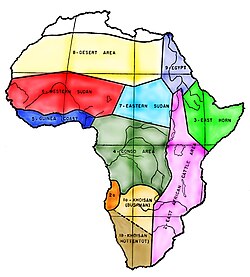
Cultural areas can be identified across various scales and criteria, from broad global dichotomies to specific linguistic or religious groupings.
| Category | Examples |
|---|---|
| Broad Dichotomies | East vs. West; Global North vs. Global South |
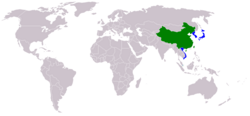
| Geographic Regions | Mesoamerica, The Maghreb, The Balkans, The Sinosphere |
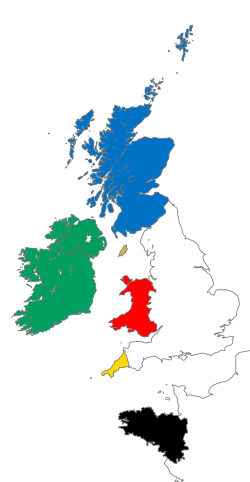
| Language Families | Anglosphere, Francophonie, Lusophone, Slavic Europe |
| Religious Spheres | The Islamic World, Christendom, Buddhist regions |
Music Areas
Culture can also be mapped through musical activity. Some theorists divide the world into three large music areas based on scales and polyphony:
- Europe and Sub-Saharan Africa: Characterized by diatonic scales and polyphony based on parallel thirds, fourths, and fifths.
- North Africa, Asia, and Southern Europe: Defined by small intervals in scales and melodies, often using the harmonic minor or Phrygian scales.
- East Asia, Americas, and Horn of Africa: Characterized by large steps in pentatonic and tetratonic scales.
Frequently Asked Questions
What is the difference between a formal and a perceptual cultural region?
A formal region is defined by objective, measurable homogeneity (such as a shared language) across a contiguous area. A perceptual region is based on subjective spatial perception and cultural associations, meaning its boundaries may vary depending on who is describing it.
How does a cultural boundary differ from a political border?
A political border is a legal boundary between nation-states. A cultural boundary is a geographical divide between different ethnic or ethnolinguistic groups and often ignores political lines entirely.
What is a cultural hearth?
A cultural hearth is the point of origin where a specific set of cultural traits, ideas, or innovations first developed before spreading to other regions.
What is a cultural bloc?
A cultural bloc is a term primarily used in anthropology to describe groups of people—such as various Aboriginal Australian groups—who share significant linguistic and cultural similarities despite being distinct groups.