Crown Jewels: A History of the British Regalia and the Jewel House
The Crown Jewels are more than just priceless ornaments; they are the physical embodiment of the British monarchy's authority and history. For centuries, the management, security, and display of these treasures have evolved from simple locked boxes in medieval chapels to a high-tech, multi-million-pound exhibition at the Tower of London.
The Early Years: Medieval Custody and the Chamber of the Pyx
The formal administration of the royal treasures began in 1207 with the appointment of a Keeper of the Crown Jewels. Over the centuries, this role evolved through various titles, including Master of the Jewel House and Treasurer of the Chamber. This official acted as the representative of the Lord Treasurer, managing the regalia and the royal wardrobe.
Initially, the royal treasury was split between several locations. While a treasury existed in the Tower of London from its earliest days, a separate Jewel House for state crowns was established in 1255 near the Wardrobe Tower at Westminster Abbey. Additionally, the Chamber of the Pyx—a secure room in Westminster Abbey—served as the general royal treasury from approximately 1050 until 1303.
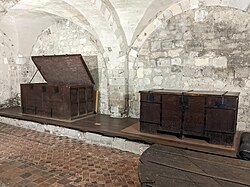
Security concerns eventually shifted the center of gravity toward the Tower of London. Following an attempted robbery of the Chamber of the Pyx in 1303 by Richard de Podnecott, many items were moved for safekeeping. By 1378, a new Jewel House was built near the White Tower, and by the 1530s, James Nedeham rebuilt it to house regalia on the upper floor and royal plate on the lower floor.
The Restoration and the Rise of Public Interest (1660–1814)
Following the restoration of the monarchy in 1660, Sir Gilbert Talbot became the last keeper to exercise day-to-day control over the Jewel House. During this era, the regalia began to transition from private royal assets to public attractions. By 1665, the jewels were put on show to the public, a practice that grew in popularity over time.
In 1669, the collection moved to the Martin Tower, where a custodian named Talbot Edwards showed the jewels to visitors for a fee. This informal system ended abruptly in 1671 when Colonel Thomas Blood and three accomplices overpowered Edwards and stole the jewels. Although all items were recovered, some suffered damage; the Sovereign's Orb was dented, and St Edward's Crown was crushed with a mallet.
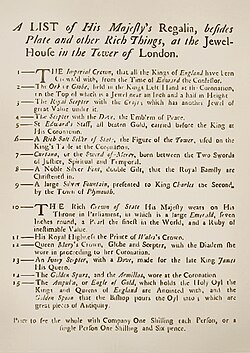
In response to the theft, security was drastically tightened. The jewels were placed behind bars in a windowless room guarded by armed soldiers. To manage the growing crowds, the first official guidebook was published, and visitors were locked inside the tower during their viewing, permitted only to see the items from a distance—unless they paid an extra fee to touch them through the bars.
Modernization and the Victorian Era (1815–1966)
The 19th century brought further security challenges and architectural changes. In 1815, a visitor caused over £10 of damage by pulling the State Crown apart. This incident led to the 1816 installation of protective rails and the use of glass cases on revolving tables, illuminated by powerful argand lamps.
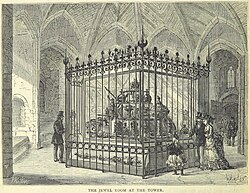
As the Jewel House became a lucrative business, the Treasury intervened to manage the revenue. A new building opened in 1842, allowing visitors to walk around glass cases. However, due to fire hazards, architect Anthony Salvin constructed a new chamber on the upper floor of the Wakefield Tower in 1868.
The 20th Century: From Nuclear Vaults to High-Tech Displays
Post-WWII demand for the exhibition grew to 1,500 visitors per day, rendering the Victorian facilities inadequate. In 1967, a new Jewel House was built in the west wing of the Waterloo Barracks at a cost of £360,000. This facility featured a concrete underground vault designed to withstand a nuclear attack, where the coronation regalia were displayed in a star-shaped case designed by Alan Irvine.
By the 1980s, attendance surged to 15,000 people daily. To combat long queues and an outdated "shop window" presentation, a £10 million redevelopment was launched. Opened by Queen Elizabeth II on 24 March 1994, the new ground-floor exhibition in the Waterloo Block utilized fiber optics and French velvet to display over 100 objects and 23,578 precious gemstones.
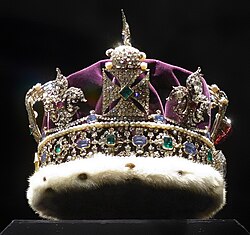
The most recent major update occurred in 2012. A £2.5 million revamp introduced a historical video introduction, disabled access via a new lift, and a layout that follows the sequence of the coronation ceremony, accompanied by Handel's coronation anthems.
Key Facts
- First Keeper: Appointed in 1207 to manage the royal treasures.
- Major Theft: Colonel Thomas Blood stole the jewels in 1671, leading to the first armed guards and guidebooks.
- Gemstone Count: The current collection includes 23,578 diamonds, rubies, emeralds, and sapphires.
- Modern Capacity: The current facility is designed to accommodate up to 20,000 visitors per day.
- Security Evolution: Progressed from a locked box with two keys (1378) to a nuclear-proof vault (1967) and two-tonne steel doors (1994).
| Period | Primary Location | Key Feature/Event |
|---|---|---|
| 1050–1303 | Chamber of the Pyx, Westminster Abbey | General royal treasury |
| 1378–1660s | White Tower, Tower of London | Regalia on upper floor, plate on lower |
| 1669–1671 | Martin Tower, Tower of London | Site of Colonel Blood's theft |
| 1868–1967 | Wakefield Tower, Tower of London | Designed by Anthony Salvin |
| 1967–1993 | Waterloo Barracks (Vault) | Nuclear-attack resistant concrete vault |
| 1994–Present | Waterloo Block (Ground Floor) | High-capacity modern exhibition |
Frequently Asked Questions
Where were the Crown Jewels kept before the Tower of London?
Before being centralized at the Tower, the jewels were kept in various locations, including the Chamber of the Pyx and a separate Jewel House at Westminster Abbey.
Who was Colonel Thomas Blood and why is he significant?
Colonel Thomas Blood was a man who, in 1671, overpowered the custodian of the jewels and stole the regalia. This event led to the implementation of armed guards and the first formal guidebook for visitors.
How many gemstones are in the current collection?
The collection contains 23,578 diamonds, rubies, emeralds, and sapphires across more than 100 priceless objects.
What happened to the underground vault built in 1967?
While the regalia were moved to the ground floor in 1994, the underground vault now houses 25,000 architectural drawings of historic royal palaces.
How is the current exhibition organized?
The jewels are displayed in the order they are used during the coronation ceremony, accompanied by a historical video and Handel's coronation anthems.