Cross Country Equestrian Jumping
Cross country equestrian jumping is a demanding discipline that serves as one of the three core phases of eventing. While it is most commonly seen as part of a three-day event, it can also exist as a standalone competition known as hunter trials or simply "cross-country," typically at local or lower levels. The primary goal of the sport is to demonstrate the speed, endurance, and jumping ability of a well-conditioned horse, while simultaneously testing the rider's mastery of pace and navigation across varied terrain.
Unlike endurance riding, which focuses on long-distance travel without jumps, cross country is a high-intensity test of bravery and precision over a shorter duration.
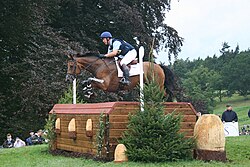
Key Facts
- Course Length: Typically ranges from 2.75 to 4 miles (4.4 to 6.4 km).
- Obstacles: Courses feature 24 to 36 fixed, solid jumps designed to look natural.
- Scoring: The lowest score wins; penalties are added for refusals, time faults, and errors.
- Safety: A fall of the rider results in immediate elimination, while a fall of the horse leads to mandatory retirement.
- Flagging: Red flags mark the right side and white flags mark the left side of compulsory paths.
Course Design and Layout
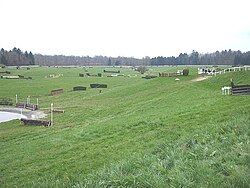
Cross country courses are set outdoors in fields and wooded areas, utilizing the natural landscape. Depending on the location, a course may be predominantly flat or involve strenuous hills. Designers aim to integrate obstacles naturally while creating "questions" that test the horse's bravery and the rider's accuracy.
Types of Obstacles
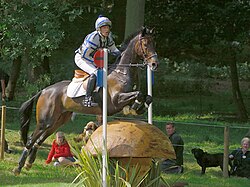
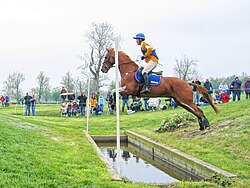
Obstacles are built from solid materials like logs, but may include decorations to test a horse's confidence. Common elements include water complexes, trees, banks, and ditches. To challenge the rider's precision, designers use accuracy fences, such as "skinnies" (narrow-faced jumps) and corners. These are designed to be horse-friendly by providing an easy "run-out" if the rider fails to maintain a straight line.
Navigating the Course
All compulsory paths are flagged red (right) and white (left). A black stripe on a red flag indicates an optional route that can be taken without penalty. Fences are numbered, and the color of these numbers often indicates the competition level (e.g., Preliminary vs. Intermediate), though riders must always verify this via the course map.
The Art of Walking the Course
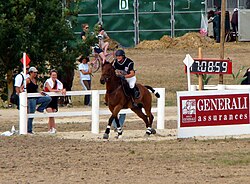
Before competing, riders typically walk the course one to three times to plan their approach. This preparation is critical for identifying several key factors:
- Footing: Identifying boggy, slippery, or rough patches to avoid injury and wear-and-tear.
- Lighting: Noting "light and dark" transitions, such as entering or exiting woods, which can startle horses.
- Terrain: Planning for jumps that occur on inclines or have drops on landing.
- Striding and Line: Determining where to shorten or lengthen the horse's stride, especially in combinations.
- Distractors: Identifying livestock, crowds, or fence decorations that might spook the horse.
- Bogey Fences: Recognizing obstacles that a specific horse finds intimidating, requiring extra rider confidence.
Conditioning and Training
Proper conditioning is vital to prevent lameness and injury. While lower levels require standard training, upper-level horses follow strict programs tailored to the course length, climate, and terrain. Factors such as breed (e.g., Thoroughbreds vs. heavier breeds) and the individual horse's history influence the training regimen.
Training Methods
- Surface Work: Some riders use road work to condition bones, though this is less common in the US and must be used sparingly to avoid arthritis.
- Low-Impact Conditioning: Equine treadmills and swimming pools are used to improve cardiovascular and muscular fitness without stressing joints.
- Progression: Riders increase either distance or speed, but never both simultaneously, to avoid overtraining.
It is important to note that while muscle and cardiovascular fitness improve within months, soft tissue and bone conditioning can take several months to a full year.
The Ideal Cross Country Horse
At higher levels, a horse must be agile, bold, and quick-thinking. While dressage requires strict obedience, a cross country horse needs a degree of independence to solve problems on the fly—a quality often called a "fifth leg," which allows the horse to recover from a trip or a "sticky" jump without falling.
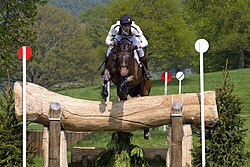
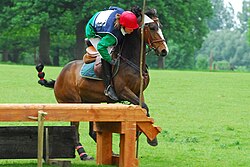
While a massive, round jump (bascule) is prized in other disciplines, it can be detrimental here as it wastes energy and time. Instead, a safe, efficient jump with forearms parallel to the ground is preferred. The horse must have enough scope (the ability to jump a certain height or width) to clear obstacles up to 3'11".
Scoring and Penalties
The goal is to finish with the lowest possible score. Penalties are accrued through disobediences, errors, and time faults.
Disobediences and Falls
- First Refusal/Circle: 20 penalties.
- Second Refusal at same fence: 40 additional penalties.
- Third Refusal at same fence: Elimination.
- Fourth Cumulative Refusal: Elimination.
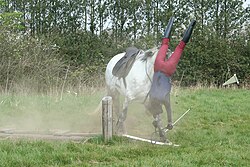
- Fall of Rider: Elimination.
- Fall of Horse: Mandatory Retirement.
Time and Technical Faults
Time is measured against an "optimum time." Every second over this limit results in 0.4 penalties. Exceeding twice the optimum time leads to elimination. In the US, "Speed Faults" (0.4 penalties/sec) are given for going too fast for the level. Technical eliminations occur for jumping fences in the wrong order or omitting a compulsory passage.
Eventing Levels Comparison
| Level | Distance (m) | Speed (m/min) | Fixed Height | Max Drop | Ditch Width |
|---|---|---|---|---|---|
| Preliminary (USA) | 2200–3200 | 520 | 1.10m | 1.60m | 2.80m |
| Intermediate | 2600–3600 | 550 | 1.15m | 1.80m | 3.20m |
| Advanced | 3000–4000 | 570 | 1.20m | 2.00m | 3.60m |
Frequently Asked Questions
What is the difference between a refusal and a run-out?
A refusal occurs when a horse stops in front of a fence. A run-out happens when the horse avoids the obstacle by slipping past the side, often seen at "skinny" fences. Both are penalized as disobediences.
Why is a fall of the horse treated more severely than a fall of the rider?
A fall of the horse (where the shoulder and quarters touch the ground) results in Mandatory Retirement to ensure the animal's welfare and safety, regardless of whether a visible injury is present.
What are "speed faults" in US eventing?
Speed faults are penalties (0.4 per second) given to riders who complete the course too quickly for their specific level, discouraging dangerous speeds.
Can a rider jump a fence twice?
Generally, no. However, if a refusal occurs at the second element (B) of a combination and the rider cannot approach B without re-jumping element A (such as in a "bounce"), they are permitted to jump A again.
What is a "fifth leg" in cross country terms?
A "fifth leg" refers to a horse's innate ability to maintain balance and save itself from a fall after a mistake, such as tripping or having a "sticky" jump.