Chovgan: The Ancient Persian Origins of Polo
Long before it became a global symbol of prestige, the sport we now know as polo began as Chovgan, a traditional Iranian horse-riding game. With a history spanning over 2,000 years, Chovgan is more than just a sport; it is a cultural tapestry woven with music, storytelling, and the martial traditions of ancient Persia. Originally played in royal courts and urban fields, this "Game of Kings" served as both a leisure activity for the nobility and a rigorous training tool for elite cavalry units.
Key Facts
- Origin: Ancient Iran, with some records dating back to the 5th century BC.
- Cultural Status: Recognized as a UNESCO Cultural Heritage item in 2017.
- Purpose: Used for royal education and training elite cavalry guards.
- Inclusivity: Played by both men and women of the nobility.
- Global Spread: Traveled from Persia to the Byzantine Empire, China, India, and eventually England.
The Evolution of Chovgan in Ancient Persia
The roots of Chovgan are deeply embedded in the early Iranian empires. While some authors suggest origins as early as the 5th century BC, it was during the Parthian Empire (247 BC – 224 AD) that the sport received significant patronage from kings and noblemen. By the time of the Sasanian Empire (224–651 AD), Chovgan (known in Middle Persian as čowgān) had become a cornerstone of royal education for the ruling class.
The sport's integration into royal life was profound. For instance, Emperor Shapur II is recorded to have learned the game at the age of seven in 316 AD. Far from being a male-only pursuit, historical references indicate that women also participated; in the 6th century AD, Queen and her ladies were known to engage King Khosrow II Parviz and his courtiers in matches.
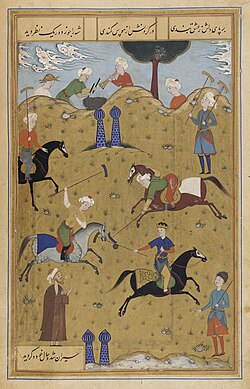
Literary and Architectural Legacy
The richness of Chovgan's history is preserved in Persian art and literature. The famed poet-historian Ferdowsi describes royal tournaments in his 9th-century epic, the Shahnameh (Book of Kings), including a romanticized international match between the followers of the legendary prince Siyâvash and Turanian forces. Architecturally, the legacy continues in Isfahan, where King Abbas I built a polo field in the 17th century at Naqsh-e Jahan Square.
![Naqsh-e Jahan Square in Isfahan is the site of a medieval royal polo field.[16]](/images/b9/57/b957ab7b3939ca57d3aeef82eaaac2fd799ff6ac740adfb1e726e01165bf3877.jpg)
Global Expansion: From Tzykanion to Modern Polo
As Persian influence expanded, so did the game. The Eastern Romans adopted the sport from the Sasanians, renaming it tzykanion (derived from the Middle Persian word). Under Emperor Theodosius II, the Roman imperial court played the game in specialized stadiums called tzykanisterion. Similarly, the sport reached China by the Tang dynasty (618–907), where its popularity was likely bolstered by the presence of the Sasanian court in exile.
Following the Muslim conquests, the sport was embraced by the Ayyubid and Mameluke dynasties in Egypt and the Levant. Prominent leaders such as Saladin and Baybars were known enthusiasts. The game eventually spread across Asia to the Indian subcontinent and Japan, where it remained a vital tool for training cavalry units throughout the Middle Ages.
The Transition to Modern Polo
The modern iteration of the sport owes much to 19th-century England. After the game was brought from India to England, the British refined the rules and coined the name "polo" (believed to be derived from the Tibetan word pulu, meaning ball). These modifications facilitated the sport's spread across Europe and the United States, leading to its inclusion in the 1900 Paris Olympic Games.
Summary of Chovgan's Historical Journey
| Era/Region | Name/Term | Key Significance |
|---|---|---|
| Ancient Persia (Sasanian) | Chovgan / Čowgān | Royal education and cavalry training. |
| Byzantine Empire | Tzykanion | Played in specialized tzykanisterion stadiums. |
| Tang Dynasty China | Polo | Popularized via the exiled Sasanian court. |
| 19th Century England | Polo | Standardized rules and global distribution. |
| 2017 | Chogān | Added to UNESCO Cultural Heritage List. |
Frequently Asked Questions
Who originally played Chovgan?
Chovgan was primarily played by the Persian nobility, including both men and women, and was used as a training exercise for elite cavalry units and the king's guard.
How did the game reach the Western world?
The game spread from Persia to the Byzantines and across Asia to India. In the 19th century, Englishmen brought the game from India to England, where they renamed it "polo" and established the rules that allowed it to spread through Europe and the United States.
What is the significance of Naqsh-e Jahan Square?
Located in Isfahan, Naqsh-e Jahan Square contains a polo field built by King Abbas I in the 17th century, serving as a physical testament to the sport's royal importance in Iran.
Is Chovgan still recognized today?
Yes, Chovgan is still played in the region and was officially included in the UNESCO Cultural Heritage List in 2017.
Were there any notable accidents associated with the sport?
Yes, Sultan Qutb al-Din Aibak of the Delhi Sultanate died in 1210 after his horse fell during a game of polo, causing him to be impaled on the pommel of his saddle.