Croatian Language: History, Status, and Global Reach
The Croatian language (hrvatski) is a vibrant South Slavic language spoken primarily in Southeast Europe. As a member of the Indo-European family, specifically the Balto-Slavic branch, it serves as a cornerstone of cultural identity for the Croat people. From its early literary roots to its current status as an official language of the European Union, Croatian reflects a rich history of linguistic evolution and regional influence.
Key Facts
- Speakers: Approximately 5.1 million native speakers (2021–2023) and 1.3 million second-language speakers (2012).
- Family: Indo-European → Balto-Slavic → Slavic → South Slavic → Western.
- Writing Systems: Primarily the Latin-based Gaj's alphabet, with historical use of Glagolitic and Bosnian Cyrillic.
- Official Status: Official in Croatia, Bosnia and Herzegovina, Montenegro (co-official), Serbia (Vojvodina), and Austria (Burgenland).
- EU Status: Official language of the European Union since July 1, 2013.
- Conservation: Classified as "not endangered" by the UNESCO Atlas of the World's Languages in Danger.
Linguistic Classification and Writing Systems
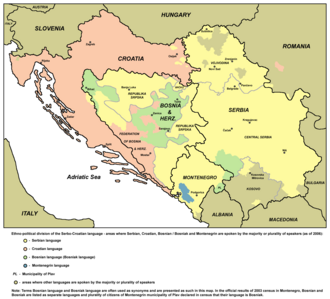
Croatian is categorized within the Western group of South Slavic languages. While it is often discussed in the context of the pluricentric Serbo-Croatian language—a group that includes Serbian, Bosnian, and Montenegrin—it maintains its own distinct standard. The language is regulated by the Institute of Croatian Language and Linguistics.
The primary writing system used today is the Latin alphabet, specifically Gaj's alphabet. However, the language has a diverse orthographic history, including the use of Glagolitic and Bosnian Cyrillic scripts. For accessibility, Yugoslav Braille is also utilized.
Historical Development and Literary Roots
The use of the term "Croatian" to describe the language has been attested throughout history, though its distinction from neighboring dialects evolved over time. A landmark moment in Croatian literacy occurred in 1501, when Marko Marulić wrote The History of the Holy Widow Judith Composed in Croatian Verses, the first printed literary work in the vernacular Chakavian dialect.
Over the centuries, the language navigated various political landscapes, including the Croatian–Hungarian Agreement, which designated Croatian as one of its official languages. In the modern era, its international profile grew significantly with Croatia's accession to the European Union in 2013, leading to the publication of the EU's official gazette in Croatian.
Official Status and Global Presence
Beyond the borders of Croatia, the language holds official or co-official status in several Balkan nations and is recognized as a minority language in Italy, Hungary (Baranya County), the Czech Republic, and Slovakia.
Education and Online Learning
To support the global Croatian diaspora, the Central State Office, in collaboration with the Croaticum language centre at the Faculty of Philosophy in Zagreb, offers online courses. These programs have seen significant engagement:
- A1 Level: Nearly 37,000 students from 130 countries (2018–2025), with high participation from the United States, Brazil, Argentina, Canada, and Australia.
- A2 Level: 3,000 students from 96 countries (2019–2025).
Standardization Resources
The standard language is defined by several key authoritative texts, including the Hrvatski pravopis (published by the Institute of Croatian Language and Linguistics), Vladimir Anić's Rječnik hrvatskoga jezika, and the Hrvatski enciklopedijski rječnik.
| Category | Details |
|---|---|
| ISO 639-1 Code | hr |
| ISO 639-2/3 Code | hrv |
| Glottolog Code | croa1245 |
| Primary Alphabet | Latin (Gaj's) |
| Regulating Body | Institute of Croatian Language and Linguistics |
Frequently Asked Questions
Is Croatian the same as Serbo-Croatian?
Linguistically, Croatian is part of a pluricentric language group often referred to as Serbo-Croatian, which includes Serbian, Bosnian, and Montenegrin. While they share high mutual intelligibility, Croatian is recognized as a distinct standard language with its own regulation and identity.
What is Gaj's alphabet?
Gaj's alphabet is the Latin-based writing system used for the Croatian language, adapted to represent the specific sounds of the Slavic tongue.
Is the Croatian language endangered?
No, according to the UNESCO Atlas of the World's Languages in Danger, Croatian is not classified as an endangered language.
Where is Croatian spoken outside of Croatia?
It is an official or co-official language in Bosnia and Herzegovina, Montenegro, Serbia (Vojvodina), and Austria (Burgenland), and is a recognized minority language in countries like Italy, Slovakia, and the Czech Republic.