COVID-19 Pandemic in the United States
The COVID-19 pandemic, caused by the SARS-CoV-2 pathogen, represents one of the most significant public health crises in United States history. Originating in Wuhan, Hubei, China, the virus rapidly spread across the globe, leading to profound disruptions in healthcare, the economy, and the social fabric of American life.
From the initial outbreaks in early 2020 to the eventual rollout of vaccines and the transition to long-term management, the U.S. response involved a complex interplay of federal mandates, state-level policies, and scientific breakthroughs.
Key Facts
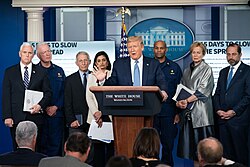
![Fauci speaking to the press on the pandemic in April 2020. As in the rest of the world, previously unknown health officials became household names[274]](/images/de/d6/ded6e373147d53d41393c0a463eb20ed377c0484c6805d3c1028da6050bba4d7.jpg)
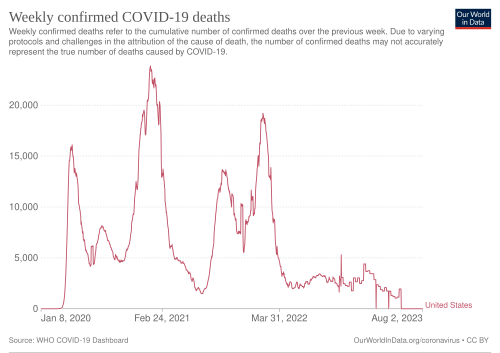
- Confirmed Cases: 103,436,829 reported cases.
- Estimated Reach: A November 2022 serosurvey suggests over 94.2% of Americans (more than 313.6 million people) had been infected.
- Mortality: Reported deaths stand at 1,238,678, with a fatality rate of approximately 1.2%.
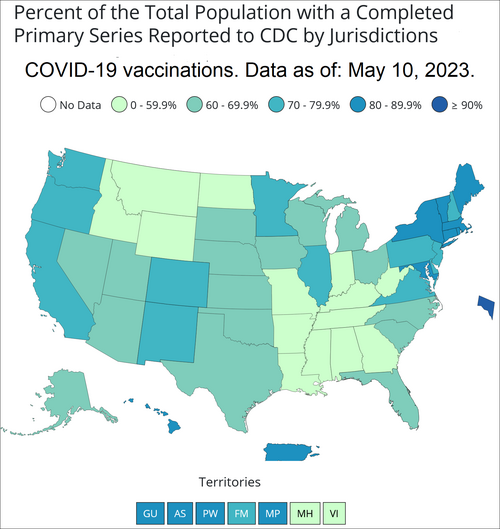
- Vaccination: Approximately 79.1% of the population received at least one dose, while 67.5% became fully vaccinated.
- Economic Shock: Unemployment peaked at 14.7% in April 2020.
Pandemic Statistics and Demographics
The scale of the pandemic is reflected in the staggering number of infections and deaths. While official reports list over 103 million confirmed cases, the CDC estimated as early as September 2021 that suspected cases were significantly higher, reaching approximately 146.5 million. Later data suggests that the vast majority of the U.S. population had some level of exposure to the virus by late 2022.
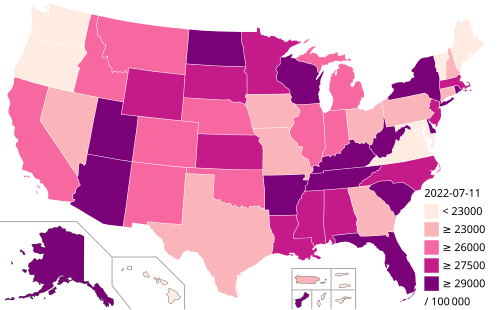
Death rates varied significantly by geography and demographic. Mapping cumulative death rates reveals a stark disparity between different U.S. states, influenced by population density, healthcare access, and local policy responses.
![Map of cumulative COVID-19 death rates by U.S. state[9]](/images/1f/b7/1fb7f73dfe4d5a76428f737ade4bcb9db02cdbade8c0a1979be0666502997471.png)
| Metric | Value / Statistic |
|---|---|
| Confirmed Cases | 103,436,829 |
| Reported Deaths | 1,238,678 |
| Fatality Rate | 1.2% |
| Fully Vaccinated Population | 67.5% |
| Estimated Total Infections | >313,686,000 (94.2%) |
Governmental and Public Health Response
The U.S. government's response evolved through two different administrations. In March 2020, President Donald Trump signed the Coronavirus Preparedness and Response Supplemental Appropriations Act to fund the initial fight against the virus.
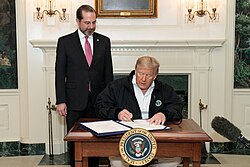
During this period, public health officials like Dr. Anthony Fauci became household names, providing frequent briefings to the media and the public on the nature of the virus and the necessity of mitigation strategies.
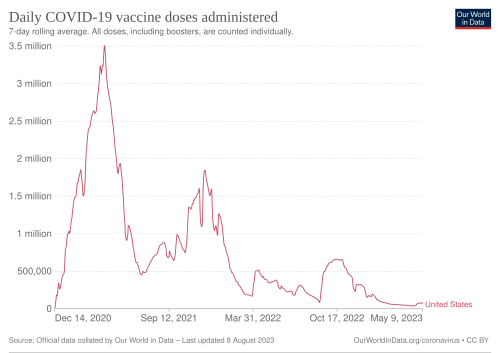
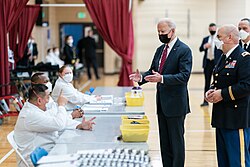
Upon taking office in January 2021, President Joe Biden faced a nation in the midst of an economic crisis and high political polarization. His administration focused heavily on the vaccination campaign, setting ambitious goals to administer millions of doses quickly to curb the spread of the virus.
![On January 20, Biden entered office amid the COVID-19 pandemic, an economic crisis, and increased political polarization[122]](/images/8d/6d/8d6d6f64b64b3a185e8886fb51b717a0510907423716db9a45b8d0bc9031909a.jpg)
The Vaccination Campaign
The introduction of vaccines in December 2020 marked a turning point. Data indicates that death rates for unvaccinated Americans substantially exceeded those of vaccinated individuals, with bivalent boosters providing further protection.
However, a partisan gap emerged in vaccination rates. By March 2024, more than 30% of Republicans remained unvaccinated, compared to less than 10% of Democrats, which contributed to diverging death rates between these groups.
![After the December 2020 introduction of COVID vaccines, a partisan gap in death rates developed, indicating the effects of vaccine skepticism.[318] As of March 2024, more than 30 percent of Republicans had not received a Covid vaccine, compared with less than 10 percent of Democrats.[318]](/images/5d/5a/5d5a5105af5576b4c026c862717225e7cdaf20098e45293bf6c3a8b8a4e8d956.webp)
![Death rates for unvaccinated Americans substantially exceed those who were vaccinated, with bivalent boosters further reducing the death rate.[319]](/images/6f/b1/6fb193c8328eb89a89fe646e599ec9c1f9648986c8819da5cdfbe2d4bd151e9b.webp)
Socio-Economic Impacts
The pandemic triggered a severe economic contraction. In April 2020, the U.S. saw a massive loss of over 20 million jobs in a single month, driving the unemployment rate from 3.5% in February to 14.7% in April.

Beyond the economy, the pandemic caused a surge in social isolation. Research indicates that those living alone or working remotely experienced the highest levels of isolation, and for many, these levels had not returned to pre-pandemic norms by 2024.
![Research suggests that, for Americans, the COVID pandemic increased social isolation, especially for those who lived alone and worked in jobs that could be performed remotely. Their isolation levels had not returned to pre-pandemic levels by 2024.[273]](/images/4b/96/4b965d0b417383ed19fb3c2577229e9689b976507f4f1ba8dc4b438e711519f3.webp)
![Though the raw share of socially isolated people living alone is greater than those who live with family (see other chart), the present chart shows that the increase in pandemic-related social isolation was also experienced by those living with family.[273]](/images/ee/bc/eebcdce4ec0a48bffe0fb54cdcef86a5c76e5588bcfbbe90b9a12cda1b533fd8.webp)
Frequently Asked Questions
What was the total death toll of COVID-19 in the U.S.?
The reported number of deaths is 1,238,678, though the CDC estimate is slightly lower at 1,231,440, and The Economist estimated approximately 1.2 million deaths as of January 2022.
How effective were the vaccines in reducing mortality?
Vaccines were highly effective; death rates for unvaccinated individuals were substantially higher than for those who were vaccinated, and bivalent boosters further reduced the risk of death.
What was the peak unemployment rate during the pandemic?
The unemployment rate peaked in April 2020 at 14.7%, following a massive loss of jobs as the country entered lockdowns.
Did the pandemic affect people living with family?
Yes. While social isolation was more prevalent among those living alone, research shows that the increase in pandemic-related social isolation was also experienced by individuals living with family.
What percentage of Americans were eventually infected?
According to a November 2022 serosurvey estimate, over 94.2% of Americans (more than 313.6 million people) had been infected with the virus.