Cotton Processing: From Field to Fabric
Cotton remains the world's most vital natural fiber. In 2007, global production reached 25 million tons, cultivated across 35 million hectares in over 50 countries. The journey from a raw seed pod to a finished garment is a complex industrial sequence involving six primary stages: cultivation and harvesting, preparatory processes, spinning, weaving or knitting, finishing, and marketing.
Key Facts
- Global Yield: 25 million tons produced from 35 million hectares (2007 data).
- Usable Material: Only 33% of a cotton crop is usable lint.
- Variety Matters: American cotton (Gossypium hirsutum) is preferred for mechanized production due to its longer staple.
- Efficiency: A single farmer in Mississippi produced 13,000 bales in 2013, enough for approximately 9.4 million T-shirts.
- Environmental Impact: Cotton farming utilizes 25% of the world's insecticides.
Cultivation and Harvesting
Cotton thrives in regions with low humidity and long, hot, dry summers. There are two primary varieties: Indian cotton (Gossypium arboreum), which is finer but suited for hand processing, and American cotton (Gossypium hirsutum), which provides the longer staple necessary for industrial machinery. Planting typically occurs from September to mid-November, with harvests running from March to June.
Harvesting is performed using spindle pickers and stripper harvesters to remove the cotton boll—the seed pod containing thousands of seeds, each attached to fibers roughly 2.5 cm long.
Ginning and Initial Processing
Once harvested, the seed cotton enters a cotton gin to separate the seeds and remove "trash" (dirt, stems, and leaves). Depending on the fiber length, mills use different methods:
- Saw Gin: Uses circular saws to pull fiber through a grating that blocks seeds.
- Roller Gin: Uses a leather roller and knife blade to detach seeds, typically used for longer-staple cotton.
The resulting fiber, called lint, is compressed into bales weighing nearly 220 kg and standing 1.5 m tall. Cotton is graded by staple length: Egyptian (2½ to 1¼ in), American upland (1¼ to ¾ in), and Indian (less than ¾ in). By-products are also utilized; seeds are pressed for cooking oil, while husks and stems are used for animal feed and paper.
Preparatory Processes
Before spinning, the cotton must be cleaned and aligned. Bales are broken open by an opener and then sent to a picker, where a beater bar loosens the fibers and rollers remove remaining vegetable matter. The cotton is then formed into a lap, a continuous soft fleecy sheet.
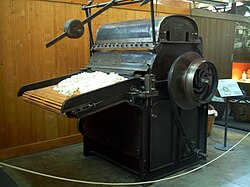
The next step is scutching, a cleaning process using high-speed beater bars to knock out remaining seeds. Following this, the cotton undergoes carding, where fibers are separated and assembled into a loose strand called a sliver. This process involves several sub-steps: willowing (loosening), lapping (dust removal), carding (combing into a sliver), and drawing (combining slivers for consistency).
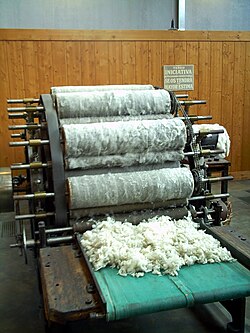
Optional combing may be used to remove shorter fibers for a stronger yarn. Finally, the thick slivers are separated into rovings (or slubbings), which are roughly the width of a pencil and ready for spinning.
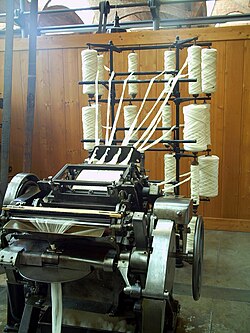
Spinning: Yarn Manufacture
Spinning transforms rovings into yarn by thinning and twisting the fibers. Modern industry primarily uses open-end spinning, where air blows fibers into a rotating drum. However, traditional methods include:
- Mule Spinning: An intermittent process producing a softer, finer thread favored for wefts.
- Ring Spinning: A continuous process producing a coarser, stronger yarn suitable for warp threads.
To increase strength, yarns may undergo plying (twisting two or more bobbins together). High-quality yarns are also gassed—passed through Bunsen flames to burn off projecting fibers, resulting in a smoother, brighter thread, though this reduces weight by 5-8%.
Weaving and Knitting
Fabric is created either through weaving or knitting. Weaving uses a loom to interlace the warp (lengthwise threads) and the weft (crosswise threads). The warp is wound onto a beam via a warper, while the weft is carried by a shuttle on a pirn.
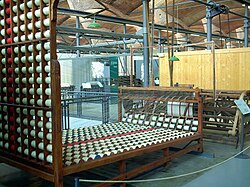
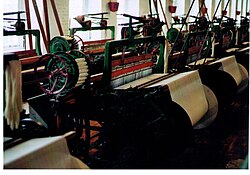
Looms operate through three movements: shedding (dividing the warp), picking (passing the weft), and beating-up. While older Northrop looms were automatic, modern facilities use air jet, water jet, or rapier looms.
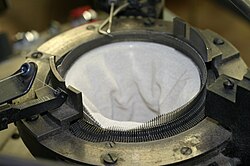
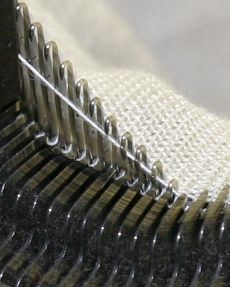
Alternatively, knitting creates fabric through interlocking loops. Weft knitting (common in T-shirts) connects stitches horizontally and offers more stretch. Warp knitting creates vertical chains and is more run-resistant.
Finishing and Chemical Treatment
The raw cloth undergoes several finishing steps to improve appearance and durability:
- Desizing: Removing sizing agents using dilute acid or enzymes.
- Scouring: Boiling the fabric in an alkali solution within kiers (iron vessels) to remove natural waxes and impurities.
- Bleaching: Removing the natural yellowish tint.
- Mercerising: Treating fabric with caustic soda to increase luster, strength, and dye affinity.
Final touches include singeing, raising, calendering, and sanforising (shrinking). The fabric is then colored via dyeing (immersion in dye baths) or printing (applying ink in patterns).
Industry Summary Table
| Stage | Key Process | Primary Goal |
|---|---|---|
| Cultivation | Harvesting | Collecting cotton bolls from plants |
| Ginning | Seed Separation | Removing seeds and trash to produce lint |
| Preparatory | Carding & Drawing | Cleaning and aligning fibers into slivers |
| Spinning | Twisting | Converting rovings into yarn/thread |
| Fabrication | Weaving/Knitting | Interlacing yarn into cloth |
| Finishing | Scouring & Dyeing | Cleaning, strengthening, and coloring |
Environmental and Social Impact
Cotton production is resource-intensive. It requires significant arable land and irrigation, which can spread pests. The industry is a major consumer of water (70% used in wet processing) and energy, with spinning and chemical processing being the most energy-demanding stages.
While cotton acts as a carbon sink due to its cellulose content (44.44% carbon), the emissions from fertilizers and machinery often outweigh the carbon stored. To combat these issues, the industry is split between organic and genetically modified (GM) cotton, with GM varieties aiming to reduce water use and increase disease resistance.
Frequently Asked Questions
What is the difference between a warp and a weft?
The warp refers to the lengthwise threads that are held under tension on the loom, while the weft refers to the crosswise threads that are woven through the warp.
What is the purpose of mercerising?
Mercerising involves treating cotton with a caustic soda solution to swell the fibers, which improves the fabric's strength, luster, and ability to absorb dyes.
How does ring spinning differ from mule spinning?
Ring spinning is a continuous process that produces a stronger, coarser yarn. Mule spinning is an intermittent process that produces a softer, finer thread.
What is a cotton count?
A cotton count is a measurement of yarn thickness. For example, a 10-count cotton means that 8,400 yards of yarn weigh one pound, whereas a 40-count is finer because more yardage is required to reach the same weight.
Why is scouring necessary in the finishing process?
Scouring removes natural waxes, seed fragments, and other non-fibrous impurities from the cotton, ensuring the fabric is clean and ready for bleaching and dyeing.