COSEWIC and the Protection of Canada's Wildlife
Protecting biodiversity requires a rigorous, scientific approach to identifying which animals and plants are most vulnerable. In Canada, this critical task is handled by the Committee on the Status of Endangered Wildlife in Canada (COSEWIC). As an independent body of scientists and wildlife experts, COSEWIC serves as the primary authority for identifying species at risk across the country.
The Role and History of COSEWIC
Established in 1977, COSEWIC was created to provide a single, scientifically sound classification system for wildlife facing the threat of extinction. Its primary purpose, or raison d'être, is to identify species at risk and designate their conservation status based on empirical evidence.
The importance of the committee was further solidified by the Species at Risk Act (SARA) of 2002, which officially appointed COSEWIC as the body responsible for identifying and assessing the status of species. While the designations assigned by COSEWIC are not legally binding on their own, the committee reports its findings to the public and the government. These reports heavily influence the Minister of the Environment when deciding which species to add to the official List of Wildlife Species at Risk.
Scientific Criteria for Assessment
To ensure global consistency and scientific accuracy, COSEWIC does not work in isolation. The committee bases its quantitative criteria for status assessments on the revised IUCN Red List, which is recognized as the most comprehensive global inventory of the conservation status of biological species. The IUCN (International Union for Conservation of Nature) is the world's leading authority on species conservation.
In a reciprocal relationship, COSEWIC provides the IUCN with a Regional Red List, contributing Canadian data to the broader global effort to track biodiversity loss.
Understanding Risk Categories
COSEWIC classifies wildlife into several distinct categories based on the level of threat they face. As of December 2013, there were 686 wildlife species categorized by the committee. These categories range from those requiring monitoring to those that have vanished entirely from the wild.
The categories include Special Concern, Threatened, and Endangered for species still present in Canada, as well as Extirpated (species no longer found in the wild within Canada) and Extinct. Species that do not meet the criteria for these risks are labeled as Not at Risk (NAR).
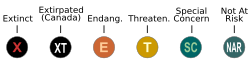
| Risk Category | Number of Species | Description |
|---|---|---|
| Endangered (E) | 302 | Facing imminent extinction |
| Special Concern (SC) | 196 | May become threatened or endangered |
| Threatened (T) | 166 | Likely to become endangered |
| Extirpated (XT) | 22 | No longer found in the wild in Canada |
| Extinct (X) | 15 | No longer existing anywhere |
Key Facts
- Founded: 1977.
- Legal Framework: Appointed by the 2002 Species at Risk Act to assess species status.
- Scientific Basis: Uses quantitative criteria from the IUCN Red List.
- Independence: Operates as an independent committee of scientists and experts.
- Influence: Reports provide the scientific basis for the Minister of the Environment's official risk lists.
Frequently Asked Questions
Is a COSEWIC status designation legally binding?
No, the status assigned by COSEWIC is not legally binding. However, it serves as a critical scientific report that influences the government's decision to add species to the official List of Wildlife Species at Risk.
What is the difference between Extinct and Extirpated?
Extinct means the species no longer exists anywhere on Earth. Extirpated means the species is no longer found in the wild within Canada, though it may still exist in other parts of the world.
How does COSEWIC determine if a species is at risk?
COSEWIC uses quantitative criteria based on the revised IUCN Red List, the world's most comprehensive inventory of biological species conservation status.
Who is responsible for the final legal listing of a species?
While COSEWIC identifies and assesses the status, the Minister of the Environment is responsible for the actual addition of species to the List of Wildlife Species at Risk.
Where can the public find updated information on species?
COSEWIC provides updated status reports on designated species through its online platforms.